. 2003 Oct;9(10):1198-207.
doi: 10.1261/rna.5960503.

G-quartet-dependent recognition between the FMRP RGG box and RNA

Affiliations

G-quartet-dependent recognition between the FMRP RGG box and RNA

Andres Ramos et al. RNA. 2003 Oct.

Abstract

Fragile-X syndrome, the most common monogenic form of mental retardation, is caused by down-regulation of the expression of Fragile X Mental Retardation Protein (FMRP). FMRP is a multifunctional, multidomain RNA-binding protein that acts as a translational repressor in neuronal cells. Interaction between FMRP and mRNA targets involves an RGG box, a protein motif commonly thought to mediate unspecific interactions with nucleic acids. Instead, FMRP RGG box has been shown to recognize RNA G-quartet structures specifically and to be necessary in neurons for RNP particle formation and dendritic mRNA localization. In the present study, we have characterized structurally three representative RNA targets of FMRP in their unbound form and in complex with the RGG box. We observe a large heterogeneity in the conformation of the RNA targets and in their RGG binding mode, which could be the basis of recognition specificity. We also found that G-quartet formation occurs not only intramolecularly but can also be mediated by RNA dimerization. These findings suggest a potential role of RNA:RNA interactions in protein:RNA complexes and in RNP particle assembly.


Figures
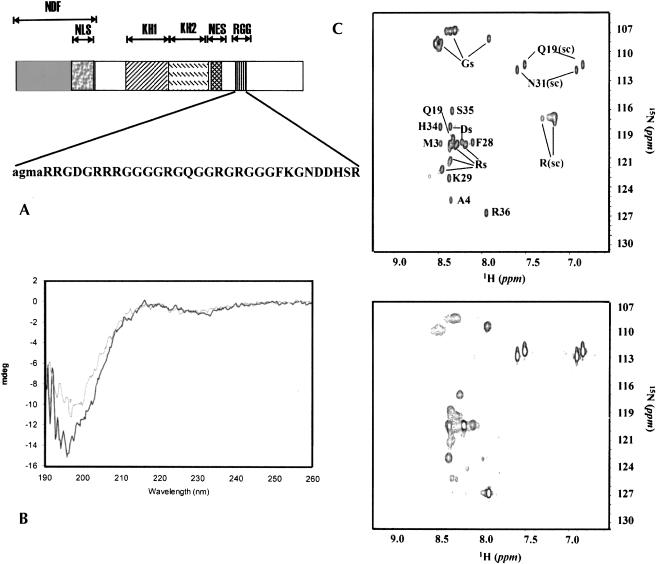
FIGURE 1.
FIGURE 1.
(A) FMRP domain structure. The different motifs are indicated: NDF, NLS, NES, KH1 and KH2, and RGG stand for the N-terminal domain of FMRP, the nuclear localization signal, the nuclear export signal, the two K-homology (KH) domains, and the RGG motif, respectively. The sequence of RGG_P is shown in the inset. Four additional residues (in lower case) were added for cloning and purification purposes. (B) Far-UV CD spectra of RGG_P at pH 5 (black curve) and pH 7 (gray curve) and 20°C. (C) 1H-15N HSQC spectra of the peptide at pH 5 (top) and 7.4 (bottom). The spectra were recorded at 27°C using a 1.3-mM concentration of RGG_P. Partial assignment of the peptide resonances is indicated. The sidechain exchangeable protons of Arg, Gln, and Asn are indicated by (sc).
FIGURE 2.
FIGURE 2.
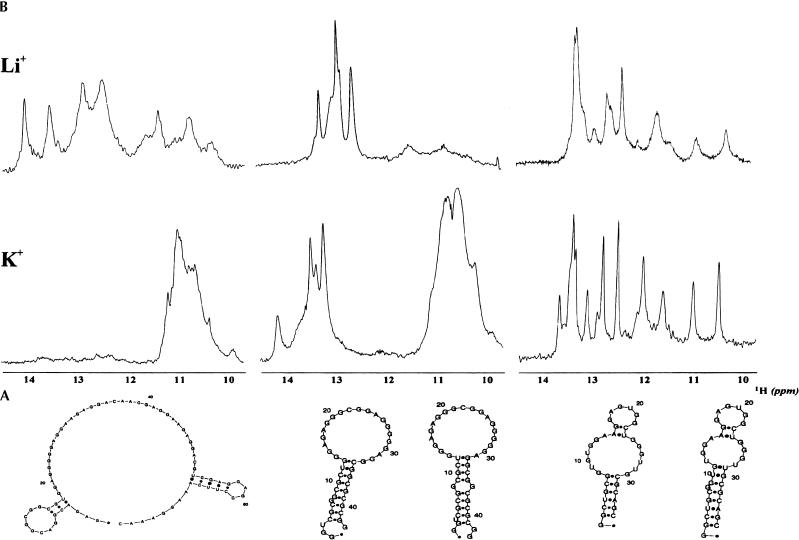
(A) Sequences and predicted secondary structures of FMRP_RNA, MAP1B_RNA, and SC1_RNA. (B) 1D 1H spectra of the 0.3-mM solutions of the three RNAs recorded in 10 mM Tris-HCl (pH 7.4) and 150 mM LiCl (top) and KCl (bottom). Secondary structure predictions were obtained using Zucker’s algorithm (Zucker 2003).
FIGURE 3.
FIGURE 3.
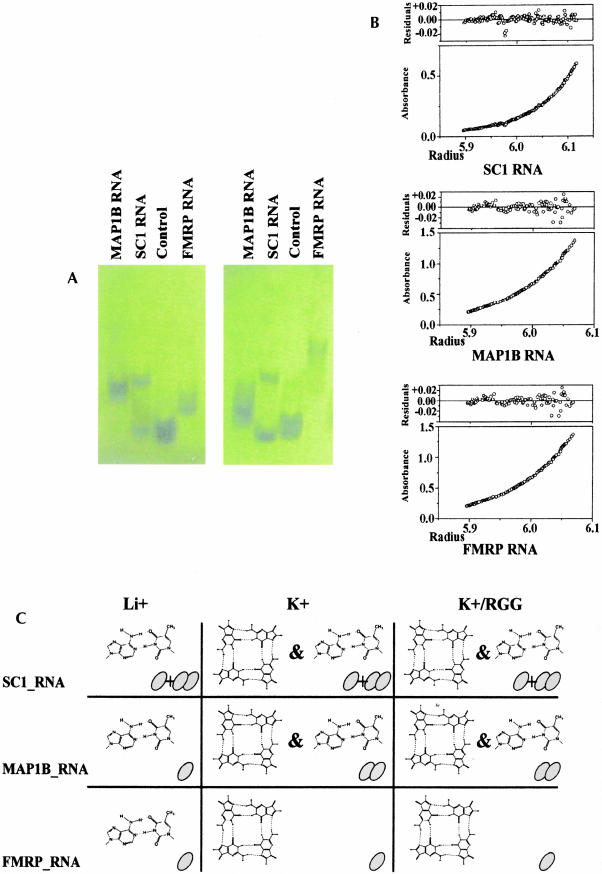
(A) Native gel of: MAP1B_RNA (lane 1), SC1_RNA (lane 2), MUNC_RNA (lane 3), and FMRP_RNA (lane 4) run using 0.12 mM RNA concentrations in 40 mM Tris-Acetate (pH 7.2) and 100 mM KCl (left) and 100 mM LiCl (right). (B) Fitting of a typical set of analytical ultracentrifugation data recorded for the three RNAs. Sample concentrations were 1 μM in 10 mM Tris-HCl (pH 7.4) and 150 mM KCl. (C) Summary of the observed secondary structures and multimeric state of the three RNAs studied. Appropriate symbols are used for indicating the presence of G-quartets and Watson–Crick base pairing. Monomers and dimers are indicated with one and two ovals, respectively. Plus and ampersand are used to indicate the coexistence of monomeric and dimeric species in solution and of helical and G-quartet structures. It should, however, be appreciated that the two types of secondary structures can, in principle, be formed intramolecularly or intermolecularly.
FIGURE 4.
FIGURE 4.
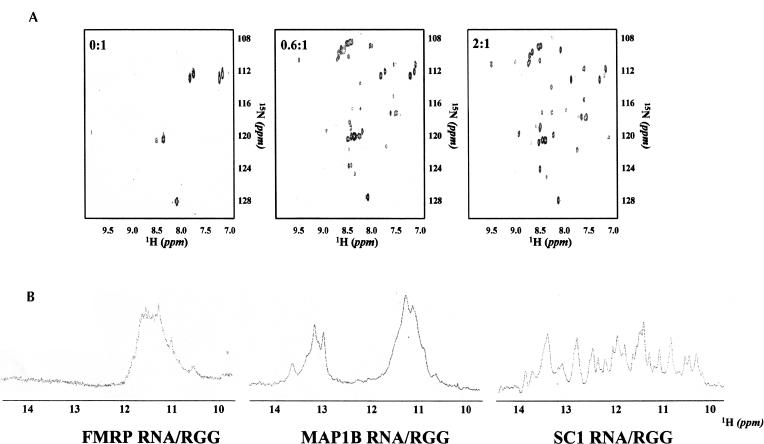
(A) 1H-15N HSQC spectra recorded for different ratios of SC1_RNA:RGG_P. Protein concentrations of 0.3 mM were used and RNA was added to reach protein:RNA ratios of 0:1, 0.6:1, and 2:1 (left to right). Experiments were recorded in 10 mM Tris-HCl (pH 7.4) and 150 mM KCl. (B) 1D 1H spectra of the three RNAs:RGG_P complexes recorded in 10 mM Tris-HCl (pH 7.4) and 150 mM KCl under saturation conditions.

References

    1. Adinolfi, S., Bagni, C., Musco, G., Gibson, T., Mazzarella, L., and Pastore, A. 1999. Dissecting FMR1, the protein responsible for fragile X syndrome, in its structural and functional domains. RNA 5: 1248–1258. - PMC - PubMed
    1. Adinolfi, S., Ramos, A., Martin, S.R., Dal Piaz, F., Pucci, P., Bardoni, B., Mandel, J.L., and Pastore, A. 2003. The N-terminus of the Fragile X Mental Retardation Protein contains a novel domain involved in dimerization and RNA-binding. Biochemistry (in press). - PubMed
    1. Bardoni, B. and Mandel, J.P. 2002. Advances in understanding of fragile X pathogenesis and FMRP function, and in identification of X linked mental retardation genes. Curr. Opin. Genet. Devel. 12: 284–293. - PubMed
    1. Bartels, C., Xia, T.H., Billeter, M., Gunter, P., and Wüthrich, K. 1995. The program XEASY for computer supported NMR spectral analysis of biological macromolecules. J. Biomol. NMR 5: 1–10. - PubMed
    1. Brown, V., Jin, P., Ceman, S., Darnell, J.C., O’Donnell, W.T., Tenenbaum, S.A., Jin, X., Feng, Y., Wilkinson, K.D., Keene, J.D., et al. 2001. Microarray identification of FMRP-associated brain mRNAs and altered mRNA translational profiles in Fragile X Syndrome. Cell 107: 477–487. - PubMed

Publication types

MeSH terms