Efficient and specific repair of sickle beta-globin RNA by trans-splicing ribozymes
- PMID: 13130139
- PMCID: PMC1370489
- DOI: 10.1261/rna.5450203
Efficient and specific repair of sickle beta-globin RNA by trans-splicing ribozymes
Abstract
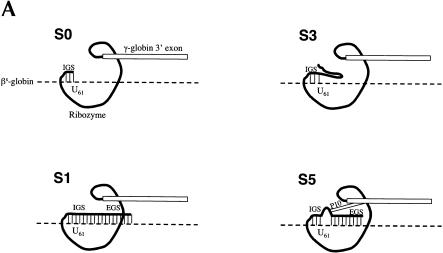
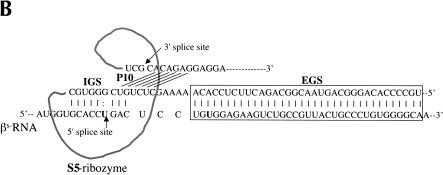
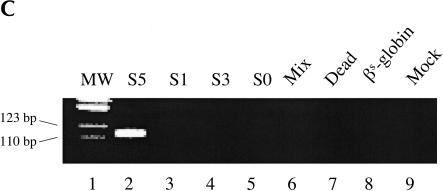
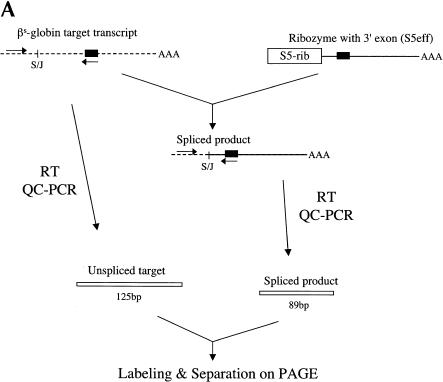
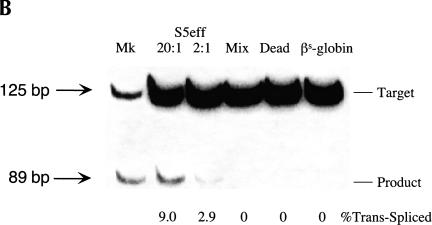
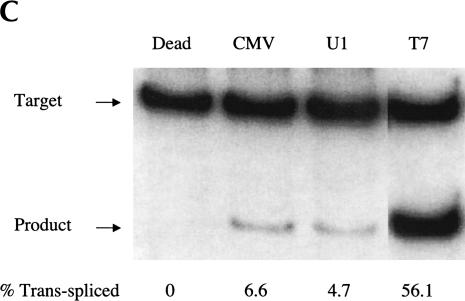
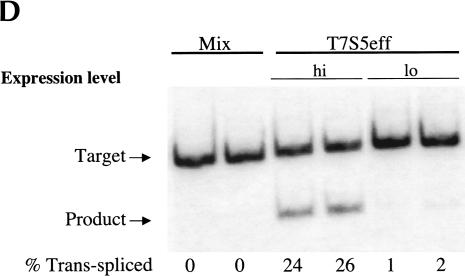
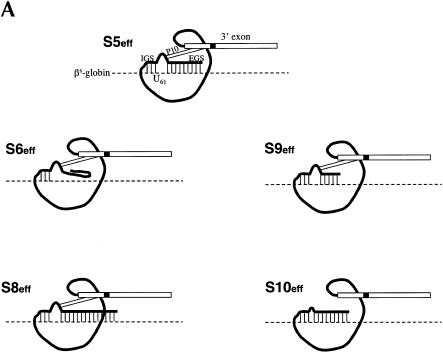
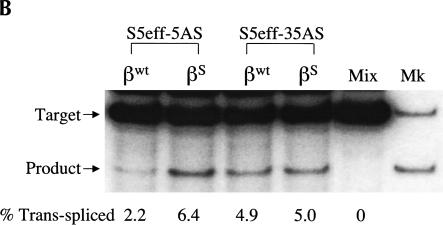
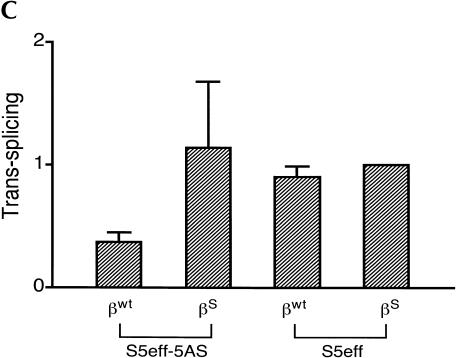
Previously we demonstrated that a group I ribozyme can perform trans-splicing to repair sickle beta-globin transcripts upon transfection of in vitro transcribed ribozyme into mammalian cells. Here, we sought to develop expression cassettes that would yield high levels of active ribozyme after gene transfer. Our initial expression constructs were designed to generate trans-slicing ribozymes identical to those used in our previous RNA transfection studies with ribozymes containing 6-nucleotide long internal guide sequences. The ribozymes expressed from these cassettes, however, were found to be unable to repair sickle beta-globin RNAs. Further experiments revealed that two additional structural elements are important for ribozyme-mediate RNA repair: the P10 interaction formed between the 5' end of the ribozyme and the beginning of the 3' exon and an additional base-pairing interaction formed between an extended guide sequence and the substrate RNA. These optimized expression cassettes yield ribozymes that are able to amend 10%-50% of the sickle beta-globin RNAs in transfected mammalian cells. Finally, a ribozyme with a 5-bp extended guide sequence preferentially reacts with sickle beta-globin RNAs over wild-type beta-globin RNAs, although the wild-type beta-globin transcript forms only a single mismatch with the ribozyme. These results demonstrate that trans-splicing ribozyme expression cassettes can be generated to yield ribozymes that can repair a clinically relevant fraction of sickle beta-globin RNAs in mammalian cells with greatly improved specificity.
Figures
References
-
- Been, M.D. and Cech, T.R. 1986. One binding site determines sequence specificity of Tetrahymena pre-rRNA self-splicing, trans-splicing, and RNA enzyme activity. Cell 47: 207–216. - PubMed
-
- Couture, L.A. and Stinchcomb, D.T. 1996. Anti-gene therapy: The use of ribozymes to inhibit gene function. Trends Genet. 12: 510– 515. - PubMed
-
- Elbashir, S.M., Harborth, J., Lendeckel, W., Yalcin, A., Weber, K., Tuschl, T. 2001. Duplexes of 21-nucleotide RNAs mediate RNA interference in cultured mammalian cells. Nature 411: 494–498. - PubMed
Publication types
MeSH terms
Substances
LinkOut - more resources
Full Text Sources
Other Literature Sources
Medical