Neurophysiological monitoring in the endovascular therapy of aneurysms
- PMID: 13679263
- PMCID: PMC7973999
Neurophysiological monitoring in the endovascular therapy of aneurysms
Abstract
Background and purpose: Endovascular aneurysm therapy has associated risks of ischemic complications. We undertook this study to evaluate the efficacy of neurophysiological monitoring (NPM) techniques in the detection of ischemic changes that may be seen during endovascular treatment of cerebral aneurysms.
Methods: Thirty-five patients underwent NPM during endovascular treatment of cerebral aneurysms. The patients underwent a total of 50 endovascular procedures, including balloon test occlusion (19 patients), GDC embolization (22 patients), and permanent vessel occlusion (nine patients). NPM included electroencephalography, somatosensory evoked potentials, and/or brain stem auditory evoked potentials, depending on the location of the aneurysm.
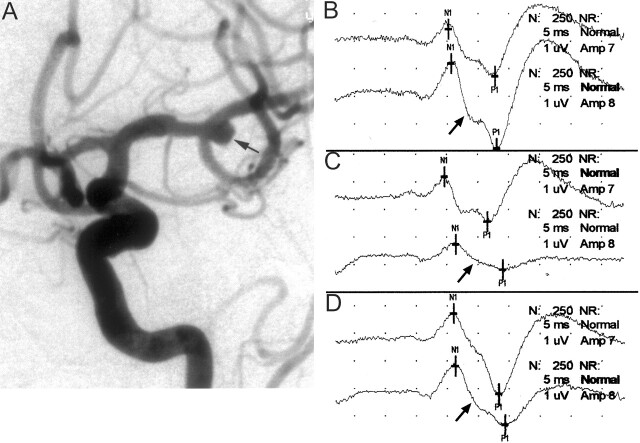
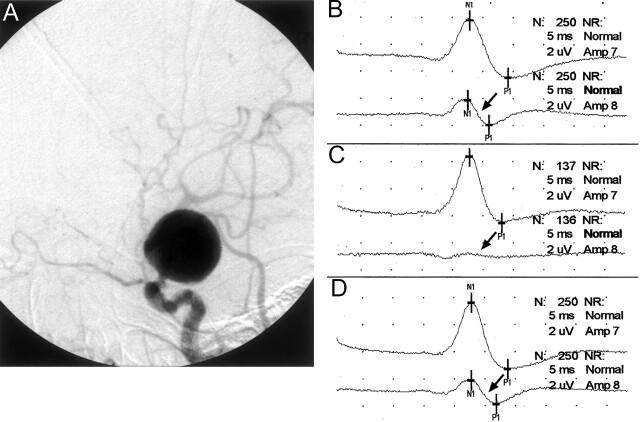
Results: NPM changes were seen in nine (26%) of 35 patients and altered the management in five (14%) of 35 patients. In three of the five cases, NPM changes were observed without corresponding neurologic physical examination changes after balloon test occlusion (performed while the patients were under general anesthesia in two cases). In the two other cases in which NPM changes altered management, ischemia was detected at the time of intra-aneurysmal therapy while the patients were under general anesthesia. Overall, 18 of 35 patients underwent a total of 19 balloon test occlusion procedures. Of the 17 remaining patients, 13 underwent aneurysm coiling, two were not treated because of inability to safely place coils, and two were treated for distal aneurysms. Two patients developed transient neurologic deficits without concurrent NPM changes, representing false-negative NPM test results.
Conclusion: NPM is a valuable adjunct to endovascular treatment of cerebral aneurysms. Our study suggests that these monitoring techniques may reduce ischemic complications and can be used to help guide therapeutic decisions.
Figures
References
-
- Sundt TM Jr, Michenfelder JD. Focal transient cerebral ischemia in the squirrel monkey: effect on brain adenosine triphosphate and lactate levels with electrocorticographic and pathologic correlation. Circ Res 1972;30:703–712 - PubMed
-
- Branston NM, Symon L, Crockard HA, Pasztor E. Relationship between the cortical evoked potential and local cortical blood flow following acute middle cerebral artery occlusion in the baboon. Exp Neurol 1974;45:195–208 - PubMed
-
- Branston NM, Strong AJ, Symon L. Extracellular potassium activity, evoked potential and tissue blood flow: relationships during progressive ischaemia in baboon cerebral cortex. J Neurol Sci 1977;32:305–321 - PubMed
-
- Branston NM, Ladds A, Symon L, Wang AD. Comparison of the effects of ischaemia on early components of the somatosensory evoked potential in brainstem, thalamus, and cerebral cortex. J Cereb Blood Flow Metab 1984;4:68–81 - PubMed
MeSH terms
LinkOut - more resources
Full Text Sources
Medical