. 2003 Sep 30;100(20):11535-40.
doi: 10.1073/pnas.1933593100. Epub 2003 Sep 17.

ASH1, a Drosophila trithorax group protein, is required for methylation of lysine 4 residues on histone H3

Affiliations

ASH1, a Drosophila trithorax group protein, is required for methylation of lysine 4 residues on histone H3

Kristin Nastase Byrd et al. Proc Natl Acad Sci U S A. .

Abstract

Covalent modifications of histone tails modulate gene expression via chromatin organization. As examples, methylation of lysine 9 residues of histone H3 (H3) (H3-K9) is believed to repress transcription by compacting chromatin, whereas methylation of lysine 4 residues of H3 (H3-K4) is believed to activate transcription by relaxing chromatin. The Drosophila trithorax group protein absent, small, or homeotic discs 1 (ASH1) is involved in maintaining active transcription of many genes. Here we report that in extreme ash1 mutants, no H3-K4 methylation is detectable. Within the limits of our assays, this lack of detectable H3-K4 methylation implies that ASH1 is required for essentially all H3-K4 methylation that occurs in vivo. We report further that the 149-aa SET domain of ASH1 is sufficient for H3-K4 methylation in vitro. These findings support a model in which ASH1 is directly involved in maintaining active transcription by conferring a relaxed chromatin structure.


Figures
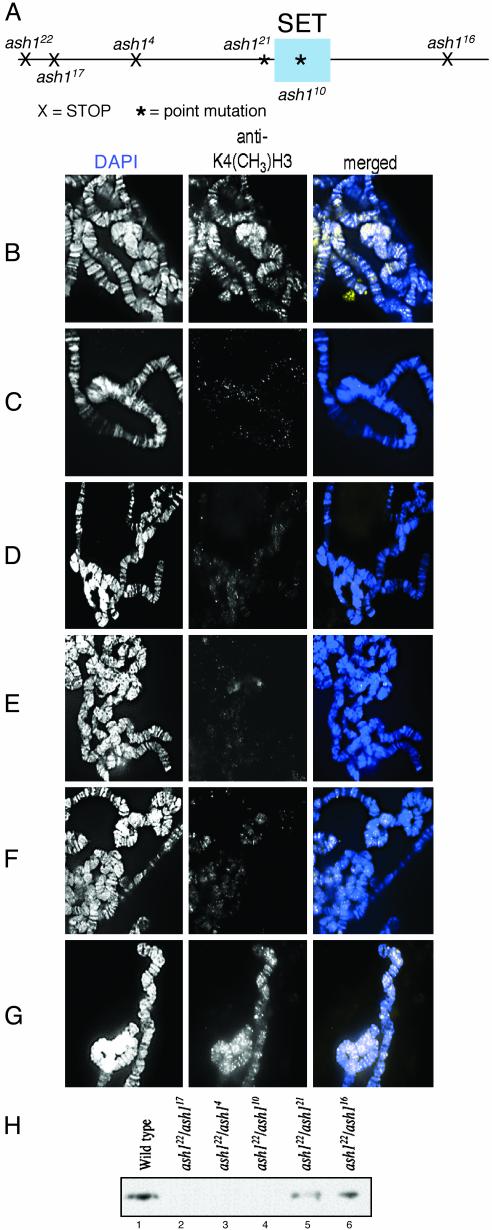
Fig. 1.
Fig. 1.
Methylation of H3-K4 in ash1 mutants. (A) Schematic showing location of aberrations in ASH1 protein caused by the alleles used in this study. X, STOP codon; *, point mutation. (B–G) Methylation of H3-K4 was detected by immunofluorescence on polytene chromosomes (white, Center; yellowish-white, Right). DNA was detected by 4′,6-diamidino-2-phenylindole (white, Left; blue, Right). (B) Wild type; a large number of euchromatic bands are detected. (C) ash117/ash122, no bands are detected. (D) ash14/ash122, no bands are detected. (E) ash110/ash122, few if any bands are detected. (F) ash121/ash122, some bands are detected. (G) ash116/ash122, like wild-type, a large number of euchromatic bands are detected. (H) Immunoblot of methylated H3-K4 extracted from salivary glands. Lane 1, wild-type salivary glands; lanes 2–6, salivary glands from heteroallelic combinations of ash1 mutations.
Fig. 2.
Fig. 2.
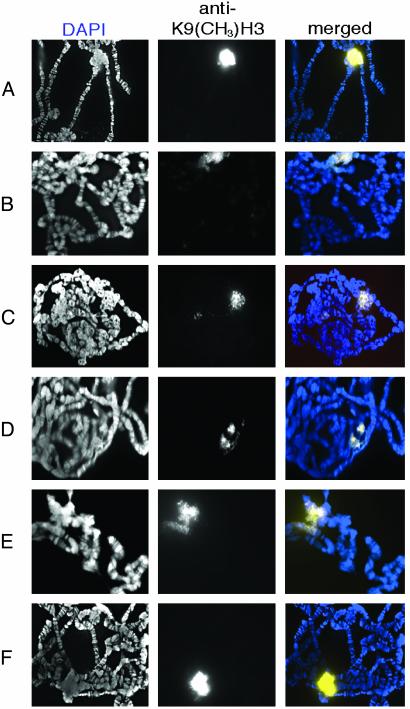
Methylation of H3-K9 in ash1 mutants. H3-K9 methylation was detected by immunofluorescence on polytene chromosomes (white, Center; yellowish-white, Right). DNA was detected by 4′,6-diamidino-2-phenylindole (white, Left; blue, Right). (A) Wild type. (B) ash117/ash122.(C) ash14/ash122.(D) ash110/ash122. (E) ash121/ash122. (F) ash116/ash22.
Fig. 3.
Fig. 3.
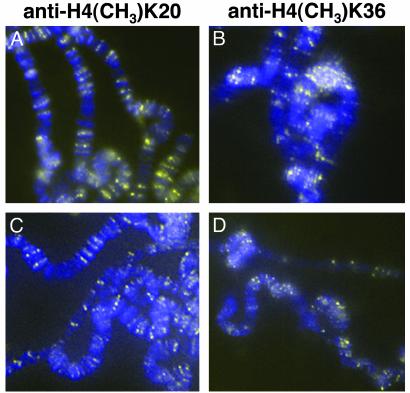
Methylation of H4-K20 and H3-K36 in ash1 mutants. Histone methylation was detected by immunofluorescence on polytene chromosomes (yellow). DNA was detected by 4′,6-diamidino-2-phenylindole (blue). (A and B) H4-K20 methylation. (A) Wild type. (B) ash14/ash122.(C and D) H3-K36 methylation. (C) Wild type. (D) ash14/ash122.
Fig. 4.
Fig. 4.
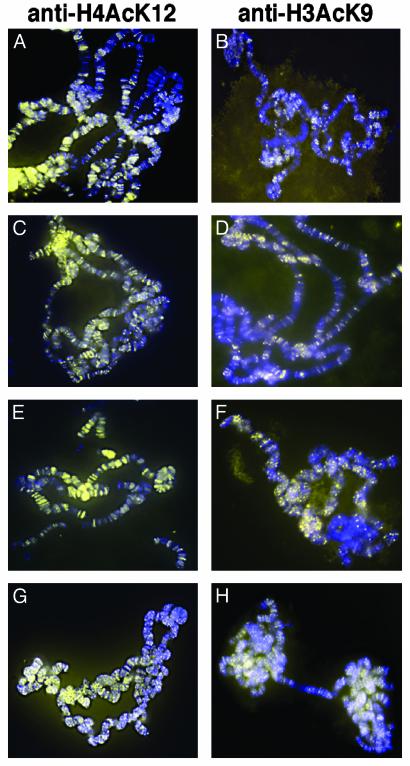
Histone acetylation in ash1 mutants. Histone acetylation was detected by immunofluorescence on polytene chromosomes (yellow). DNA was detected by 4′,6-diamidino-2-phenylindole (blue). (A, C, E, and G) Histone H4 acetylation (lysine 12). (A) Wild type. (C) ash117/ash122. (E) ash14/ash122. (G) ash110/ash122. (B, D, F, and H) H3 acetylation (lysine 9). (B) ash117/ash122. (F) ash14/ash122. (H) ash110/ash122.
Fig. 5.
Fig. 5.
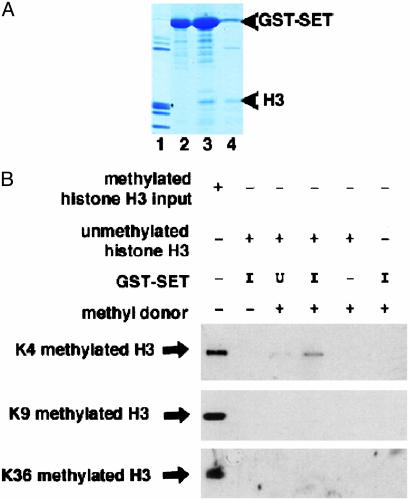
The SET domain of ASH1 can bind to H3 and methylate K4 residues. (A) Partially purified GST-SET fusion protein was used for GST pull-down with core histones. Lanes 1 and 2 show input histones and input GST-SET, respectively. Lane 3 shows GST pull-down with induced GST-SET and histones. Lane 4 shows GST pull-down with uninduced GST-SET and histones. Note that although some nonspecific bands are evident in both the GST-SET input and GST-SET-induced lanes (lanes 2 and 3), none of the bands in the input lane (lane 2) correspond to the molecular weight of H3, which is marked by an asterisk. Upper arrowhead indicates the size of the GST-SET fusion protein; Lower arrowhead indicates the size of H3. (B) To assay for HMTase activity, the partially purified GST-SET fusion protein was incubated with unmethylated H3 and a methyl donor and immunoblotted with antiH3-K4 dm. Lane 1, methylated histone input. Lane 2, GST-SET induced plus unmethylated histones. Lane 3, GST-SET uninduced plus unmethylated histones plus methyl donor. Lane 4, GST-SET induced plus unmethylated histones plus methyl donor. Lane 5, unmethylated histones plus methyl donor. Lane 6, GST-SET induced plus methyl donor. Lanes 1 and 2 show that the anti-K4 methylated antibody detects methylated but not unmethylated H3. Lane 5 shows that the methyl donor will not spontaneously methylate H3. Lanes 3 and 4 show the results of HMTase assay in the presence of uninduced (U) or induced (I) GST-SET, respectively. Coomassie staining revealed equal loading of GST-SET fusion protein in each lane (data not shown).

References

    1. Strahl, B. D. & Allis, C. D. (2000) Nature 403, 1–45. - PubMed
    1. Murray, K. (1964) Biochemistry 3, 10–15. - PubMed
    1. Rea, S., Eisenhaber, F., O'Carroll, D., Strahl, B. D., Sun, Z., Schmid, M., Opravil, S., Ponting, C. P., Allis, C. D. & Jenuwein, T. (2000) Nature 406, 593–599. - PubMed
    1. Strahl, B. D., Ohba, R., Cook, R. G. & Allis, C. D. (1999) Proc. Natl. Acad. Sci. USA 96, 14967–14972. - PMC - PubMed
    1. Beisel, C., Imhof, A., Greene, J., Kremmer, E. & Sauer, F. (2002) Nature 419, 857–862. - PubMed

Publication types