


A noncognate aminoacyl-tRNA synthetase that may resolve a missing link in protein evolution
- PMID: 13679580
- PMCID: PMC208751
- DOI: 10.1073/pnas.1932482100
A noncognate aminoacyl-tRNA synthetase that may resolve a missing link in protein evolution
Abstract
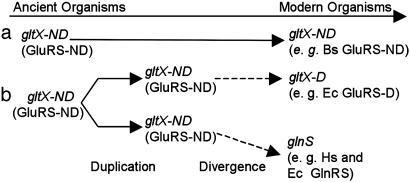
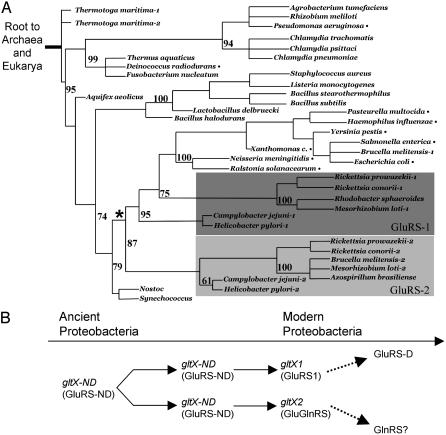
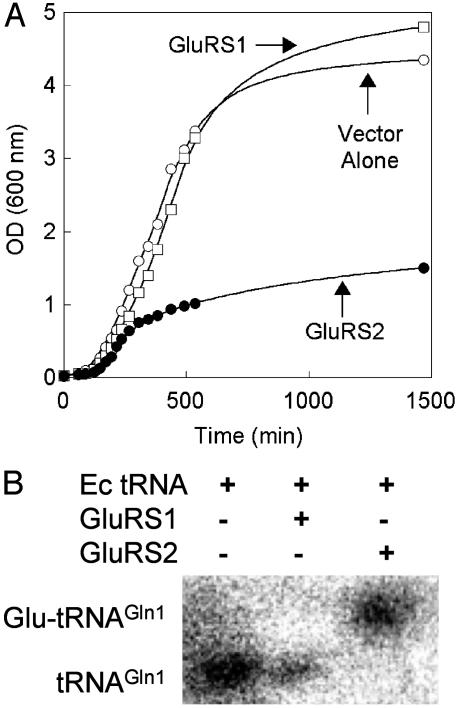
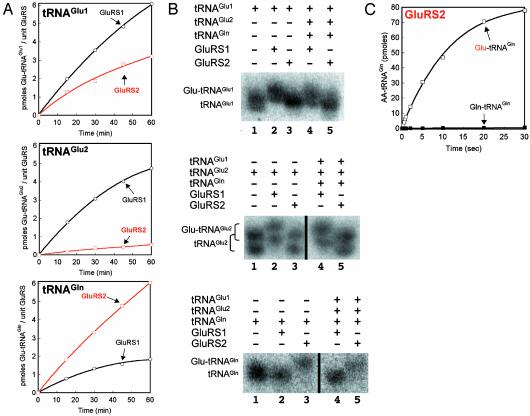
Efforts to delineate the advent of many enzymes essential to protein translation are often limited by the fact that the modern genetic code evolved before divergence of the tree of life. Glutaminyl-tRNA synthetase (GlnRS) is one noteworthy exception to the universality of the translation apparatus. In eukaryotes and some bacteria, this enzyme is essential for the biosynthesis of Gln-tRNAGln, an obligate intermediate in translation. GlnRS is absent, however, in archaea, and most bacteria, organelles, and chloroplasts. Phylogenetic analyses predict that GlnRS arose from glutamyl-tRNA synthetase (GluRS), via gene duplication with subsequent evolution of specificity. A pertinent question to ask is whether, in the advent of GlnRS, a transient GluRS-like intermediate could have been retained in an extant organism. Here, we report the discovery of an essential GluRS-like enzyme (GluRS2), which coexists with another GluRS (GluRS1) in Helicobacter pylori. We show that GluRS2's primary role is to generate Glu-tRNAGln, not Glu-tRNAGlu. Thus, GluRS2 appears to be a transient GluRS-like ancestor of GlnRS and can be defined as a GluGlnRS.
Figures
References
-
- Ohno, S. (1970) Evolution by Gene Duplication (Springer, New York).
-
- Nowak, M. A., Boerlijst, M. C., Cooke, J. & Smith, J. M. (1997) Nature 388, 167–171. - PubMed
-
- Prince, V. E. & Pickett, F. B. (2002) Nat. Rev. Genet. 3, 827–837. - PubMed
-
- Kollman, J. M. & Doolittle, R. F. (2000) J. Mol. Evol. 51, 173–181. - PubMed
-
- Laursen, R. A. & Duffy, L. (1978) FEBS Lett. 92, 200–202. - PubMed
Publication types
MeSH terms
Substances
LinkOut - more resources
Full Text Sources
Other Literature Sources
