


The ability to replicate in macrophages is conserved between Yersinia pestis and Yersinia pseudotuberculosis
- PMID: 14500510
- PMCID: PMC201058
- DOI: 10.1128/IAI.71.10.5892-5899.2003
The ability to replicate in macrophages is conserved between Yersinia pestis and Yersinia pseudotuberculosis
Abstract
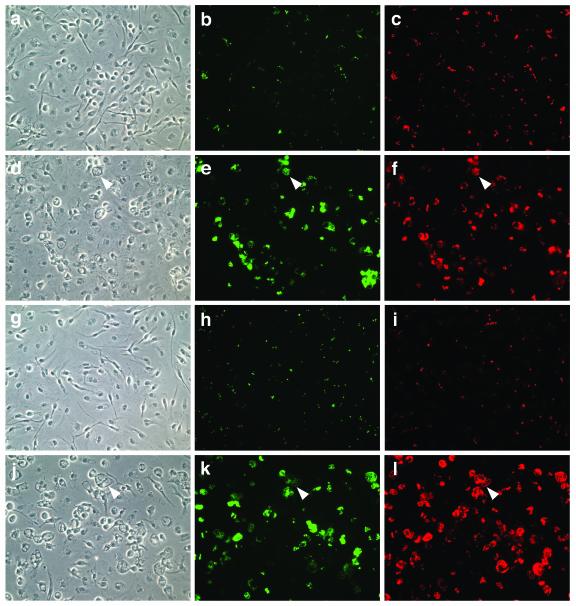
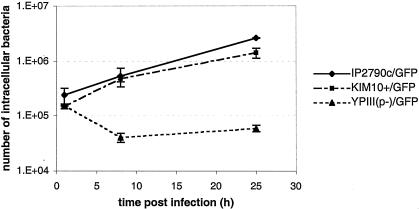
Yersinia pestis, the agent of plague, has arisen from a less virulent pathogen, Yersinia pseudotuberculosis, by a rapid evolutionary process. Although Y. pestis displays a large number of virulence phenotypes, it is not yet clear which of these phenotypes descended from Y. pseudotuberculosis and which were acquired independently. Y. pestis is known to replicate in macrophages, but there is no consensus in the literature on whether Y. pseudotuberculosis shares this property. We investigated whether the ability to replicate in macrophages is common to Y. pestis and Y. pseudotuberculosis or is a unique phenotype of Y. pestis. We also examined whether a chromosomal type III secretion system (TTSS) found in Y. pestis is present in Y. pseudotuberculosis and whether this system is important for replication of Yersinia in macrophages. A number of Y. pestis and Y. pseudotuberculosis strains of different biovars and serogroups, respectively, were tested for the ability to replicate in primary murine macrophages. Two Y. pestis strains (EV766 and KIM10(+)) and three Y. pseudotuberculosis strains (IP2790c, IP2515c, and IP2666c) were able to replicate in macrophages with similar efficiencies. Only one of six strains tested, the Y. pseudotuberculosis YPIII(p(-)) strain, was defective for intracellular replication. Thus, the ability to replicate in macrophages is conserved in Y. pestis and Y. pseudotuberculosis. Our results also indicate that a homologous TTSS is present on the chromosomes of Y. pestis and Y. pseudotuberculosis and that this secretion system is not required for replication of these bacteria in macrophages.
Figures
References
-
- Alexeyev, M. F. 1995. Three kanamycin resistance gene cassettes with different polylinkers. BioTechniques 18:52, 54, 56. - PubMed
-
- Black, D. S., and J. B. Bliska. 2000. The RhoGAP activity of the Yersinia pseudotuberculosis cytotoxin YopE is required for antiphagocytic function and virulence. Mol. Microbiol. 37:515-527. - PubMed
Publication types
MeSH terms
Substances
Grants and funding
LinkOut - more resources
Full Text Sources
Other Literature Sources
