. 2003 Nov 1;552(Pt 3):945-52.
doi: 10.1113/jphysiol.2003.050971. Epub 2003 Sep 18.

Variable amplification of synaptic input to cat spinal motoneurones by dendritic persistent inward current

Affiliations

Variable amplification of synaptic input to cat spinal motoneurones by dendritic persistent inward current

H Hultborn et al. J Physiol. .

Abstract

Electrophysiological and computational evidence indicate that the excitatory current from the synapses on the somato-dendritic membrane is not large enough to drive the motoneurones to the firing frequencies actually attained under normal motor activity. It has been proposed that this paradox could be explained if the voltage-dependent persistent inward currents (PICs) present in the dendrites of motoneurones served to amplify synaptic excitation. We report here that dendritic PICs cause a large amplification of synaptic excitation, and that this amplification is enhanced when the background firing by current injection is increased. Moreover the frequency reduction by synaptic inhibition is greatly enhanced at higher firing frequencies, when the current through the recording electrode has activated the dendritic PICs, as is the case when the current-to-frequency slope suddenly becomes steeper. We also demonstrate that synaptic inhibition is several times more effective in reducing the firing caused by synaptic excitation than firing evoked by current injection through the recording microelectrode. That would be explained if motoneuronal discharge by synaptic excitation--but not by current injection in the soma--is always supported by dendritic PICs. We conclude that dendritic PICs contribute dynamically to the transformation of synaptic input into a motoneuronal frequency code.


Figures
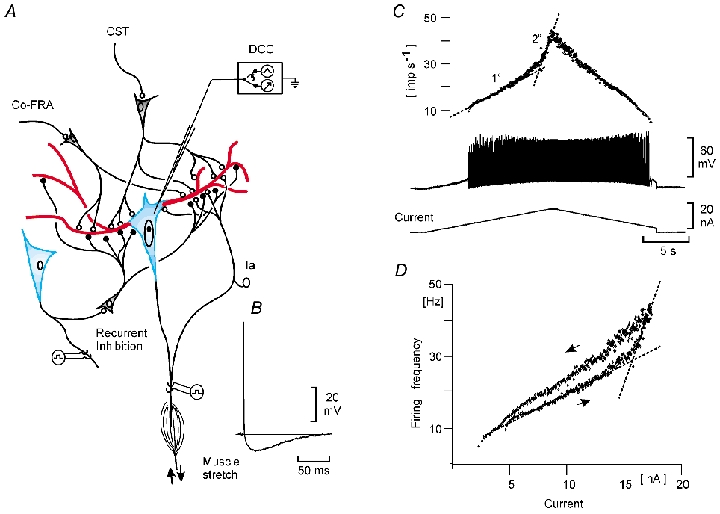
Figure 1
Figure 1. Schematic drawing of the experimental arrangement and firing response to current injected through the recording electrode
A, the motoneurone soma/initial segment (blue) where the summated inward current/depolarization is converted into a frequency code, with the post-spike afterhyperpolarization (B) as a key element for the current–frequency relation (C). A also shows the excitatory input from the corticospinal tract (CST), the crossed extensor reflex (co-FRA) and the muscle spindle Ia afferents, as well as the inhibitory input from motor axon collaterals, via Renshaw cells (recurrent inhibition). In all cases, the dominating part of the synaptic input is directed to the dendritic area (red). The major part of the non-inactivating voltage-dependent persistent inward currents (PICs) is also localized to the dendritic compartments (red). C, firing pattern and membrane potentials during injection of triangular current pulses. Upper plot, instantaneous firing frequency; middle trace, spike activity; third trace, triangular profile of the injected current. The thin interrupted lines in the upper part approximate in the current-frequency slopes (I–f slopes) corresponding to Kernell's (1965a,b) primary (1o) and secondary (2o) ranges of firing. The steeper relation with the secondary range is likely to be explained by PICs recruited from the dendritic compartments with stronger currents through the somatic recording electrode (see Bennett et al. 1998). Recording was done in DCC mode (see Methods). D, plot of spike frequency vs. injected current for the data in C. Note the counter-clockwise hysteresis that is a reflection of the PICs recruited at the initiation of the secondary range (see Bennett et al. 1998).
Figure 2
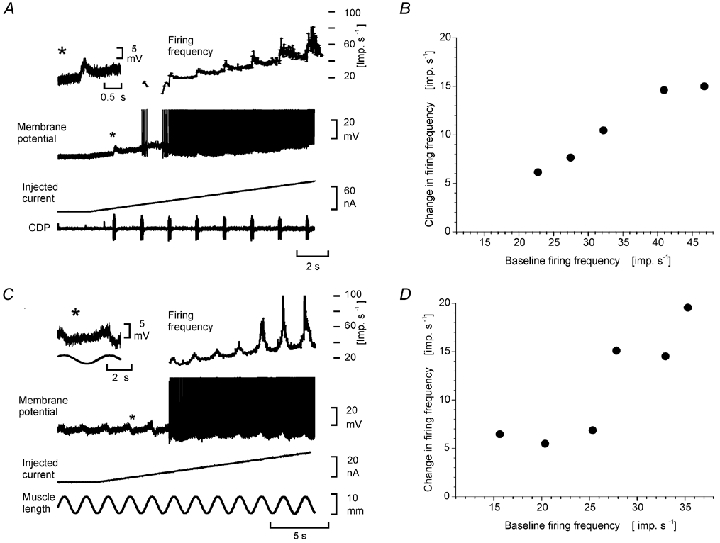
Figure 2. Amplification of the frequency response to corticospinal tract stimulation (A and B) and muscle stretch (C and D) during increasing firing frequencies evoked by gradually increasing depolarizing current through the recording microelectrode
A, recordings from a posterior biceps motoneurone. The inset (*) shows the CST EPSP evoked by a train (50 stimuli at 300 Hz) to the pyramidal tract, recorded at a membrane potential close to firing threshold. The main recordings show the cell's firing frequency (upper plot), spike train (second trace) the injected current (third trace), and the cord dorsum potential (CDP, fourth trace). B, the increased firing frequency during the CST excitation (ordinate) as a function of firing frequency induced by the injected current through the recording microelectrode (abscissa). C, recordings from a triceps surae motoneurone. The inset (*) shows the stretch evoked EPSP recorded at a membrane potential close to firing threshold. The main recordings show the cell's firing frequency (upper plot), spike train (second trace), injected current (third trace), and muscle stretch (fourth trace). D, the increased frequency response during the stretch excitation (ordinate) as a function of firing frequency induced by the current through the recording microelectrode (abscissa).
Figure 3
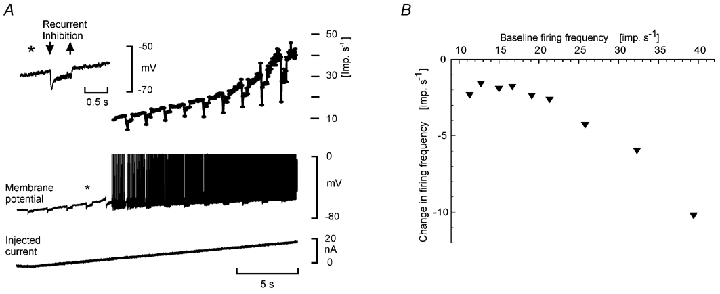
Figure 3. Amplification of the reduction in firing frequency by recurrent inhibition during increasing firing frequencies evoked by gradually increasing depolarizing current through the recording microelectrode
Recordings from a flexor digitorum longus motoneurone. A, inset (*), the recurrent inhibition evoked by a train (50 stimuli at 100 Hz, 5 ×T) of antidromic volleys in the nerve to lateral gastrocnemious–soleus, recorded at a membrane potential close to firing threshold. Same format as in Fig. 2. Note that the reduction is constant along the primary range, but increases markedly in the secondary range. B, the reduced firing frequency during the recurrent inhibition (ordinate) as a function of firing frequency induced by current through the recording microelectrode (abscissa).
Figure 4
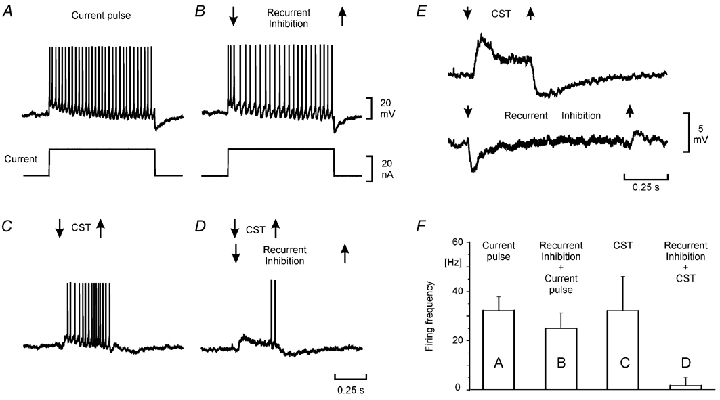
Figure 4. Recurrent inhibition is more effective in reducing firing evoked by synaptic excitation than by current injection
Recordings from a semitendinousus motoneurone. A and B, repetitive firing elicited by a rectangular current pulse alone (A) and together with recurrent inhibition (B). C and D, repetitive firing evoked by a train of impulses to the CST alone (C) and together with recurrent inhibition (D). Each alternative was repeated 20 times and the means and s.d. are shown as a bar graph in F. E, the recurrent inhibition (90 stimuli at 100 Hz, 5 ×T) and the EPSP evoked by the CST stimulation (14 stimuli at 200 Hz) used in B–D, but here recorded at a membrane potential close to firing threshold. The records were low frequency (1 Hz) filtered.

Comment in

References

    1. Bennett DJ, Hultborn H, Fedirchuk B, Gorassini M. Synaptic activation of plateaus in hindlimb motoneurons of decerebrate cats. J Neurophysiol. 1998;80:2023–2037. - PubMed
    1. Binder MD. Integration of synaptic and intrinsic dendritic currents in cat spinal motoneurons. Brain Res Rev. 2003;40:1–8. - PubMed
    1. Carlin KP, Jones KE, Jiang Z, Jordan LM, Brownstone RM. Dendritic L-type calcium currents in mouse spinal motoneurons: implications for bistability. Eur J Neurosc. 2000;12:1635–1646. - PubMed
    1. Crone C, Hultborn H, Kiehn O, Mazieres L, Wigstrom H. Maintained changes in motoneuronal excitability by short-lasting synaptic inputs in the decerebrate cat. J Physiol. 1988;405:321–343. - PMC - PubMed
    1. Fyffe RE. Spatial distribution of recurrent inhibitory synapses on spinal motoneurons in the cat. J Neurophysiol. 1991;65:1134–1149. - PubMed

Publication types

LinkOut - more resources