. 2003 Sep 30;100(20):11490-3.
doi: 10.1073/pnas.1635049100. Epub 2003 Sep 22.

Fruit odor discrimination and sympatric host race formation in Rhagoletis

Affiliations

Fruit odor discrimination and sympatric host race formation in Rhagoletis

Charles Linn Jr et al. Proc Natl Acad Sci U S A. .

Abstract

Rhagoletis pomonella is a model for incipient sympatric speciation (divergence without geographic isolation) by host-plant shifts. Here, we show that historically derived apple- and ancestral hawthorn-infesting host races of the fly use fruit odor as a key olfactory cue to help distinguish between their respective plants. In flight-tunnel assays and field tests, apple and hawthorn flies preferentially oriented to, and were captured with, chemical blends of their natal fruit volatiles. Because R. pomonella rendezvous on or near the unabscised fruit of their hosts to mate, the behavioral preference for apple vs. hawthorn fruit odor translates directly into premating reproductive isolation between the fly races. We have therefore identified a key and recently evolved (<150 years) mechanism responsible for host choice in R. pomonella bearing directly on sympatric host race formation and speciation.


Figures
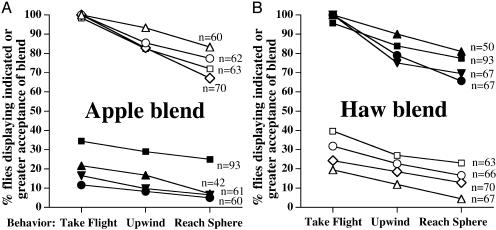
Fig. 1.
Fig. 1.
Percentages of tested apple- (open symbols) and hawthorn-origin flies (filled symbols) displaying the indicated or greater behavioral acceptance of apple blend (A) and hawthorn (Haw) blend (B) in flight-tunnel assays. Behavioral responses in order of increasing blend acceptance are as follows: walk and groom (fly remaining in release cage), take flight (flight from the release cage), upwind (oriented flight toward sphere), and reach sphere. The percentage of flies displaying walk-and-groom behavior = 100% – % take flight. Populations tested were ▵, Urbana, IL; ▿, Urbana, IL, hawthorn flies reared on apple for two generations; ○, Grant, MI; □, Fennville, MI; and ⋄, Geneva, NY, apple fly colony. P < 1 × 10⁻⁷ for every test of behavioral difference between races at a site, as determined by Fisher's exact test. Populations within a race did not differ significantly from each other in their responses to their natal fruit blend. However, significant heterogeneity occurred among apple-fly populations in their responses to hawthorn blend (G test reaching sphere = 11.3, P = 0.158, 3 df) and among hawthorn fly populations to apple blend (G test = 15.8, P = 0.0006, 2 df).
Fig. 2.
Fig. 2.
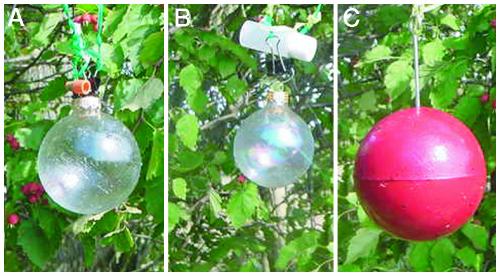
Tanglefoot-coated spheres used for field trials. (A) Clear sphere with septum used to release volatiles for three-way choice tests at Fennville, MI. (B) Clear sphere with scintillation vial used to release volatiles for paired apple-blend vs. blank tests. (C) Red sphere used in New York field trials and flight tunnel. Background is a hawthorn tree with red fruits visible.
Fig. 3.
Fig. 3.
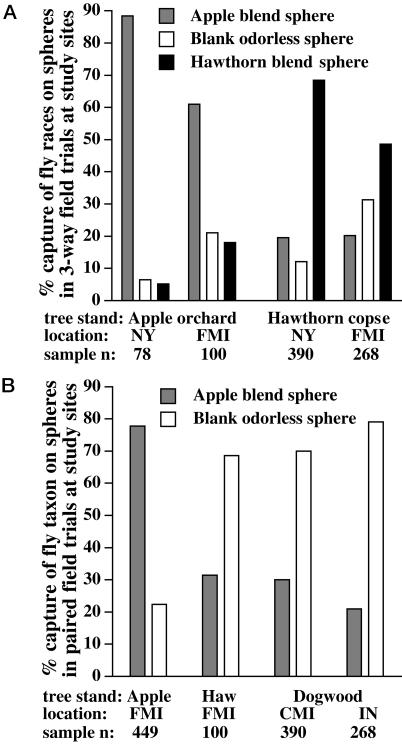
Total percentages of resident Rhagoletis flies captured across replicate trapping periods on baited spheres (red in New York, clear in Michigan and Indiana) in apple orchards, hawthorn copses, and dogwood-tree stands in Geneva, NY, Fennville, MI (FMI), Cassopolis, MI (CMI), and Granger, IN. (A) Results for three-way choice study of apple blend, hawthorn blend, and blank spheres. P < 1 × 10–12 for all pairwise comparisons of difference in fly capture on sphere types between apple orchard and hawthorn tree copses, as determined by G contingency tests. (B) Results for paired field study of apple blend vs. blank, clear spheres in apple, hawthorn, and dogwood tree stands. P < 1 × 10–15 for all comparisons of difference in capture on sphere types between apple vs. hawthorn or dogwood stands, as determined by two-tailed Fisher's exact test. Sample n = total number of flies trapped on all spheres in a given tree stand.

References

    1. Coyne, J. A. (1992) Nature 355, 511–515. - PubMed
    1. Bush, G. L. (1969) Am. Nat. 103, 669–672.
    1. Schluter, D. (2001) Trends Ecol. Evol. 16, 372–380. - PubMed
    1. Johnson, P. A. & Gullberg, U. (1998) in Endless Forms: Species and Speciation, eds. Howard, D. J. & Berlocher, S. H. (Oxford Univ. Press, New York), pp. 79–89.
    1. Fry, J. D. (2003) Evolution (Lawrence, Kans.) 57, 1735–1746. - PubMed

Publication types

LinkOut - more resources