. 1992;2(3):273-83.

Differential modes of activation define orphan subclasses within the steroid/thyroid receptor superfamily

Affiliations

Differential modes of activation define orphan subclasses within the steroid/thyroid receptor superfamily

J P Lydon et al. Gene Expr. 1992.

Abstract

We report that three orphan receptors, hERR1, hERR2, and hTR2, members of the steroid/thyroid receptor (SR/TR) superfamily, can be activated by different ligand-independent pathways. hERR1 and hERR2 exhibit constitutive activity in the absence of exogenously added ligands. Furthermore, this constitutive activity is localized in the carboxy terminal domain of both receptors and can be transferred to other members of this superfamily using domain switch strategies. In addition, we show that hERR1 can remain constitutively active in the less evolved eukaryotic cell Saccharomyces cerevisiae. In contrast, hTR2 is not constitutively active. However, a chimera of hTR2 can be activated in a ligand-independent manner through a signal transduction pathway initiated at the cell membrane by the neurotransmitter dopamine. Like hERR1 and hERR2, hTR2 is ligand-independently activated through its carboxy terminal domain. Together, these results suggest the existence of emerging subgroups within the SR/TR superfamily that can regulate gene expression through different modes of activation.


Figures
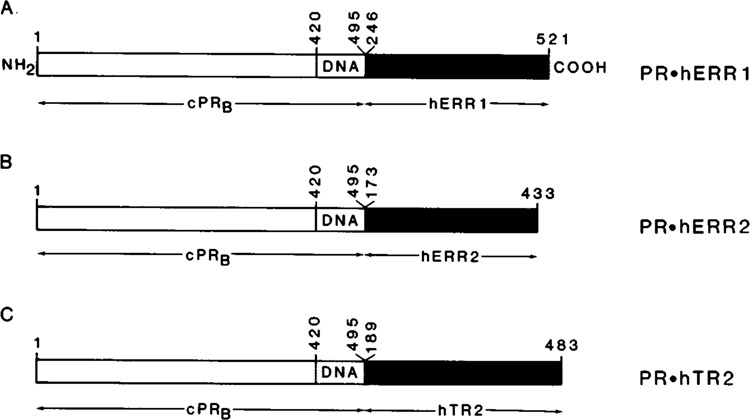
Figure 1
Figure 1
Orphan chimeric receptor constructs used for transactivation assays. The chimeric receptor constructs contained the N-terminal region (amino acids [aa] 1-420) and DNA-binding domain (DNA) (aa420-495) of the chicken progesterone receptor B subtype (cPRB) fused in frame to the carboxy terminal domain of the relevant orphan receptors. The regions of orphan receptors used to generate the chimeric receptor constructs (A) PR.hERRl, (B) PR.hERR2, and (C) PR.hTR2 included the aa246-521 of hERRl, aal73-433 of hERR2, and aal89-483 of hTR2 respectively. The chimeric receptor cDNAs were cloned into the unique EcoR I site of the eukaryotic expression plasmid p91023(B) and constitutively expressed under the control of the adenoviral major late promoter (see Materials and Methods).
Figure 2
Figure 2
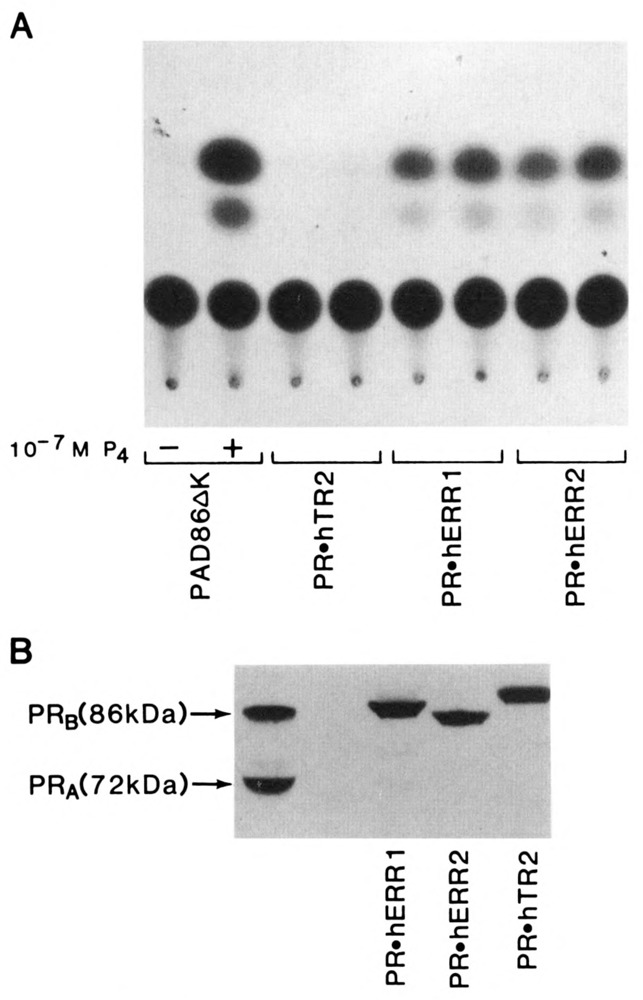
Transactivational assays of PR.hERRl, PR.hERR2, and PR.hTR2. A. The expression vectors (5 μg) encoding cPRB (PAD86ΔK) and the orphan receptor chimeras PR.hERRl, PR.hERR2, and PR.hTR2 were co-transfected with the reporter plasmid PREtkCAT (5 μg) in the monkey kidney cell line CV-1 by the polybrene method. CV-1 cells were cultured for 48 hours in serum-free media supplemented with Nutridoma-SR. The results of the CAT assay using PAD86ΔK in the absence or presence of progesterone (10−7M) are indicated. Duplicate CAT assays for each of the orphan receptor chimeras are shown. The experiment was performed 6 times, and the variation in duplicate signals between experiments did not exceed 5%. B. COS M6 monkey kidney cells cultured in nutridoma-supplemented media were transfected with the chimeric receptor constructs PRhERRl, PR.hERR2, and PR.hTR2 (5 μg), as described in A. After 48 hours of culture, high-salt extracts were prepared and analyzed by immunoblotting with the monoclonal antibody PR22 specific to the N-terminus of cPR (see Materials and Methods). The left lane indicates the molecular sizes of the progesterone receptor subtypes A and B in 100 μg of chicken oviduct cytosolic protein.
Figure 3
Figure 3
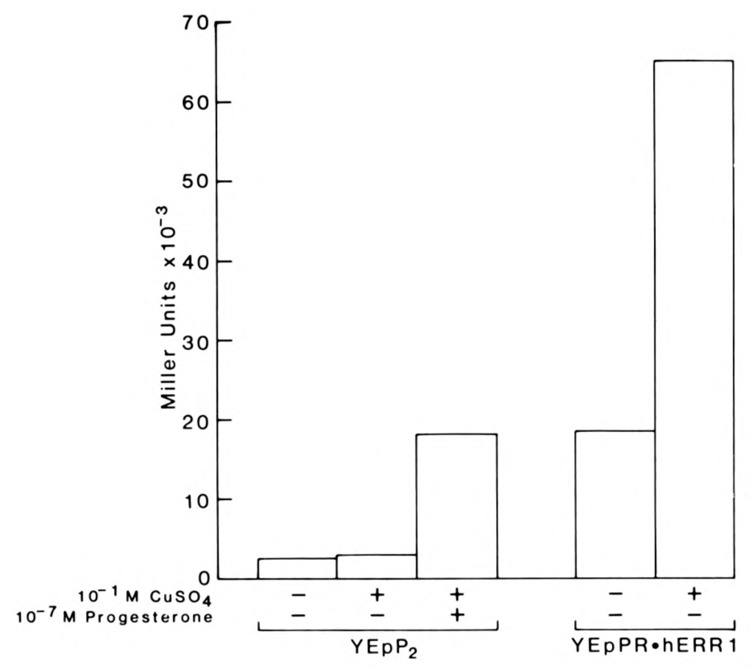
The orphan receptor chimera PR.hERRl is constitutively active in Saccharomyces cerevisiae. The yeast expression constructs YEpP2 and YEpPR.hERRl encoding the chicken progesterone receptor (cPRB) and PR.hERRl respectively, were expressed and assayed with the reporter plasmid YRpPl in the protease deficient yeast strain BJ3505. The values of each test point represent the average of 4 separate experiments performed in triplicate. Under the same experimental conditions, immunoblot analysis of expressed cPRB and PR.hERRl using the monoclonal antibody PR22 revealed that each receptor was expressed intact and in equivalent amounts (data not shown), as was shown in Figure 2B.
Figure 4
Figure 4
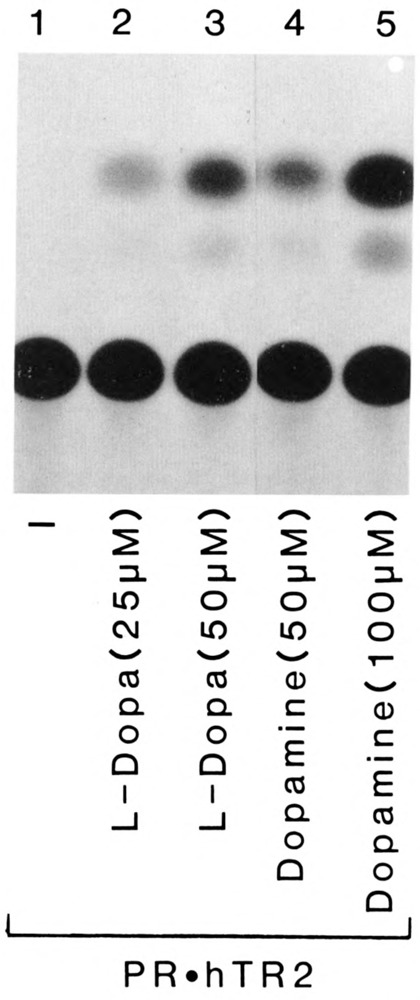
Dopamine and L-dopa induce PR.hTR2 dependent transcription of PREtkCAT. PR.hTR2 was co-transfected with PREtkCAT in CV-1 cells and cultured as described in Figure 2. Transfected cells were either untreated (lane 1) or treated with L-dopa (lanes 2 and 3) or dopamine (lanes 4 and 5) at concentrations indicated.
Figure 5
Figure 5
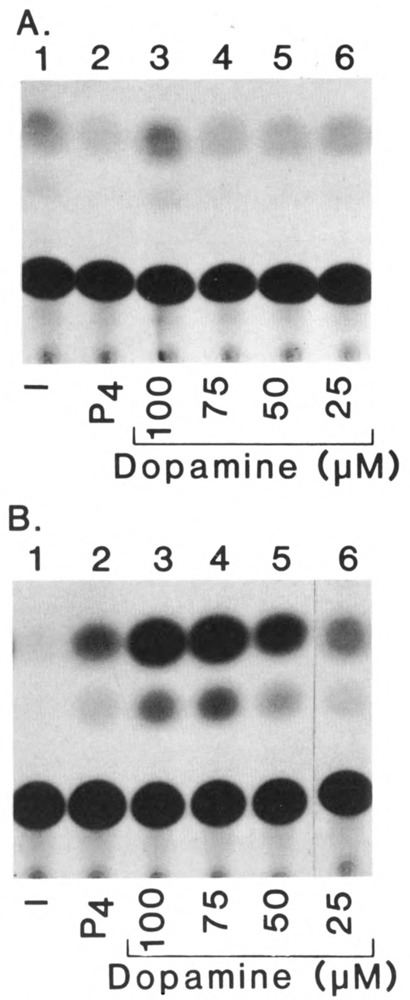
Dopamine activation of cPR mutants. CV-1 cells were cotransfected as described in Figure 2, with the receptor plasmid PREtkCAT and the expression plas mid p91023(B) containing the cPRB gross deletion mutants C1H and C1C2. The results of the transactivation studies on C1H and C1C2 are shown in A and B respectively. For both receptor mutants, transfected cells were untreated (lane 1) or treated with progesterone (P4) (10−7M) (lane 2) or dopamine (lanes 3–6) as described in Figure 4.

References

    1. Arriza J. L., Weinberger C., Cerelli G., Glasser T. M., Handelin B. L., Housman D. E., and Evans R. M. (1987), Science 237, 268–275. - PubMed
    1. Butt T. R., Khan M. I., Marsh J., Ecker D. J., and Crooke S. T. (1988), J Biol Chem 263, 16364–16371. - PubMed
    1. Carson M. A., Tsai M.-J., Conneely O. M., Maxwell B. L., Clark J. H., Dobson A. D. W., Elbrecht A., Toft D. O., Schrader W. T., and O’Malley B. W. (1987), Mol Endocrinol 1, 791–801. - PubMed
    1. Carson M. A., Lee A. T., Dobson A. D. W., Conneely O. M., Schrader W. T., and O’Malley B. W. (1990), J Steroid Biochem 34, 1–9. - PubMed
    1. Chaney W. G., Howard D. R., Pollard J. W., Sallustio S., and Stanley P. (1986), Somat Cell Mol Genet 12, 237–244. - PubMed

Publication types

MeSH terms