


The effect of chain length on protein solubilization in polymer-based vesicles (polymersomes)
- PMID: 14507679
- PMCID: PMC1303440
- DOI: 10.1016/S0006-3495(03)74639-6
The effect of chain length on protein solubilization in polymer-based vesicles (polymersomes)
Abstract
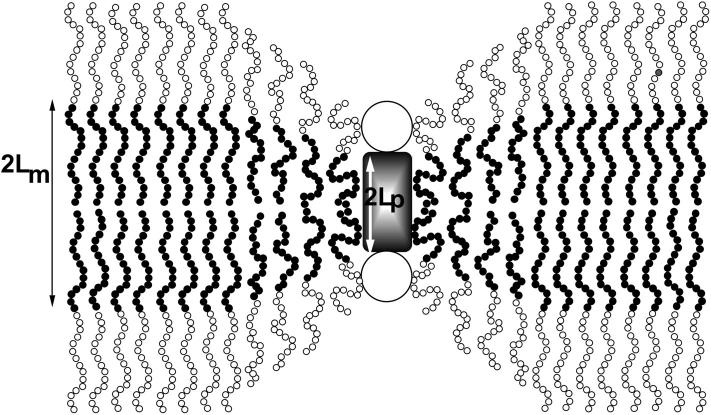
Using a mean-field analysis we derive a consistent model for the perturbation of a symmetric polymeric bilayer due to the incorporation of transmembrane proteins, as a function of the polymer molecular weight and the protein dimensions. We find that the mechanism for the inhibition of protein incorporation in polymeric bilayers differs from that of their inclusion in polymer-carrying lipid vesicles; in polymersomes, the equilibrium concentration of transmembrane proteins decreases as a function of the thickness mismatch between the protein and the bilayer core, whereas in liposomes the presence of polymer chains affects the protein adsorption kinetics. Despite the increased stiffness of polymer bilayers (when compared to lipid ones), their perturbation decay length and range of protein-protein interaction is found to be relatively long. The energetic penalty due to protein adsorption increases relatively slowly as a function of the polymer chain length due to the self-assembled nature of the polymer bilayer. As a result, we predict that transmembrane proteins may be incorporated in significant numbers even in bilayers where the thickness mismatch is large.
Figures


References
-
- Allen, T. M., C. Hansen, F. Martin, C. Redemann, and A. Yauyoung. 1991. Liposomes containing synthetic lipid derivatives of poly(ethylene glycol) show prolonged circulation half-lives in vivo. Biochim. Biophys. Acta. 1066:29–36. - PubMed
-
- Bermudez, H., A. K. Brannan, D. A. Hammer, F. S. Bates, and D. E. Discher. 2002. Molecular weight dependence of polymersome membrane structure, elasticity, and stability. Macromolecules. 35:8203–8208.
-
- Bezrukov, S. M. 2000. Functional consequences of lipid packing stress. Current Opinion in Colloid & Interface Science. 5:237–243.
-
- Blume, G., and G. Cevc. 1990. Liposomes for the sustained drug release in vivo. Biochim. Biophys. Acta. 1029:91–97. - PubMed
Publication types
MeSH terms
Substances
LinkOut - more resources
Full Text Sources
Research Materials
