


Prevalence of sensing abnormalities in dual chamber implantable cardioverter defibrillators
- PMID: 14510657
- PMCID: PMC6932559
- DOI: 10.1046/j.1542-474x.2003.08309.x
Prevalence of sensing abnormalities in dual chamber implantable cardioverter defibrillators
Abstract
Background: The clinical efficacy of ICD therapy depends on accurate sensing of intracardiac signals and sensing algorithms. We investigated the occurrence of sensing abnormalities in patients with dual chamber ICDs.
Methods: The study group consisted of all patients with dual chamber ICDs enrolled in the LESS trial and patients implanted with dual chamber ICDs at a single center between January 1997 and July 2000. Electrograms of spontaneous ventricular arrhythmias requiring device intervention were analyzed.
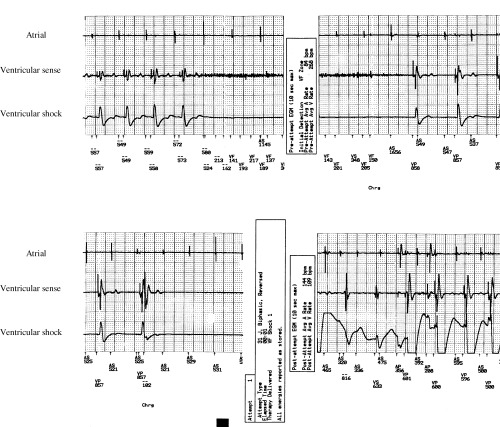
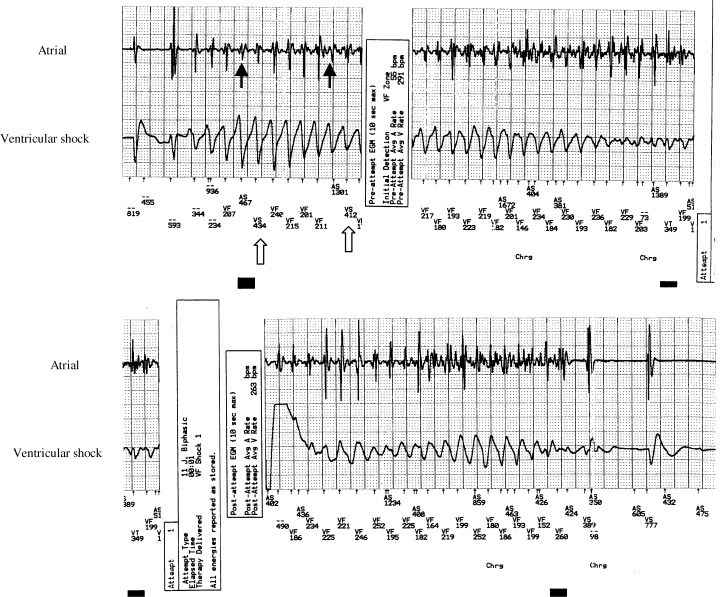
Results: A total of 48 patients met the criteria for enrollment. Among the 244 episodes, 215 (88%) were due to ventricular tachycardia and 29 (12%) were due to ventricular fibrillation. Overall undersensing was infrequent with 12 (20%) patients exhibiting on average 2.2 undersensed beats during 26 episodes of ventricular arrhythmias. There was no delay in therapy due to undersensing. Oversensing occurred in 5 (10%) patients resulting in 13 (2.7%) episodes of inappropriate therapy. None of the patients had any lead abnormalities and oversensing resolved after device reprogramming in 4 patients while 1 patient required a separate rate sensing lead. Among patients with oversensing, 4 out of 5 were pacing before the index event while among patients with no oversensing only 5 out of 42 were pacing (P<0.001).
Conclusions: Dual chamber ICDs demonstrate outstanding accuracy of sensing. However, because of the selection of patient population requiring more frequent pacing, oversensing occurs with a significant frequency. Meticulous evaluation in such patients is necessary to minimize the likelihood of oversensing and inappropriate shocks.
Figures
References
-
- Moss A, Hall W, Cannom D, et al Improved survival with an implanted defibrillator in patients with coronary disease at high risk for ventricular arrhythmia. Multicenter Automatic Defibrillator Implantation Trial. N Engl J Med 1996;335: 1933–1940. - PubMed
-
- Zipes D, Wyse D, Friedman P, et al A comparison of antiarrhythmic‐drug therapy with implantable defibrillators in patients resuscitated from near fatal ventricular arrhythmias. N Engl J Med 1997;337: 1576–1583. - PubMed
-
- Buxton AE, Lee KL, DiCarlo L, et al Electrophysiologic testing to identify patients with coronary artery disease who were at risk for sudden death. N Engl J Med 2000;342: 1937–1945. - PubMed
-
- Santini M, Ansalone G, Auriti A, et al Indications for dual‐chamber (DDD) pacing in implantable cardioverter‐defibrillator patients. Am J Cardiol 1996;78: 116–118. - PubMed
-
- Higgins S, Williams S, Pak J, et al Indications for implantations of a dual‐chamber pacemaker combined with an implantable cardioverter‐defibrillator. Am J Cardiol 1998;81: 1360–1362. - PubMed
Publication types
MeSH terms
LinkOut - more resources
Full Text Sources
Medical
Miscellaneous
