Effects of communicating individual risks in screening programmes: Cochrane systematic review
- PMID: 14512475
- PMCID: PMC200799
- DOI: 10.1136/bmj.327.7417.703
Effects of communicating individual risks in screening programmes: Cochrane systematic review
Abstract
Objective: To assess the effects of different types of individualised risk communication for patients who are deciding whether to participate in screening.
Design: Systematic review.
Data sources: Specialist register of the Cochrane consumers and communication review group, scientific databases, and a manual follow up of references.
Selection of studies: Studies were randomised controlled trials addressing decisions by patients whether or not to undergo screening and incorporating an intervention with an element of "individualised" risk communication-based on the individual's own risk factors for a condition (such as age or family history).
Outcome measures: The principal outcome was uptake of screening tests; further cognitive and affective measures were also assessed to gauge informed decision making.
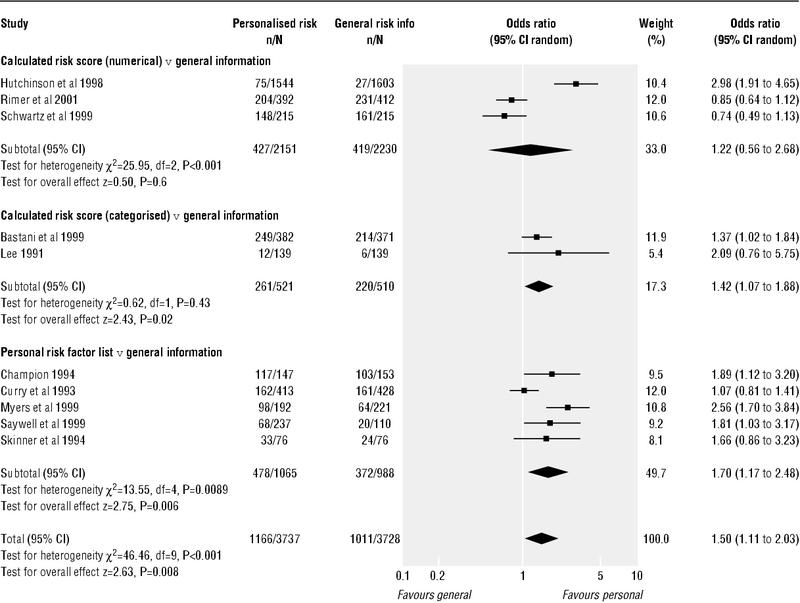
Results: 13 studies were included, 10 of which addressed mammography programmes. Individualised risk communication was associated with an increased uptake of screening tests (odds ratio 1.5, 95% confidence interval 1.11 to 2.03). Few cognitive or affective outcomes were reported consistently, so it was not possible to conclude whether this increase in the uptake of tests was related to informed decision making by patients.
Conclusions: Individualised risk estimates may be effective for purposes of population health, but their effects on increasing uptake of screening programmes may not be interpretable as evidence of informed decision making by patients. Greater attention is required to ways of developing interventions for screening programmes that can achieve this.
Figures
Comment in
-
Review: communication of individualized risk estimates improves uptake of screening procedures.ACP J Club. 2004 Mar-Apr;140(2):44. ACP J Club. 2004. PMID: 15122864 No abstract available.
References
-
- General Medical Council. Seeking patients consent: the ethical considerations. London: GMC, 1999.
-
- Edwards A, Hood K, Matthews EJ, Russell D, Russell IT, Barker J, et al. The effectiveness of one-to-one risk communication interventions in health care: a systematic review. Med Dec Making 2000;20: 290-7. - PubMed
-
- Gail MH, Brinton LA, Byar DP, Corle DK, Green SB, Schairer C, et al. Projecting individualized probabilities of developing breast cancer for white females who are being examined annually. J Natl Cancer Inst 1989;81: 1879-86. - PubMed
Publication types
MeSH terms
LinkOut - more resources
Full Text Sources
Medical
Research Materials