. 2003 Nov;140(5):839-46.
doi: 10.1038/sj.bjp.0705509. Epub 2003 Sep 29.

WAY-855 (3-amino-tricyclo[2.2.1.02.6]heptane-1,3-dicarboxylic acid): a novel, EAAT2-preferring, nonsubstrate inhibitor of high-affinity glutamate uptake

Affiliations

WAY-855 (3-amino-tricyclo[2.2.1.02.6]heptane-1,3-dicarboxylic acid): a novel, EAAT2-preferring, nonsubstrate inhibitor of high-affinity glutamate uptake

John Dunlop et al. Br J Pharmacol. 2003 Nov.

Abstract

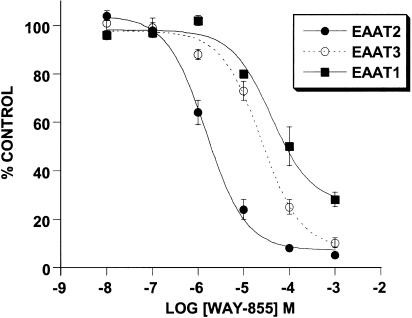
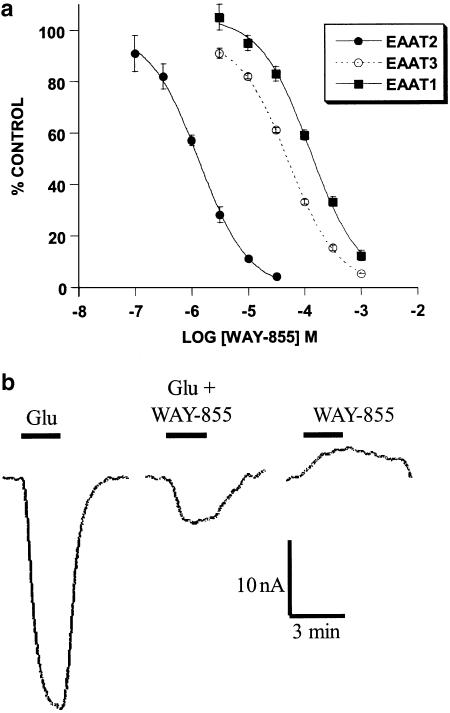
The pharmacological profile of a novel glutamate transport inhibitor, WAY-855 (3-amino-tricyclo[2.2.1.0(2.6)]heptane-1,3-dicarboxylic acid), on the activity of the human forebrain glutamate transporters EAAT1, EAAT2 and EAAT3 expressed in stable mammalian cell lines and in Xenopus laevis oocytes is presented. WAY-855 inhibited glutamate uptake mediated by all three subtypes in a concentration-dependent manner, with preferential inhibition of the CNS-predominant EAAT2 subtype in both cells and oocytes. IC50 values for EAAT2 and EAAT3 inhibition in cells were 2.2 and 24.5 microM, respectively, while EAAT1 activity was inhibited by 50% at 100 microM (IC50 values determined in oocytes were 1.3 microM (EAAT2), 52.5 microM (EAAT3) and 125.9 microM (EAAT1)). Application of WAY-855 to EAAT-expressing oocytes failed to induce a transporter current, and the compound failed to exchange with accumulated [3H]d-aspartate in synaptosomes consistent with a nonsubstrate inhibitor. WAY-855 inhibited d-aspartate uptake into cortical synaptosomes by a competitive mechanism, and with similar potency to that observed for the cloned EAAT2. WAY-855 failed to agonise or antagonise ionotropic glutamate receptors in cultured hippocampal neurones, or the human metabotropic glutamate receptor subtype 4 expressed in a stable cell line. WAY-855 represents a novel structure in glutamate transporter pharmacology, and exploration of this structure might provide insights into the discrimination between EAAT2 and other EAAT subtypes.


Figures
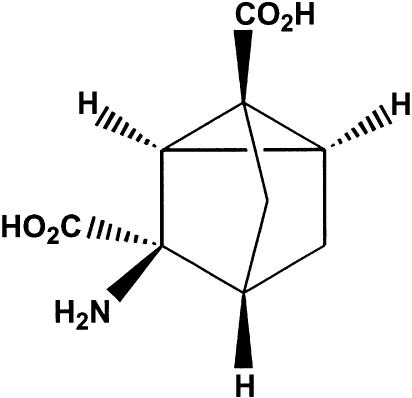
Figure 1
Figure 1
Chemical structure of WAY-855 (3-amino-tricyclo[2.2.1.02.6] heptane-1,3-dicarboxylic acid).
Figure 2
Figure 2
Concentration-dependent inhibition of glutamate uptake mediated by the cloned human glutamate transporters EAAT1 – 3 expressed in MDCK cells. Glutamate uptake into cells expressing each of the transporter subtypes was examined in the absence and presence of increasing concentrations of WAY-855. Data are expressed as % control uptake observed in the absence of drug and represent mean values±s.e.m. from three independent experiments.
Figure 3
Figure 3
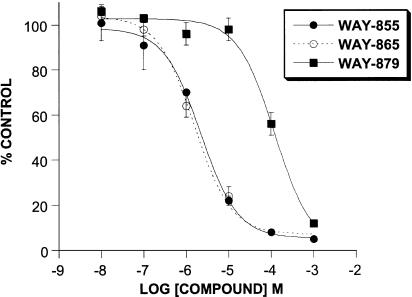
Inhibition of EAAT2-mediated glutamate uptake is stereoselective in favour of the WAY-865 enantiomer. Glutamate uptake into EAAT2-expressing cells was evaluated in the absence and presence of WAY-855 and its resolved enantiomers. Data are expressed as % control uptake observed in the absence of drug and represent mean values±s.e.m. from three independent experiments.
Figure 4
Figure 4
WAY-855 inhibits glutamate-induced currents in oocytes expressing each of the cloned human glutamate transporters EAAT1 – 3 in a concentration-dependent manner (a) and acts as a nonsubstrate inhibitor of EAAT2 (b). (a) Currents induced by application of 30 μM glutamate to EAAT-expressing oocytes were measured in the absence and presence of increasing concentrations of WAY-855. Data are expressed as % control current observed in the absence of drug and represent mean values±s.e.m. from three independent experiments. (b) A 2 min application of 30 μM glutamate to EAAT2-injected oocytes induces an inward current. WAY-855 (10 μM) blocks the glutamate-induced current but fails to generate an inward current when applied on its own.
Figure 5
Figure 5
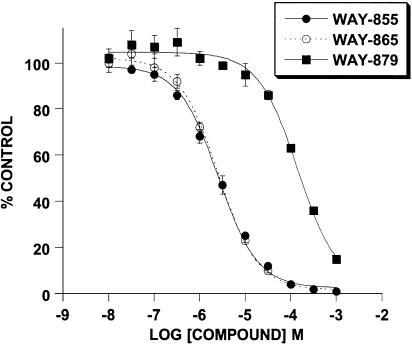
Concentration-dependent inhibition of D-aspartate uptake into P2 synaptosome fractions prepared from rat cortex by WAY-855 and the enantiomers WAY-865 and WAY-879. Synaptosomal D-aspartate uptake was measured in the presence and absence of increasing concentrations of compounds, and data are expressed as % control uptake. Mean values±s.e.m. from three independent experiments are presented.
Figure 6
Figure 6
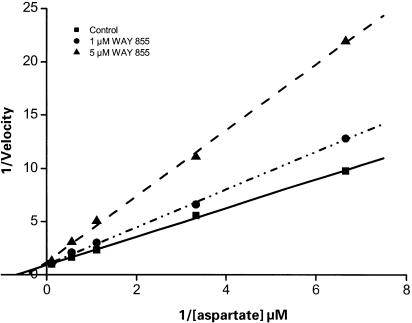
WAY-855 interacts with the excitatory amino-acid uptake system in rat cortical synaptosomes in a competitive manner. Synaptosomal D-aspartate uptake was measured in the presence of increasing concentrations of D-aspartate substrate with or without the addition of WAY-855. Lineweaver – Burk transformations of the saturable uptake data obtained in the absence (solid line) and presence of 1 μM (dotted line) or 5 μM WAY-855 (dashed line) obtained in a representative experiment are depicted. The profile is consistent with a competitive mode of inhibition, and the Ki values estimated in the presence of 1 and 5 μM WAY-855 were 0.2 and 0.5 μM, respectively.
Figure 7
Figure 7
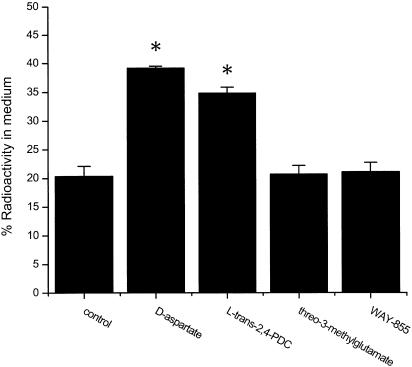
WAY-855 fails to promote exchange of previously accumulated D-[3H]aspartate from rat brain synaptosome fractions. Synaptosomes were pre-equilibrated with D-[3H]aspartate for 1 h prior to dilution into buffer with or without compounds at 2 × concentration for 5 min followed by centrifugation to separate pellet and supernatant. An aliquot of the supernatant was removed for the determination of [3H] efflux and the [3H] remaining in the pellet was determined. Data are expressed as % of radioactivity: radioactivity in supernatant/(radioactivity in supernatant+radioactivity in pellet) × 100%, and represent mean values±s.e.m. from three independent experiments. WAY-855 (100 μM) was compared with the substrates D-aspartate (30 μM) and L-trans-2,4-PDC (100 μM) and the nonsubstrate EAAT2 inhibitor threo-3-methylglutamate (300 μM). *P<0.01 compared to baseline control.
Figure 8
Figure 8
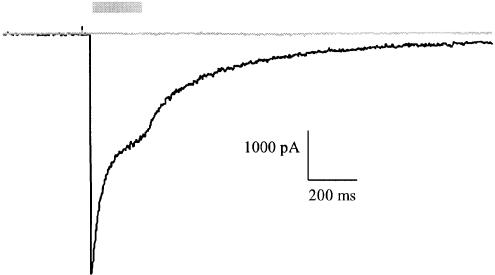
WAY-855 does not activate ionotropic glutamate receptors. Rapid application (200 ms) of 1 mM WAY-855 did not activate a mixed glutamate receptor current in cultured hippocampal neurones (grey trace). In contrast, 1 mM L-glutamate activated a large desensitising inward current (black trace). Representative profiles are presented. Grey bar indicates period of drug application.
Figure 9
Figure 9
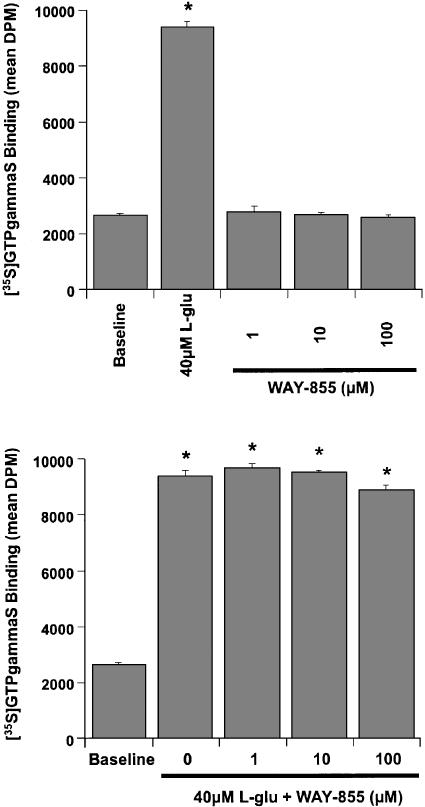
WAY-855 is not an mGluR4 receptor agonist or antagonist. Membranes from CHO cells expressing the human mGluR4 receptor subtype were incubated in the presence of L-glutamate or WAY-855 (a). L-Glutamate stimulated [35S]GTPγS binding to the mGluR4 receptor whereas WAY-855 (1 – 100 μM) did not. (b) Membranes were incubated with 40 μM L-glutamate in the absence (0) and presence of WAY-855 (1 – 100 μM). WAY-855 failed to antagonise [35S]GTPγS binding to mGluR4 stimulated by 40 μM L-glutamate. Data represent mean±s.e.m (n=3). *P<0.001 compared to baseline control. No difference was observed in the magnitude of the L-glutamate-stimulated response in the presence of WAY-855.

References

    1. ARRIZA J.L., ELIASOF S., KAVANAUGH M.P., AMARA S.G. Excitatory amino acid transporter 5, a retinal glutamate transporter coupled to a chloride conductance. Proc. Natl. Acad. Sci. U.S.A. 1997;94:4155–4160. - PMC - PubMed
    1. ARRIZA J.L., FAIRMAN W.A., WADICHE J.L., MURDOCH G.H., KAVANAUGH M.P., AMARA S.G. Functional comparison of three glutamate transporter subtypes cloned from human motor cortex. J. Neurosci. 1994;14:5559–5569. - PMC - PubMed
    1. BARNARD E.A. Ionotropic glutamate receptors: new types and new concepts. Trends Pharmacol. Sci. 1997;18:141–148. - PubMed
    1. BERGLES D.E., JAHR C.E. Synaptic activation of glutamate transporters in hippocampal astrocytes. Neuron. 1997;19:1297–1308. - PubMed
    1. BRIDGES R.J., KAVANAUGH M.P., CHAMBERLIN A.R. A pharmacological review of competitive inhibitors and substrates of high-affinity, sodium-dependent glutamate transport in the central nervous system. Curr. Pharmaceutical Des. 1999;5:363–379. - PubMed

MeSH terms

Substances

LinkOut - more resources