. 2003 Sep;9(9):1058-63.
doi: 10.3201/eid0909.030304.

Human metapneumovirus detection in patients with severe acute respiratory syndrome

Affiliations

Human metapneumovirus detection in patients with severe acute respiratory syndrome

Paul K S Chan et al. Emerg Infect Dis. 2003 Sep.

Abstract

We used a combination approach of conventional virus isolation and molecular techniques to detect human metapneumovirus (HMPV) in patients with severe acute respiratory syndrome (SARS). Of the 48 study patients, 25 (52.1%) were infected with HMPV; 6 of these 25 patients were also infected with coronavirus, and another 5 patients (10.4%) were infected with coronavirus alone. Using this combination approach, we found that human laryngeal carcinoma (HEp-2) cells were superior to rhesus monkey kidney (LLC-MK2) cells commonly used in previous studies for isolation of HMPV. These widely available HEp-2 cells should be included in conjunction with a molecular method for cell culture followup to detect HMPV, particularly in patients with SARS.


Figures
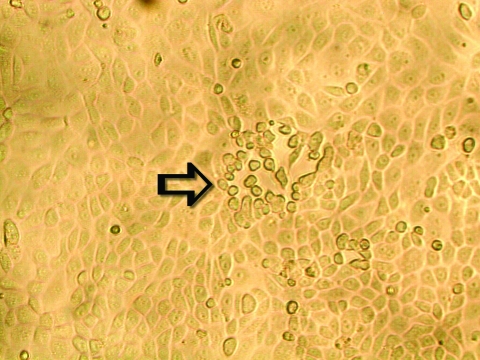
Figure 1
Figure 1
Early cytopathic effect of human metapneumovirus in rhesus monkey kidney (LLC-MK2) cell monolayers. A focus of infected cells that exhibit refractile rounding is indicated by an arrow (100X).
Figure 2
Figure 2
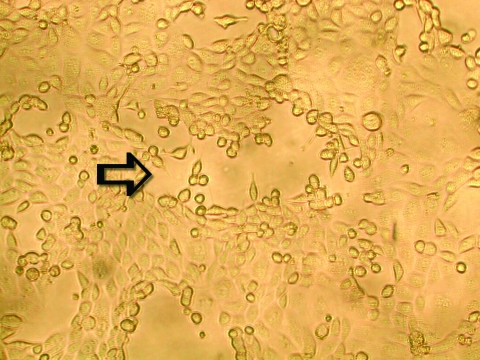
Late cytopathic effect of human metapneumovirus in rhesus monkey kidney (LLC-MK2) cell monolayers. Infected cells progressed slowly from focal rounding to detachment from cell monolayer is indicated by an arrow (100X).
Figure 3
Figure 3
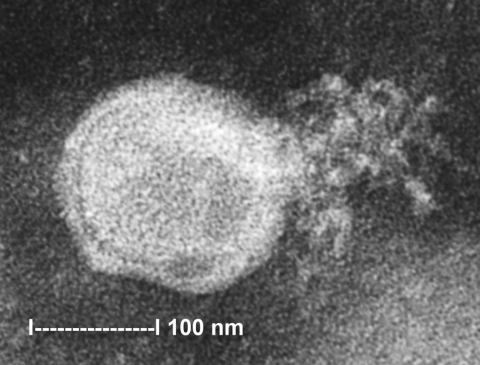
Electron micrograph of human metapneumovirus collected from the supernatant of rhesus monkey kidney (LLC-MK2) cell culture. A virion releasing nucleocapsid is shown.
Figure 4
Figure 4
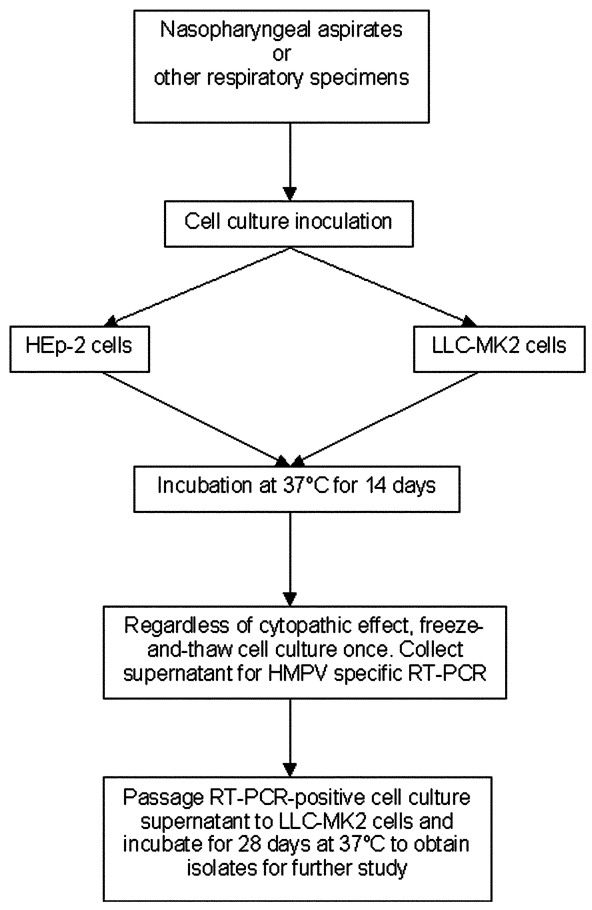
Combination approach of conventional virus isolation and molecular techniques to detect human metapneumovirus (HMPV) infection. Nasopharyngeal aspirates were examined in this study. This approach can be applied to other respiratory specimens. Prolonged incubation of rhesus monkey kidney (LLC-MK2) cells to 28 days for culture of original specimens may improve sensitivity of detection. Detection based on cytopathic effect is not sensitive for first-round culture from original specimens. All cell cultures should be examined by HMPV–specific reverse transcription-polymerase chain reaction. RT-PCR, reverse transcription-polymerase chain reaction.

Comment in

References

    1. van den Hoogen BG, de Jong JC, Groen J, Kuiken T, de Groot R, Fouchier RA, et al. A newly discovered human pneumovirus isolated from young children with respiratory tract disease. Nat Med. 2001;7:719–24. 10.1038/89098 - DOI - PMC - PubMed
    1. Jartti T, van den Hoogen B, Garofalo RP, Osterhaus AD, Ruuskanen O. Metapneumovirus and acute wheezing in children. Lancet. 2002;360:1393–4. 10.1016/S0140-6736(02)11391-2 - DOI - PMC - PubMed
    1. Nissen MD, Mackay IM, Withers SJ, Siebert DJ, Sloots TP. Evidence of human metapneumovirus in Australian children. Med J Aust. 2002;176:188. - PMC - PubMed
    1. Freymuth F, Vabret A, Legrand L, Eterradossi N, Lafay-Delaire F, Brouard J, et al. Presence of the new human metapneumovirus in French children with bronchiolitis. Pediatr Infect Dis J. 2003;22:92–4. 10.1097/00006454-200301000-00024 - DOI - PubMed
    1. Stockton J, Stephenson I, Fleming D, Zambon M. Human metapneumovirus as a cause of community-acquired respiratory illness. Emerg Infect Dis. 2002;8:897–901. - PMC - PubMed

MeSH terms

Substances

LinkOut - more resources