. 2003 Oct 14;100(21):12051-6.
doi: 10.1073/pnas.2135346100. Epub 2003 Oct 1.

Thrombomodulin allosterically modulates the activity of the anticoagulant thrombin

Affiliations

Thrombomodulin allosterically modulates the activity of the anticoagulant thrombin

Alireza R Rezaie et al. Proc Natl Acad Sci U S A. .

Abstract

Exosite 1 of thrombin consists of a cluster of basic residues (Arg-35, Lys-36, Arg-67, Lys-70, Arg-73, Arg-75, and Arg-77 in chymotrypsinogen numbering) that play key roles in the function of thrombin. Structural data suggest that the side chain of Arg-35 projects toward the active site pocket of thrombin, but all other residues are poised to interact with thrombomodulin (TM). To study the role of these residues in TM-mediated protein C (PC) activation by thrombin, a charge reversal mutagenesis approach was used to replace these residues with a Glu in separate constructs. The catalytic properties of the mutants toward PC were analyzed in both the absence and presence of TM and Ca2+. It was discovered that, with the exception of the Arg-67 and Lys-70 mutants, all other mutants activated PC with similar maximum rate constants in the presence of a saturating concentration of TM and Ca2+, although their affinity for interaction with TM was markedly impaired. The catalytic properties of the Arg-35 mutant were changed so that PC activation by the mutant no longer required Ca2+ in the presence of TM, but, instead, it was accelerated by EDTA. Moreover, the activity of this mutant toward PC was improved approximately 25-fold independent of TM. These results suggest that Arg-35 is responsible for the Ca2+ dependence of PC activation by the thrombin-TM complex and that a function for TM in the activation complex is the allosteric alleviation of the inhibitory interaction of Arg-35 with the substrate.


Figures
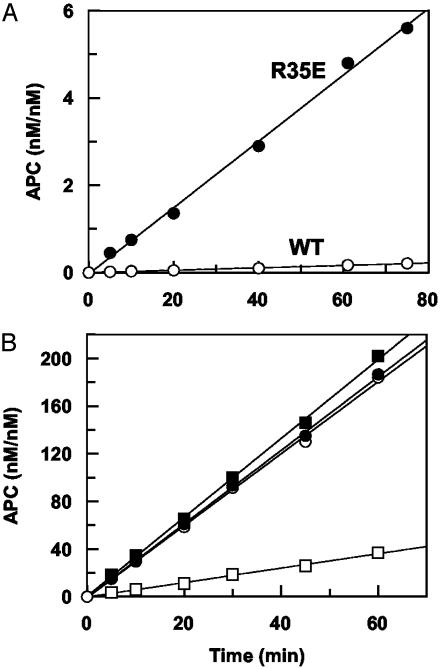
Fig. 1.
Fig. 1.
Initial rate of GD-PC activation by wild-type and R35E thrombins. (A)In the absence of TM, GD-PC (1 μM) was incubated with 50 nM wild-type (○) or 5 nM R35E thrombin (•) in TBS/Ca2+. At the indicated intervals, the activity of thrombin was inhibited by AT and the rate of APC generation was determined as described in Methods. The activation rates were 0.00276 nM/min and 0.076 nM/min for wild-type (WT) and R35E thrombin, respectively. (B)In the presence of TM456 (250 nM), the time course of GD-PC activation by 0.5 nM thrombin (○, Ca2+; □, EDTA) or R35E thrombin (•, Ca2+; ▪, EDTA) was carried out as in A. The activation rates were 3.0 nM/min (Ca2+) and 0.6 nM/min (EDTA) and 3.1 nM/min (Ca2+) and 3.3 nM/min (EDTA) for wild-type and R35E thrombin, respectively.
Fig. 2.
Fig. 2.
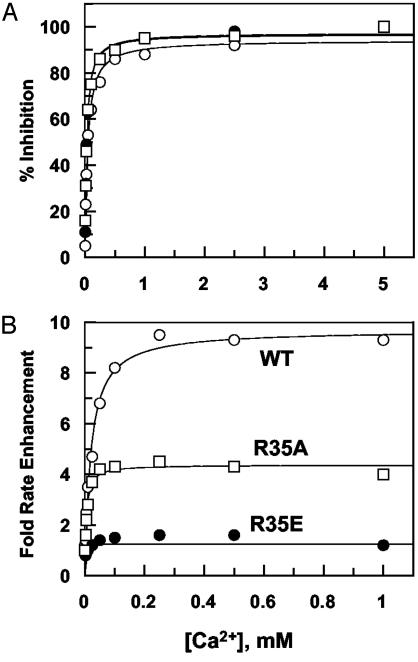
Ca2+-concentration dependence of GD-PC activation. (A) In the absence of TM, GD-PC (1 μM) activation was monitored at room temperature by 10 nM wild-type (WT, ○), 1 nM R35E (•), or 5 nM R35A thrombin (□)inthe presence of increasing concentrations of Ca2+. Data were normalized to 100% inhibition in the presence of 5 mM Ca2+.(B) The same as in A, except that the Ca2+-mediated enhancement in the activation rates in the presence of TM456 was measured and plotted vs. concentration of Ca2+. With the exception of R35E, all data fitted well to a hyperbolic binding isotherm yielding Kd(app) values of ≈30 μM and 15 μMCa2+ in the absence (A) and presence (B)ofTM.
Fig. 3.
Fig. 3.
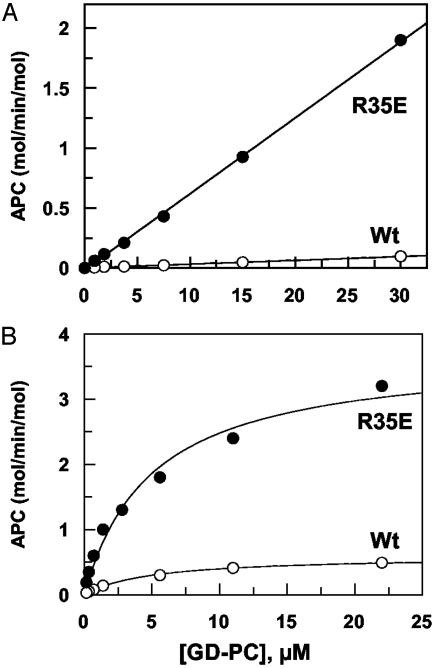
The concentration dependence of the GD-PC activation by wild-type (Wt) and R35E thrombin. (A) Twenty nanomolar wild-type (○) or 5 nM R35E thrombin (•) was incubated with increasing concentrations of GD-PC (0.5–30 μM GD-PC) in TBS/Ca2+ at room temperature for 50 min. (B) The same as in A, except that the initial rate of activations by 10 nM thrombin (○) or 2 nM R35E thrombin (•) was determined in the presence of 25 μg/ml dextran sulfate. The solid lines are best fit of data to the Michaelis–Menten equation.
Fig. 4.
Fig. 4.
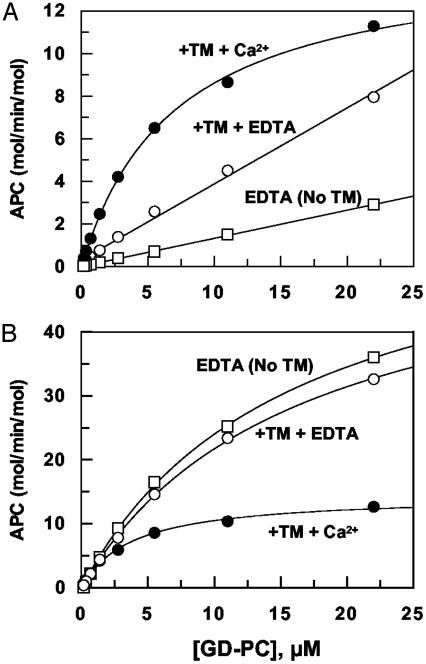
The concentration dependence of the GD-PC activation by wild-type and R35E thrombins in the absence and presence of TM456 and Ca2+.(A) Initial rate of GD-PC activation by 1 nM thrombin alone in 1 mM EDTA (□) or in complex with 500 nM TM456 was determined in the presence of either 1 mM Ca2+ (•) or EDTA (○). (B) The same as in A except that R35E thrombin was used in the reaction.
Fig. 5.
Fig. 5.
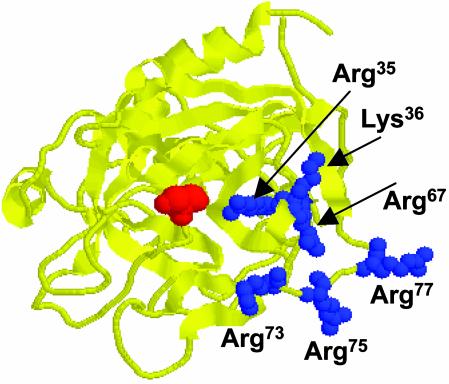
Crystal structure of human thrombin. The Arg-35 and basic residues of exosite 1 (Lys-36, Arg-67, Arg-73, Arg-75, and Arg-77) are shown in blue. The catalytic residue Ser-195 is shown in red. The coordinates of Protein Data Bank code 1PPB (21) were used to prepare the figure.

References

    1. Esmon, C. T. (1993) Thromb. Haemostasis 70, 1–5. - PubMed
    1. Walker, F. J. & Fay, P. J. (1992) FASEB J. 6, 2561–2567. - PubMed
    1. Davie, E. W., Fujikawa, K. & Kisiel, W. (1991) Biochemistry 30, 10363–10370. - PubMed
    1. Stenflo, J. (1991) Blood 78, 1637–1651. - PubMed
    1. Mather, T., Oganessyan, V., Hof, P., Huber, R., Foundling, S., Esmon, C. & Bode, W. (1996) EMBO J. 15, 6822–6831. - PMC - PubMed

Publication types

MeSH terms

LinkOut - more resources