. 2003 Oct 14;100(21):12111-6.
doi: 10.1073/pnas.2133463100. Epub 2003 Oct 1.

Mechanism and energetics of green fluorescent protein chromophore synthesis revealed by trapped intermediate structures

Affiliations

Mechanism and energetics of green fluorescent protein chromophore synthesis revealed by trapped intermediate structures

David P Barondeau et al. Proc Natl Acad Sci U S A. .

Abstract

Green fluorescent protein has revolutionized cell labeling and molecular tagging, yet the driving force and mechanism for its spontaneous fluorophore synthesis are not established. Here we discover mutations that substantially slow the rate but not the yield of this posttranslational modification, determine structures of the trapped precyclization intermediate and oxidized postcyclization states, and identify unanticipated features critical to chromophore maturation. The protein architecture contains a dramatic approximately 80 degrees bend in the central helix, which focuses distortions at G67 to promote ring formation from amino acids S65, Y66, and G67. Significantly, these distortions eliminate potential helical hydrogen bonds that would otherwise have to be broken at an energetic cost during peptide cyclization and force the G67 nitrogen and S65 carbonyl oxygen atoms within van der Waals contact in preparation for covalent bond formation. Further, we determine that under aerobic, but not anaerobic, conditions the Gly-Gly-Gly chromophore sequence cyclizes and incorporates an oxygen atom. These results lead directly to a conjugation-trapping mechanism, in which a thermodynamically unfavorable cyclization reaction is coupled to an electronic conjugation trapping step, to drive chromophore maturation. Moreover, we propose primarily electrostatic roles for the R96 and E222 side chains in chromophore formation and suggest that the T62 carbonyl oxygen is the base that initiates the dehydration reaction. Our molecular mechanism provides the basis for understanding and eventually controlling chromophore creation.


Figures
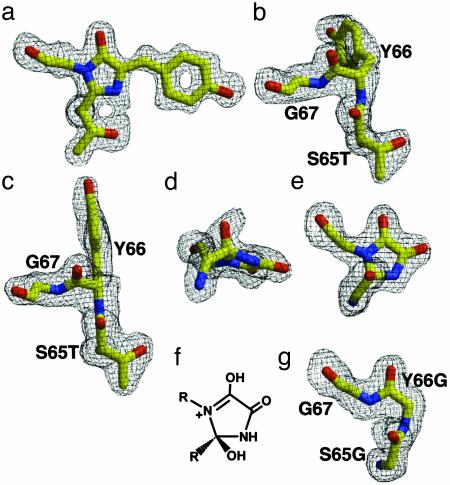
Fig. 1.
Fig. 1.
Posttranslational modifications revealed by structures of GFP variants before and after backbone cyclization. Omit |FoFc| electron density maps for the chromophore residues contoured at 3 σ (black). (a) The 1.50-Å cyclized R96A structure. (b) The 2.00-Å precyclization R96A intermediate A structure. (c) The 2.00-Å precyclization R96A intermediate B structure. (d and e) Orthogonal views of the 1.80-Å Gly-Gly-Gly aerobic oxidized postcyclization structure. (f) Proposed molecular structure of the Gly-Gly-Gly cyclized ring. (g) The 1.80-Å Gly-Gly-Gly anaerobic precyclization structure. All are illustrated inraster 3d (44).
Fig. 2.
Fig. 2.
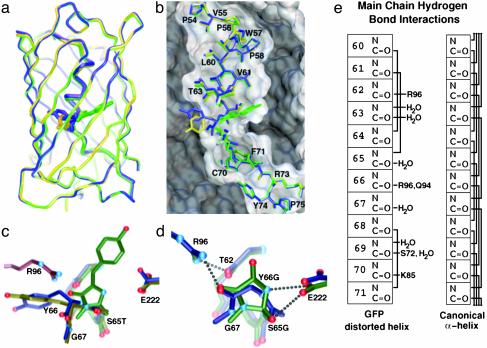
Architectural distortions and structural comparisons between precyclization and postcyclization states. (a) Superposition of R96A structures, emphasizing large conformational change for Y66 but otherwise small Cα differences between precyclization (A in yellow, B in blue) and postcyclization (green) states. (b) Central helix for three R96A structures displayed with the surface of the R96A mature structure, emphasizing helical bend. (c) Structural overlay of R96A precyclization intermediates A (yellow) and B (blue) with the mature R96A (green) structure, showing large main-chain movements in forming the chromophore. Modeled R96 (purple) indicates steric interactions with the Y66 side-chain position of the precyclization intermediate structure. (d) Superposition of the Gly-Gly-Gly structures before (blue, anaerobic) and after (green, aerobic) peptide cyclization shows functional group interactions between the R96, E222, and T62 carbonyl oxygen atoms and the chromophore residues. (e) Schematic of distortions in main-chain hydrogen-bonding interactions for the WT, Gly-Gly-Gly precyclization, and postcyclization structures (Left) displayed in comparison to a canonical α-helix (Right). Solid lines between main-chain atoms indicate presence of a hydrogen bond. ad are illustrated with avs (45).
Fig. 3.
Fig. 3.
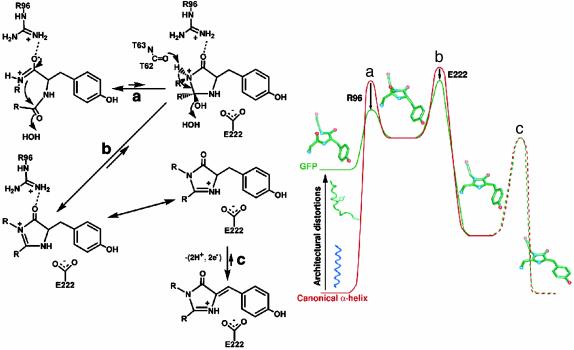
The proposed conjugation-trapping mechanism for GFP chromophore formation. The chemical mechanism for GFP chromophore formation (Left) is displayed along with a cartoon representation of the corresponding reaction coordinate (Right). The reaction coordinates (x axis) for GFP (green) and a canonical α-helix (red) are displayed against increasing energy for the chromophore residues (y axis), to highlight the three features favoring ring synthesis in the GFP scaffold: architectural distortions, R96 enhancement of the G67 nucleophile, and E222 stabilization of the dehydration transition state. (a) Peptide cyclization to generate a destabilized intermediate. (b) Dehydration, initiated by the T62 carbonyl, to trap the cyclized product through conjugation. (c) Oxidation to generate an aromatic imidazolone and conjugate the two ring systems. The chromophore images superimposed onto the cartoon are (from left to right) the R96A precyclization structure, model of cyclized intermediate, model of reduced intermediate and the R96A mature chromophore structure. Our data do not address the oxidation transition state (displayed as dashed lines).

References

    1. Ormö, M., Cubitt, A. B., Kallio, K., Gross, L. A., Tsien, R. Y. & Remington, S. J. (1996) Science 273, 1392–1395. - PubMed
    1. Cubitt, A. B., Heim, R., Adams, S. R., Boyd, A. E., Gross, L. A. & Tsien, R. Y. (1995) Trends Biochem. Sci. 20, 448–455. - PubMed
    1. Heim, R., Prasher, D. C. & Tsien, R. Y. (1994) Proc. Natl. Acad. Sci. USA 91, 12501–12504. - PMC - PubMed
    1. Tsien, R. Y. (1998) Annu. Rev. Biochem. 67, 509–544. - PubMed
    1. Chalfie, M., Tu, Y., Euskirchen, G., Ward, W. W. & Prasher, D. C. (1994) Science 263, 802–805. - PubMed

Publication types