. 2003 Oct 14;100(21):12432-7.
doi: 10.1073/pnas.2133653100. Epub 2003 Oct 3.

SecA2-dependent secretion of autolytic enzymes promotes Listeria monocytogenes pathogenesis

Affiliations

SecA2-dependent secretion of autolytic enzymes promotes Listeria monocytogenes pathogenesis

Laurel L Lenz et al. Proc Natl Acad Sci U S A. .

Abstract

Pathogenic bacteria secrete proteins that promote invasion of host tissues and resistance to immune responses. However, secretion mechanisms that contribute to the enormous morbidity and mortality of Gram-positive bacteria are largely undefined. An auxiliary protein secretion system (SecA2) has recently emerged in Listeria monocytogenes and eight other Gram-positive pathogens. Here, a proteomics approach identified seventeen SecA2-dependent secreted and surface proteins of L. monocytogenes, the two most abundant of which [the p60 and N-acetylmuramidase (NamA) autolysins] hydrolyze bacterial peptidoglycan (PGN) and contribute to host colonization. SecA2-deficient (DeltaSecA2) bacteria were rapidly cleared after systemic infection of murine hosts, and in cultured cells showed reduced cell-cell spread. p60 or NamA deficiencies (Deltap60 and DeltaNamA) caused intermediate reductions in bacterial virulence in vivo, yet showed no defect for infection of cultured cells. Restoration of virulence in Deltap60 bacteria required full-length p60 with an intact catalytic domain, suggesting that PGN hydrolysis by p60 is crucial for L. monocytogenes virulence. Coordinated PGN hydrolysis by p60 and NamA activities is predicted to generate a muramyl glycopeptide, glucosaminylmuramyl dipeptide (GMDP), which is known to modify host inflammatory responses. Thus, SecA2-dependent secretion may promote release of muramyl peptides that subvert host pattern recognition.


Figures
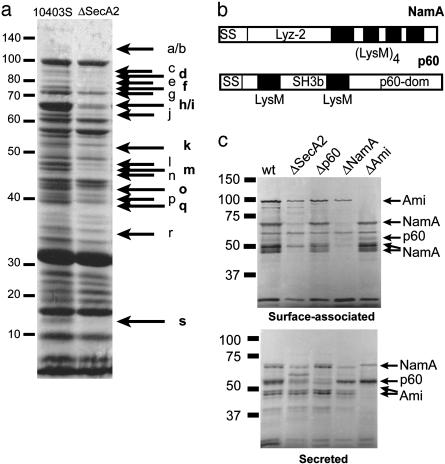
Fig. 1.
Fig. 1.
The SecA2-dependent extracellular proteome of L. monocytogenes includes two abundant autolytic enzymes. (a) SDS/PAGE of proteins extracted from the surface of log-phase WT and ΔSecA2 bacteria by boiling in SDS sample buffer (2% SDS, 5% 2-mercaptoethanol). Forty-nine protein bands were resolved in WT samples stained with colloidal Coomassie blue, 19 of which were SecA2-dependent and are indicated by arrows. Seventeen of these proteins were identified by mass spectrometry and are listed in Table 1. (b) Schematic of the SecA2-dependent NamA and p60 proteins. LysM domains promote adhesion to the bacterial cell wall; Lyz-2 and p60 domains are associated with cleavage of peptidoglycan. (c) Zymograms showing bands of autolytic activity present in samples of surface-associated and secreted proteins of the WT and mutant L. monocytogenes strains. Only the catalytic activities attributed to p60 and NamA are missing in the samples from the ΔSecA2 strain.
Fig. 2.
Fig. 2.
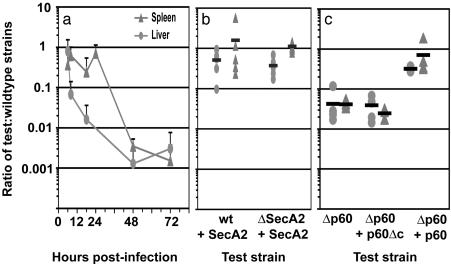
SecA2 and catalytically active p60 are essential for sustained colonization of mouse tissues by L. monocytogenes. (a) Kinetic analysis of the virulence defect for the ΔSecA2 strain. Mice were infected with a 1:1 ratio of mutant:WT bacteria. The inability of the marked ΔSecA2 test strain to persist in the host at WT levels is shown by reduced ratios of test:WT strain colonies recovered at later time points after infection. Data are compiled from three experiments comprising at least five mice per time point. Bars indicate SDs. (b) Competitive indices for five mice per group demonstrate restored virulence with expression of SecA2 in the ΔSecA2 strain. Expression of additional SecA2 in the parental strain did not affect virulence. Ratios were determined at 72 h postinfection. (c) Reduced virulence of L. monocytogenes lacking p60. Virulence is restored only by expression of p60 with an intact catalytic domain. Bars in b and c indicate mean values.
Fig. 3.
Fig. 3.
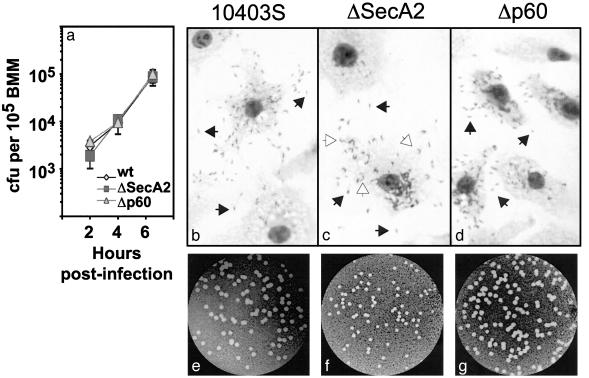
SecA2 and p60 are not required for intracellular growth of L. monocytogenes although SecA2 promotes bacterial cell-cell spread independent of p60. (a) Infection and intracellular replication of WT (10403S) and mutant bacteria were measured by plating lysates of primary mouse macrophages at the indicated times after infection. The host cell-impermeable antibiotic gentamycin sulfate was added to kill extracellular bacteria 30 min after infection. The infection efficiency and growth rates (judged by increased colony-forming units over time) were identical for all three strains. (b-d) Micrographs of mouse bone marrow macrophages 6.5 h after infection with WT or mutant L. monocytogenes strains. Black arrows indicate bacteria-induced pseudopod-like structures. White arrows show doublets of ΔSecA2 bacteria. (e-g) Plaques formed in monolayers of TIB73 hepatocytes 72 h after infection with WT or mutant bacteria. The mean diameter of plaques formed by WT and Δp60 bacteria were identical whereas the ΔSecA2 strain showed reduced cell-cell spread as judged by the 32 ± 4% smaller plaque size.
Fig. 4.
Fig. 4.
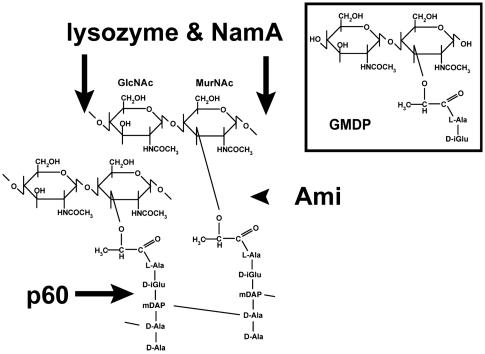
Structure of L. monocytogenes PGN, including predicted cleavage sites for p60, NamA, and other select bacteriolytic enzymes. (Inset) The structure of the GMDP glycopeptide predicted to result from cleavage by the combined activities of NamA and p60. GlcNAc, N-acetyl-glucosamine; MurNAc, N-acetyl muramic acid; iGlu, iso-glutamine; mDAP, meso-diaminopimelic acid. Note that the GlcNAc-MurNAc bond may also be cleaved by host lysozymes.

References

    1. Rosenberger, C. M. & Finlay, B. B. (2003) Nat. Rev. Mol. Cell Biol. 4, 385-396. - PubMed
    1. Vazquez-Torres, A., Xu, Y., Jones-Carson, J., Holden, D. W., Lucia, S. M., Dinauer, M. C., Mastroeni, P. & Fang, F. C. (2000) Science 287, 1655-1658. - PubMed
    1. Mills, S. D., Boland, A., Sory, M. P., van der Smissen, P., Kerbourch, C., Finlay, B. B. & Cornelis, G. R. (1997) Proc. Natl. Acad. Sci. USA 94, 12638-12643. - PMC - PubMed
    1. Hersh, D., Monack, D. M., Smith, M. R., Ghori, N., Falkow, S. & Zychlinsky, A. (1999) Proc. Natl. Acad. Sci. USA 96, 2396-2401. - PMC - PubMed
    1. Abramovitch, R. B., Kim, Y. J., Chen, S., Dickman, M. B. & Martin, G. B. (2003) EMBO J. 22, 60-69. - PMC - PubMed

Publication types

MeSH terms

LinkOut - more resources