. 2003 Oct 14;100(21):12213-8.
doi: 10.1073/pnas.2131679100. Epub 2003 Oct 6.

Repeated neonatal handling with maternal separation permanently alters hippocampal GABAA receptors and behavioral stress responses

Affiliations

Repeated neonatal handling with maternal separation permanently alters hippocampal GABAA receptors and behavioral stress responses

Fu-Chun Hsu et al. Proc Natl Acad Sci U S A. .

Abstract

Increasing evidence suggests that postnatal events, such as handling or maternal separation, can produce long-term changes in brain function. These are often expressed as changes in the profile of endocrine or behavioral responses to stress. Changes in gamma-aminobutyric acid type A receptors (GABARs), which mediate the majority of fast synaptic inhibition in adult brain, have been proposed as one potential mediator of these behavioral effects. In the current article, we use a combination of single-cell electrophysiology and antisense mRNA amplification to demonstrate permanent molecular and functional differences in GABARs within hippocampal dentate granule neurons after as few as two episodes of neonatal handling with brief maternal separation. Adult animals that as pups experienced handling with maternal separation maintained a more immature GABAR phenotype and exhibited increased activity in response to swim stress. These findings demonstrate the exquisite sensitivity of the developing GABAergic system to even subtle environmental manipulations and provide an unique molecular mechanism by which postnatal handling with maternal separation may alter stress-related behavior.


Figures
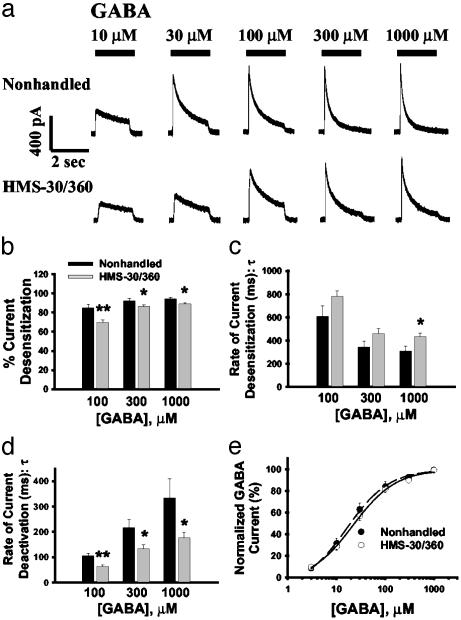
Fig. 1.
Fig. 1.
HMS-30/360 altered GABA current kinetics without changing GABA efficacy or potency. (a) Representative traces for DGN responses to GABA concentrations of 10–1,000 μM in cells from a nonhandled control rat and a HMS-30/360 rat. (b) The percentage of GABA current desensitization within a 2-sec period of GABA application was decreased in the HMS-30/360, compared with nonhandled, DGNs. (c) The desensitization rate for GABA current was slower in the HMS-30/360 group compared with the nonhandled group as indicated by an increased current desensitization time constant (τ). (d) GABA current deactivation times were shortened in HMS-30/360, compared with nonhandled, groups. (e) Normalized GABA concentration–response curves demonstrated no significant difference in GABA EC50 between non-handled and HMS-30/360 groups (*, P < 0.05; **, P < 0.01; t test).
Fig. 2.
Fig. 2.
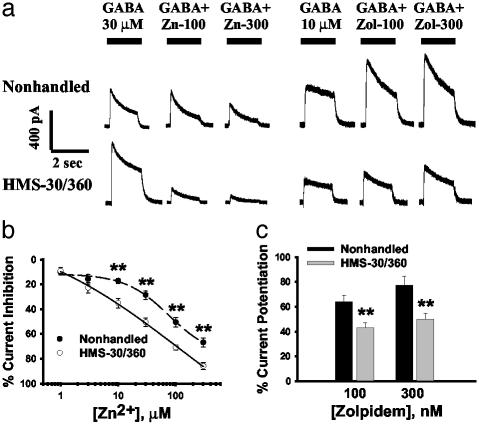
HMS-30/360 altered GABAR pharmacology. (a) Representative responses of DGNs isolated from a nonhandled and a HMS-30/360 rat to 30 μM GABA application alone and coapplication with zinc (100 and 300 μM), and to 10 μM GABA application alone and coapplication with zolpidem (Zol; 100 and 300 nM). (b) Concentration–response curves for zinc inhibition of GABA current indicated that the zinc IC50 was significantly decreased in DGNs isolated from HMS-30/360, compared with nonhandled, rats. (c) GABA current potentiation by zolpidem, a type I BZ receptor-specific positive modulator, was significantly decreased in DGNs from the HMS-30/360 rats (t test; **, P < 0.01).
Fig. 3.
Fig. 3.
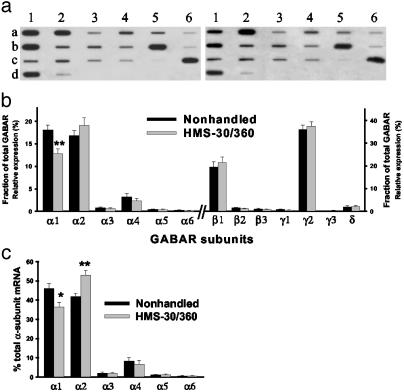
Changes in GABAR function are associated with decreased α1 mRNA expression. (a) aRNA expression profiles from single DGNs acutely isolated from nonhandled (Left) and HMS-30/360 (Right) rats. Slot blot demonstrates hybridization intensities of radiolabeled aRNA probe to a slot blot containing GABAR subunit cDNAs α1–6 (a1–a6), β1–3 (b1–b3), γ1–3 (b4–b6), δ, ε, π, and θ (c1–c4), glial fibrillary acidic protein (c5), neurofilament-L (c6), β-actin (d1), and pBluescript (d2). (b) Mean relative expression (± SEM) of GABAR subunit mRNA as a percentage of total GABAR mRNAs in DGNs isolated from HMS-30/360 vs. nonhandled rats. (c) Mean relative expression of each α-subunit mRNA as a percentage of total α subunit mRNA expression in DGN from HMS-30/360 vs. nonhandled rats (*, P < 0.05; **, P < 0.01, one-way ANOVA with post hoc t tests with Bonferroni correction for multiple comparisons).
Fig. 4.
Fig. 4.
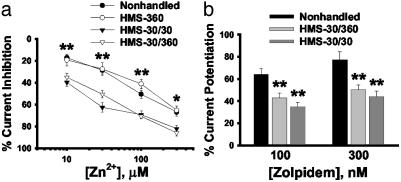
Repeated separation is critical for GABAR functional changes. (a) The long-term changes in GABAR zinc sensitivity observed in the HMS-30/360 group were similar to those observed after repeated brief separations (HMS-30/30) but not a single long separation (HMS-360). (b) The potentiation of zolpidem on GABA currents was also similar between both repeated separation groups (HMS-30/360 and HMS-30/30) and different from the nonhandled groups (*, P < 0.05; **, P < 0.01; one-way ANOVA and Tukey's test for post hoc comparison).
Fig. 5.
Fig. 5.
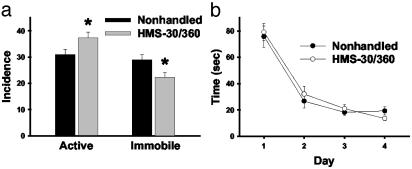
HMS-30/360 alters stress-related behavioral responses but not spatial memory performance. (a) Quantification of behaviors of adult rats that were either handled/separated or nonhandled as pups during exposure to a forced swim. Bars represent the mean incidence of individual behaviors as described in Methods (± SEM). Active behavior was calculated as the sum of climbing and swimming. HMS-30/360 rats exhibited an increase in active behavior and decrease in immobility compared with nonhandled rats (*, P < 0.05, ANOVA). Additionally, the incidence of active behaviors compared with passive behaviors is higher in the HMS-30/360 group (P < 0.001) but equal in the non-handled group. (b) Activity of HMS-30/360 and nonhandled rats as adults in Morris water maze. The abscissa indicates the day of training, and the ordinate indicates the mean time required to reach the platform. A two-way ANOVA revealed a significant effect of time (P < 0.0001) but no significant effect of treatment or interaction.

References

    1. Levine, S. (1957) Science 126, 405–406. - PubMed
    1. Levine, S., Haltmeyer, G. C., Karas, G. G. & Denenberg, V. H. (1967) Physiol. Behav. 2, 55–63.
    1. Meaney, M. J., Aitken, D. H., van Berkel, C., Bhatnagar, S. & Sapolsky, R. M. (1988) Science 239, 766–768. - PubMed
    1. Ladd, C. O., Huot, R. L., Thrivikraman, K. V., Nemeroff, C. B., Meaney, M. J. & Plotsky, P. M. (2000) Prog. Brain Res. 122, 81–103. - PubMed
    1. Bodnoff, S. R., Suranyi-Cadotte, B., Quirion, R. & Meaney, M. J. (1987) Eur. J. Pharmacol. 144, 105–107. - PubMed

Publication types

LinkOut - more resources