. 2003 Oct;69(10):5839-48.
doi: 10.1128/AEM.69.10.5839-5848.2003.

Functional analysis of the gene cluster involved in production of the bacteriocin circularin A by Clostridium beijerinckii ATCC 25752

Affiliations

Functional analysis of the gene cluster involved in production of the bacteriocin circularin A by Clostridium beijerinckii ATCC 25752

Robèr Kemperman et al. Appl Environ Microbiol. 2003 Oct.

Abstract

A region of 12 kb flanking the structural gene of the cyclic antibacterial peptide circularin A of Clostridium beijerinckii ATCC 25752 was sequenced, and the putative proteins involved in the production and secretion of circularin A were identified. The genes are tightly organized in overlapping open reading frames. Heterologous expression of circularin A in Enterococcus faecalis was achieved, and five genes were identified as minimally required for bacteriocin production and secretion. Two of the putative proteins, CirB and CirC, are predicted to contain membrane-spanning domains, while CirD contains a highly conserved ATP-binding domain. Together with CirB and CirC, this ATP-binding protein is involved in the production of circularin A. The fifth gene, cirE, confers immunity towards circularin A when expressed in either Lactococcus lactis or E. faecalis and is needed in order to allow the bacteria to produce bacteriocin. Additional resistance against circularin A is conferred by the activity of the putative transporter consisting of CirB and CirD.


Figures
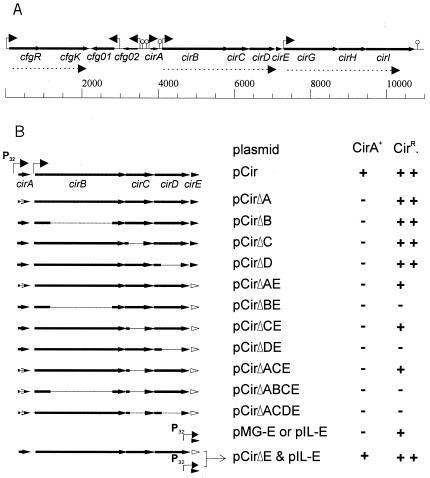
FIG. 1.
FIG. 1.
(A) Physical map of the region surrounding the circularin A structural gene cirA of C. beijerinckii ATCC 25752. Solid arrows indicate genes; bent arrows show putative promoters; lollipops represent predicted regions of dyad symmetry (ΔG0 < −10 kcal/mol); dotted arrows show possible polycistronic messengers. Map units are base pairs. (B) Schematic representation of the cir DNA fragments in the indicated plasmids and locations of the deletions (indicated by the thin lines). Open arrowheads indicate a deletion in cirE. Promoters are shown by bent arrows. CirA+, circularin A production; CirR, circularin A resistance, denoted as ++, full protection against CirA [>24-fold increase relative to E. faecalis JH2-2(pMG36c)]; +, partial protection [2- to 16-fold increase relative to E. faecalis JH2-2(pMG36c)]; −, sensitive.
FIG. 2.
FIG. 2.
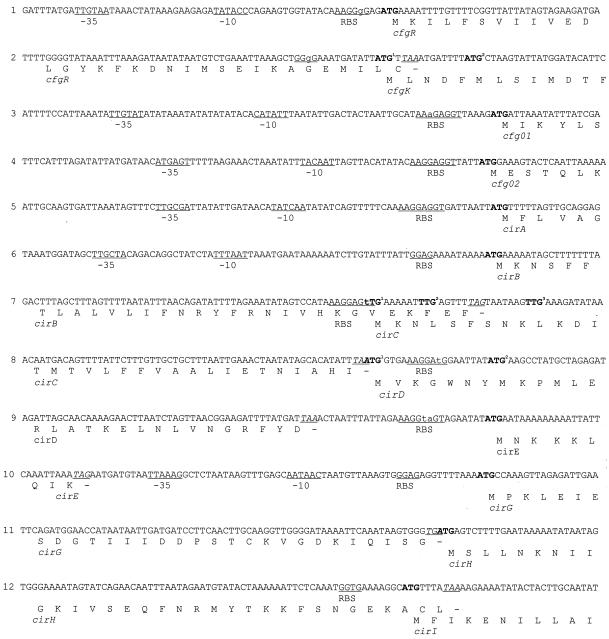
(A) Nucleotide sequences of promoter and translation initiation regions in the cir gene cluster. Putative −35, −10, and ribosome-binding site (RBS) sequences are underlined. Deduced amino acid sequences are indicated below the nucleotide sequences, and gene names are given below the amino acid sequences. Putative start codons are indicated in boldface and are numbered when more than one possibility exists. Termination codons are underlined and in italic.
FIG. 3.
FIG. 3.
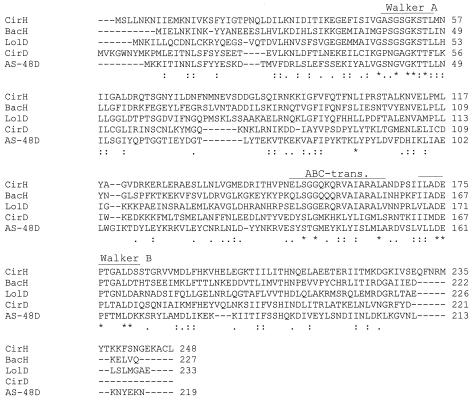
Alignment of the putative ATP binding proteins involved in circularin A (CirD, CirH) and enterocin AS-48 (AS-48D, BacH) production with LolD, a protein involved in lipoprotein secretion. Identical residues are indicated by an asterisk. Colons and periods indicate conserved and semiconserved amino acid substitutions, respectively, according to the ClustalW grouping of amino acids. Dashes indicate gaps introduced in the sequence to maximize alignment. Walker A, Walker, and ABC transporter B motifs are indicated.
FIG. 4.
FIG. 4.
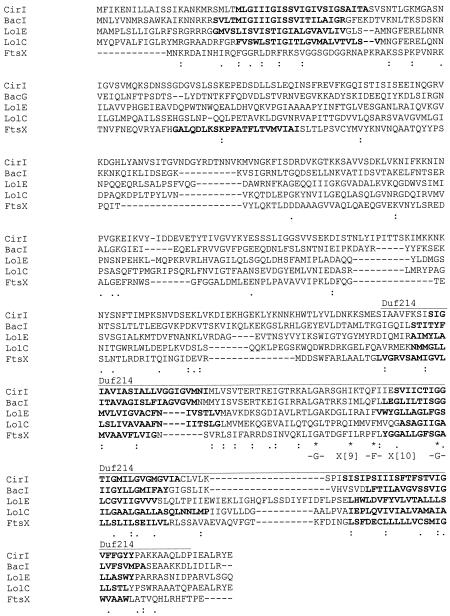
Alignment of CirI with BacG (56), FtsX (6), and LolC and LolE (37). The consensus motif G-X9-F-X10-G for ortholog group 3-1 type ABC transporters is indicated. Predicted transmembrane domains are indicated in bold. The region constituting the predicted DUF214 domain is indicated by a line above the sequences. Identical residues are indicated by an asterisk, whereas colons and periods indicate conserved and semiconserved amino acid substitutions, respectively, according to the ClustalW grouping of amino acids. Gaps were introduced in the sequence to maximize alignment.
FIG. 5.
FIG. 5.
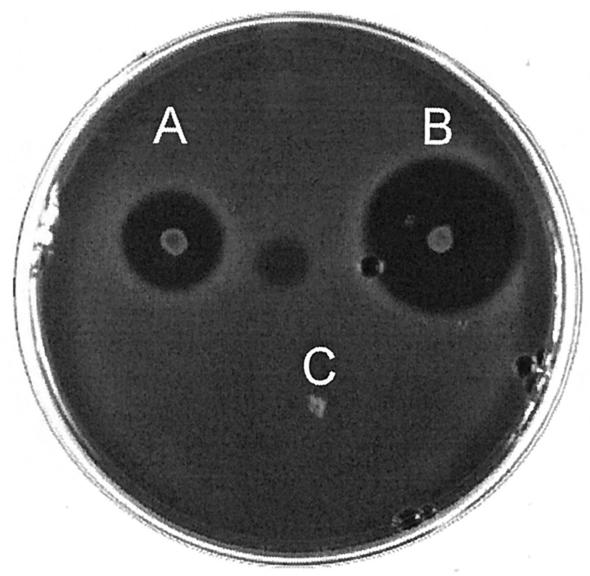
Heterologous production of circularin A by E. faecalis JH2-2, as visualized in a colony overlayer assay with Lactobacillus saké ATCC 15521 as the indicator strain. (A) E. faecalis JH2-2(pMGAE1); (B) E. faecalis JH2-2(pCir); (C) E. faecalis JH2-2(pMG36c).

References

    1. Altschul, S. F., T. L. Madden, A. A. Schaffer, J. Zhang, Z. Zhang, W. Miller, and D. J. Lipman. 1997. Gapped BLAST and PSI-BLAST: a new generation of protein database search programs. Nucleic Acids Res. 25:3389-3402. - PMC - PubMed
    1. Bateman, A., E. Birney, L. Cerruti, R. Durbin, L. Etwiller, S. R. Eddy, S. Griffiths-Jones, K. L. Howe, M. Marshall, and E. L. Sonnhammer. 2002. The Pfam protein families database. Nucleic Acids Res. 30:276-280. - PMC - PubMed
    1. Birnboim, H. C., and J. Doly. 1979. A rapid alkaline extraction procedure for screening recombinant plasmid DNA. Nucleic Acids Res. 7:1513-1523. - PMC - PubMed
    1. Blond, A., J. Peduzzi, C. Goulard, M. J. Chiuchiolo, M. Barthelemy, Y. Prigent, R. A. Salomon, R. N. Farias, F. Moreno, and S. Rebuffat. 1999. The cyclic structure of microcin J25, a 21-residue peptide antibiotic from Escherichia coli. Eur. J. Biochem. 259:747-755. - PubMed
    1. Cintas, L. M., P. Casaus, L. S. Håvarstein, P. E. Hernandez, and I. F. Nes. 1997. Biochemical and genetic characterization of enterocin P, a novel sec-dependent bacteriocin from Enterococcus faecium P13 with a broad antimicrobial spectrum. Appl. Environ. Microbiol. 63:4321-4330. - PMC - PubMed

Publication types

MeSH terms

Associated data

LinkOut - more resources