


doi: 10.1128/AEM.69.10.6302-6306.2003.
Application of host-specific bacteriophages to the surface of chicken skin leads to a reduction in recovery of Campylobacter jejuni
Affiliations
- PMID: 14532096
- PMCID: PMC201188
- DOI: 10.1128/AEM.69.10.6302-6306.2003
Item in Clipboard
Application of host-specific bacteriophages to the surface of chicken skin leads to a reduction in recovery of Campylobacter jejuni
Appl Environ Microbiol.
2003 Oct.
Abstract
Retail poultry products are widely purported as the major infection vehicle for human campylobacteriosis. Numerous intervention strategies have sought to reduce Campylobacter contamination on broiler carcasses in the abattoir. This study reports the efficacy of bacteriophage in reducing the number of recoverable Campylobacter jejuni cells on artificially contaminated chicken skin.
Figures
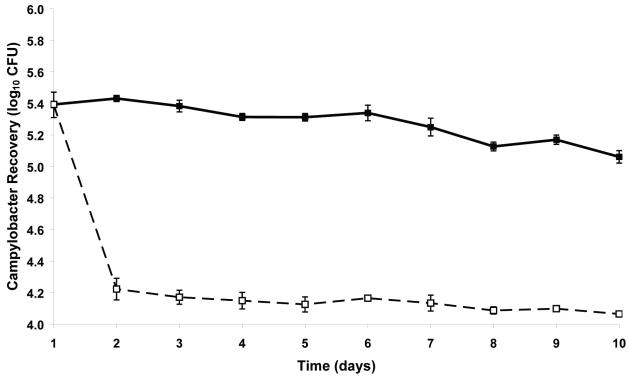
Graph showing the recovery of C. jejuni NCTC 12662 from the surface of chicken skin inoculated with 106 CFU and stored at 4°C (▪) and −20°C (□) over a 10-day period. Recovery is presented as the mean log10 CFU ± standard deviation.
References
-
- Berndtson, E., M. L. Danielsson-Tham, and A. Engvall. 1996. Campylobacter incidence on a chicken farm and the spread of Campylobacter during the slaughter process. Int J. Food Microbiol. 32:35-47. - PubMed
-
- Berndtson, E., M. Tivemo, and A. Engvall. 1992. Distribution and numbers of Campylobacter in newly slaughtered broiler chickens and hens. Int J. Food Microbiol. 15:45-50. - PubMed
-
- Berrang, M. E., R. J. Buhr, and J. A. Cason. 2000. Campylobacter recovery from external and internal organs of commercial broiler carcass prior to scalding. Poult. Sci. 79:286-290. - PubMed
-
- Berrang, M. E., S. R. Ladely, and R. J. Buhr. 2001. Presence and level of Campylobacter, coliforms, Escherichia coli, and total aerobic bacteria recovered from broiler parts with and without skin. J. Food Prot. 64:184-188. - PubMed
Publication types
MeSH terms
LinkOut - more resources
Full Text Sources
Molecular Biology Databases
