


Etiology of acute diarrhea in adults in southwestern Nigeria
- PMID: 14532177
- PMCID: PMC254369
- DOI: 10.1128/JCM.41.10.4525-4530.2003
Etiology of acute diarrhea in adults in southwestern Nigeria
Abstract
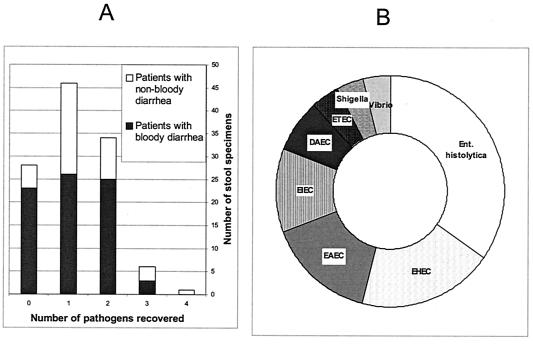
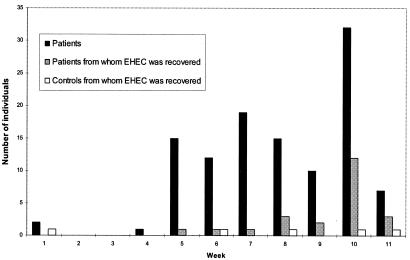
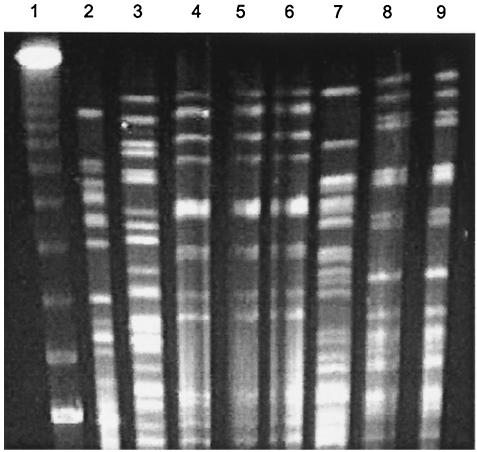
Stool specimens from 113 adult outpatients with diarrhea in southwestern Nigeria and 63 controls were examined for bacterial and parasitic enteric pathogens. Enterohemorrhagic Escherichia coli (EHEC) (P < 0.02), enteroaggregative E. coli (EAEC) (P < 0.02), and Entamoeba histolytica (P < 0.0002) were significantly associated with diarrhea. Salmonella, Shigella, nontoxigenic Vibrio cholerae, other categories of diarrheagenic E. coli, as well as a variety of helminths were recovered more frequently from the stools of patients than from the stools of controls but did not show a significant association with disease. Multiple pathogens were recovered from 36.3% of specimens, and bloody diarrhea was commonly associated with E. histolytica and diarrheagenic E. coli infections. The majority of EHEC isolates were non-O157 strains that carried the stx(2) gene. Of the 23 EHEC-infected patients, 12 (52.2%) presented during the 10th week of the study. EHEC strains isolated within this cluster were more likely to hybridize with the enterohemolysin gene probe, to be nonmotile and sorbitol positive, and to fail to agglutinate O157 antisera. Pulsed-field gel electrophoresis demonstrated that the only strains with XbaI profiles that occurred more than once were isolated during the 10th and 11th weeks of the study, suggesting an outbreak. The study has demonstrated that E. histolytica, EHEC, and EAEC are important diarrheal pathogens within the study area and that sporadic and epidemic EHEC infections occur in developing as well as developed countries. Routine surveillance for diarrheagenic E. coli, even only at the tertiary-care level, would be useful in identifying outbreaks and assist in identifying environmental reservoirs and transmission routes.
Figures
Comment in
-
Etiology of acute diarrhea in adults in southwestern Nigeria.J Clin Microbiol. 2004 Aug;42(8):3909; author reply 3909-10. doi: 10.1128/JCM.42.8.3909-3910.2004. J Clin Microbiol. 2004. PMID: 15297567 Free PMC article. No abstract available.
References
-
- Akinyemi, K. O., A. O. Oyefolu, B. Opere, V. A. Otunba-Payne, and A. O. Oworu. 1998. Escherichia coli in patients with acute gastroenteritis in Lagos, Nigeria. East Afr. Med. J. 75:512-515. - PubMed
-
- Armitage, P., and G. Berry. 1987. Statistical methods in medical research. Blackwell Scientific Publications, Oxford, United Kingdom.
-
- Barrow, G., and R. Feltham. 1993. Cowan and Steel's manual for the identification of medical bacteria, 3rd ed. Cambridge University Press, Cambridge, United Kingdom.
-
- Baudry, B., S. J. Savarino, P. Vial, J. B. Kaper, and M. M. Levine. 1990. A sensitive and specific DNA probe to identify enteroaggregative Escherichia coli, a recently discovered diarrheal pathogen. J. Infect. Dis. 161:1249-1251. - PubMed
Publication types
MeSH terms
Grants and funding
LinkOut - more resources
Full Text Sources
Medical
