


Evaluation of protocol using gene capture and PCR for detection of Helicobacter pylori DNA in feces
- PMID: 14532187
- PMCID: PMC254295
- DOI: 10.1128/JCM.41.10.4589-4593.2003
Evaluation of protocol using gene capture and PCR for detection of Helicobacter pylori DNA in feces
Abstract
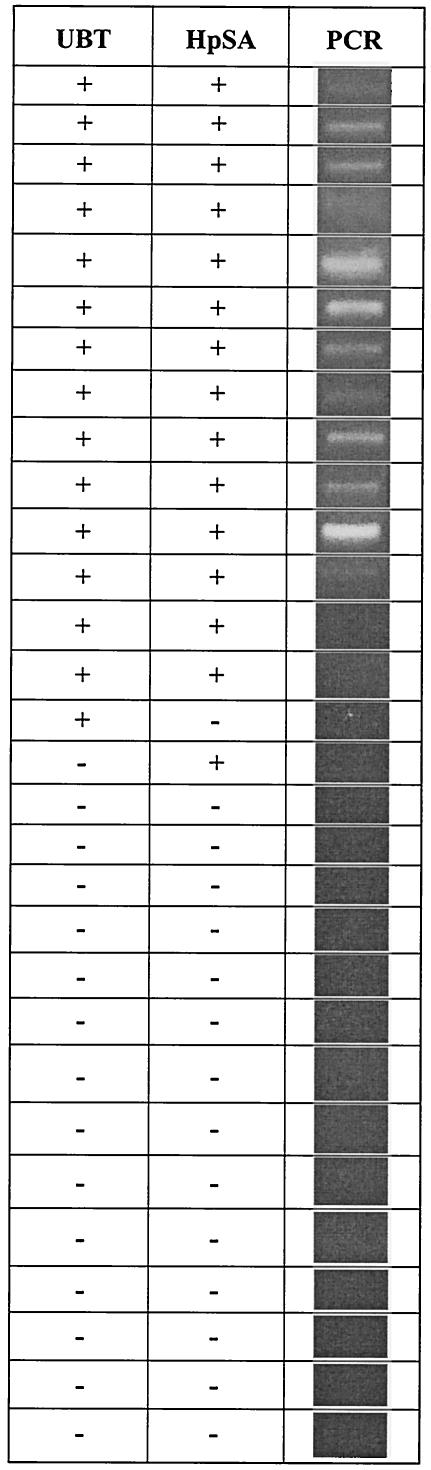
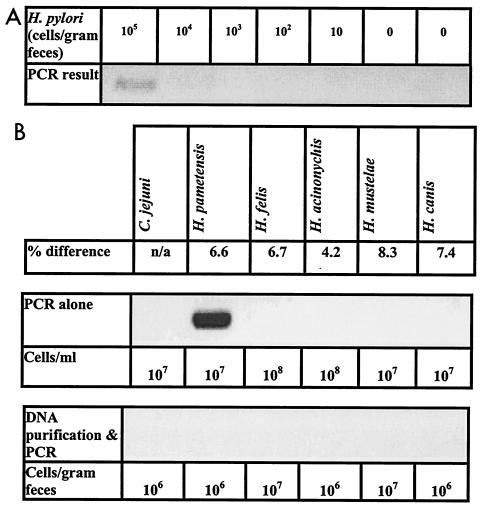
The route of transmission of Helicobacter pylori, which is usually acquired in childhood and is one of the most common bacterial infections in humans, remains undetermined. Mapping the distribution of H. pylori genotypes within families could help to determine the routes of transmission and risk factors. Here we describe a noninvasive method for obtaining H. pylori DNA isolates from the feces of children. Children presenting with gastrointestinal symptoms at the Royal Hospital for Sick Children were tested for gastric H. pylori colonization by using the 13C-urea breath test (UBT) and were asked to provide fecal samples, which were tested for H. pylori by using the HpSA fecal antigen test. DNA was purified from fecal samples by using a novel method of gene capture with subsequent H. pylori PCR analysis. Fifteen UBT-positive and 15 UBT-negative children participated in the study. The positive and negative predictive values for the assay were 80 and 100%, respectively. Fecal DNA purification followed by H. pylori PCR analysis is an effective tool for harvesting H. pylori DNA isolates from the feces of children. This technique may be developed to allow the diagnosis and noninvasive genotyping of H. pylori in children and their families.
Figures
References
-
- Cavallini, A., P. Notarnicola, P. Berloco, A. Lippolis, and A. Di Leo. 2000. Use of macroporous polypropylene filter to allow identification of bacteria by PCR in human fecal samples. J. Microbiol. Methods 39:265-270. - PubMed
-
- Colding, H., S. H. Hartzen, H. Roshanisefat, L. P. Andersen, and K. A. Krogfelt. 1999. Molecular methods for typing of Helicobacter pylori and their applications. FEMS Immunol. Med. Microbiol. 24:193-199. - PubMed
-
- Drumm, B., G. I. Perez-Perez, M. J. Blaser, and P. M. Sherman. 1990. Intrafamilial clustering of Helicobacter pylori infection. N. Engl. J. Med. 322:359-363. - PubMed
-
- Eurogast Study Group. 1993. An international association between Helicobacter pylori infection and gastric cancer. Lancet 341:1359-1362. - PubMed
-
- Finn, L. S., and D. L. J. Christie. 2001. Helicobacter pylori and Meckel's diverticula. J. Pediatr. Gastroenterol. Nutr. 32:150-155. - PubMed
Publication types
MeSH terms
Substances
LinkOut - more resources
Full Text Sources
Medical
