. 2003 Oct;41(10):4767-78.
doi: 10.1128/JCM.41.10.4767-4778.2003.

Species diversity and polymorphism in the Exophiala spinifera clade containing opportunistic black yeast-like fungi

Affiliations

Species diversity and polymorphism in the Exophiala spinifera clade containing opportunistic black yeast-like fungi

G S de Hoog et al. J Clin Microbiol. 2003 Oct.

Abstract

A monophyletic group of black yeast-like fungi containing opportunistic pathogens around Exophiala spinifera is analyzed using sequences of the small-subunit (SSU) and internal transcribed spacer (ITS) domains of ribosomal DNA. The group contains yeast-like and annellidic species (anamorph genus Exophiala) in addition to sympodial taxa (anamorph genera Ramichloridium and Rhinocladiella). The new species Exophiala oligosperma, Ramichloridium basitonum, and Rhinocladiella similis are introduced and compared with their morphologically similar counterparts at larger phylogenetic distances outside the E. spinifera clade. Exophiala jeanselmei is redefined. New combinations are proposed in EXOPHIALA: Exophiala exophialae for Phaeococcomyces exophialae and Exophiala heteromorpha for E. jeanselmei var. heteromorpha.


Figures
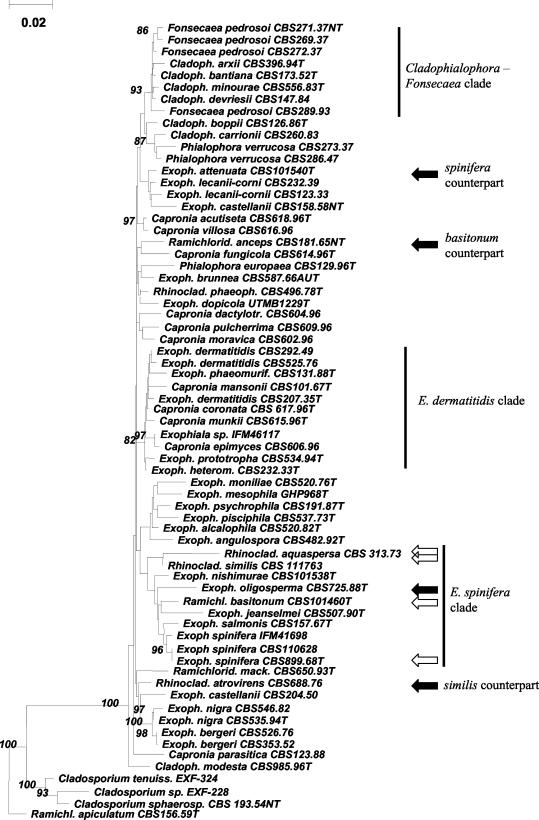
FIG. 1.
FIG. 1.
Phylogenetic tree of SSU rDNAs of 71 members of the black yeasts and relatives, constructed with the neighbor-joining algorithm in the Treecon package with Kimura-2 correction and 100 bootstrap replicates (values of >80 are shown with the branches). R. apiculatum CBS 156.59, known to be related to Cladosporium, is taken as the outgroup. The E. dermatitidis, Cladophialophora-Fonsecaea, and E. spinifera clades are shown. The open and solid arrows indicate new species and their morphologically similar but phylogenetically remote counterparts. Cladoph., Cladophialophora; Exoph., Exophiala; Ram., Ramichloridium; Rhinoclad., Rhinocladiella. The nomenclature used is according to our conclusions (see Table 1).
FIG. 2.
FIG. 2.
Phylogenetic tree of ITS rDNAs of 42 strains belonging to the E. spinifera clade constructed with the neighbor-joining algorithm in the Treecon package with Kimura-2 correction and 100 bootstrap replicates (values of >85 are shown with the branches).
FIG. 3.
FIG. 3.
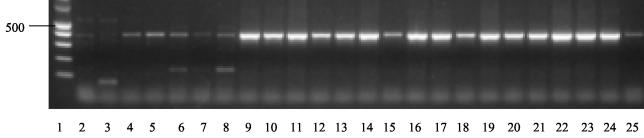
PCR products of strains after using primers selective for E. oligosperma based on ITS sequences. Lanes: 1, size marker; 2 to 5, E. jeanselmei; 2, CBS 507.90; 3, CBS 528.76; 4, CBS 109635; 5, CBS 116.86; 6 to 8, R. similis; 6, DH 11329 = HC1; 7, CBS 109135; 8, DH 12894; 9 to 24, E. oligosperma; 9, CBS 463.80; 10, CBS 835.95; 11, DH 12578; 12, CBS 715.76; 13, DH 12586; 14, CBS 814.95; 15, CBS 725.88; 16, CBS 265.49; 17, DH 12713; 18, IFM 5386; 19, UTHSC 98-911; 20, DH 11646; 21, DH 12589; 22, DH 12587; 23, DH 12585; 24, DH 12896; 25, negative control.
FIG. 4.
FIG. 4.
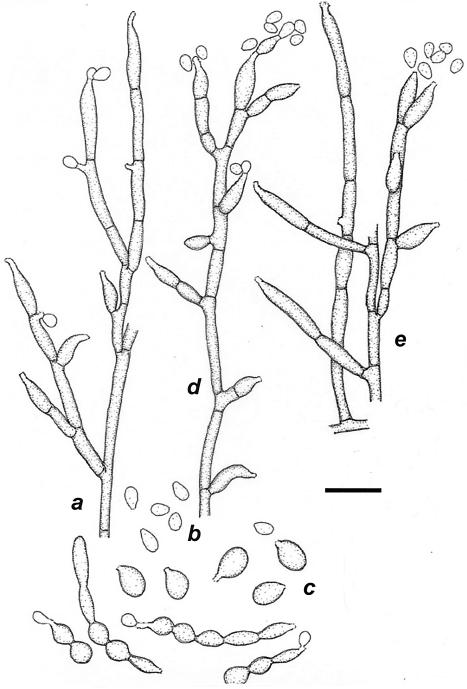
E. oligosperma CBS 245.49 (shown are the conidial apparatus [a and e], conidia [b], and germinating cells [c]) and E. jeanselmei UTMB 2670 (shown is the immature conidial apparatus [d]). Bar = 10 μm.
FIG. 5.
FIG. 5.
E. jeanselmei CBS 507.90. Shown are characteristic rocket-shaped conidiogenous cells on a mature thallus. Bar = 10 μm.
FIG. 6.
FIG. 6.
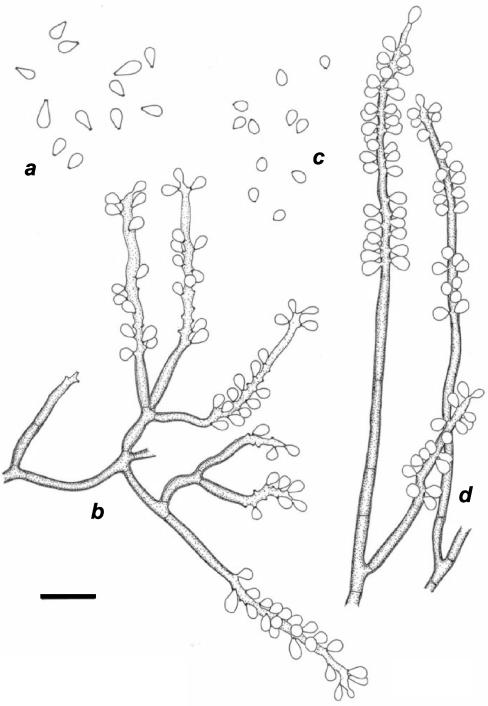
(a and b) R. basitonum CBS 101460. Shown are the conidia (a) and conidial apparatus (b). (c and d) R. anceps CBS 181.65. Shown are the conidia (c) and conidial apparatus (d). Bar = 10 μm.
FIG. 7.
FIG. 7.
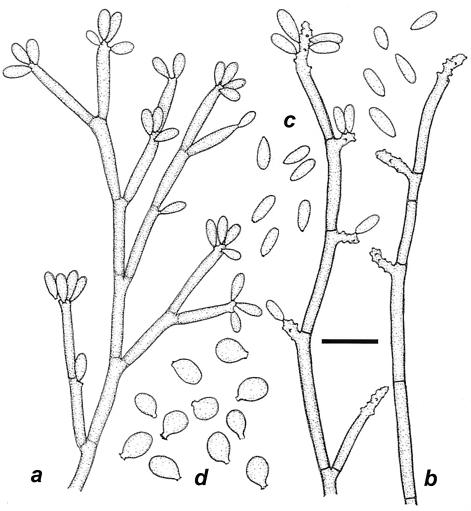
R. similis CBS 111763. (a) Immature conidial apparatus; (b) differentiated conidiogenous cells with sympodial conidia; (c) conidia; (d) germinating cells with annellated zones. Bar = 10 μm.

References

    1. Borelli, D. 1972. Acrotheca aquaspersa nova species agente de Cromomicosis. Acta Cient. Venez. 23:193-196. - PubMed
    1. Bossler, A. D., S. S. Richter, A. J. Chavez, S. A. Vogelgesang, D. A. Sutton, A. M. Grooters, M. G. Rinaldi, G. S. de Hoog, and M. A. Pfaller. 2003. Exophiala oligosperma causing olecranon bursitis. J. Clin. Microbiol. 4779-4782. - PMC - PubMed
    1. Calendron, A. 1953. Melanchlenus eumetabolus n. sp. Rev. Mycol. Suppl. Colon. 17:190-196.
    1. Calendron, A. 1953. Multiconjugaisons chez les champignons levuriformes à pigment noir. C. R. Acad. Sci. 236:1598-1600. - PubMed
    1. Calendron, A. 1953-1954. Étude bibliographique des champignons levuriformes à pigment noir. Ann. École Nat. Agric. Rennes 15:76-87.

LinkOut - more resources