. 2003 Oct 8;23(27):9116-22.
doi: 10.1523/JNEUROSCI.23-27-09116.2003.

Impaired long-term memory and NR2A-type NMDA receptor-dependent synaptic plasticity in mice lacking c-Fos in the CNS

Affiliations

Impaired long-term memory and NR2A-type NMDA receptor-dependent synaptic plasticity in mice lacking c-Fos in the CNS

Alexander Fleischmann et al. J Neurosci. .

Abstract

The immediate early gene c-fos is part of the activator protein-1 transcription factor and has been postulated to participate in the molecular mechanisms of learning and memory. To test this hypothesis in vivo, we generated mice with a nervous system-specific c-fos knock-out using the Cre-loxP system. Adult mice lacking c-Fos in the CNS (c-fosDeltaCNS) showed normal general and emotional behavior but were specifically impaired in hippocampus-dependent spatial and associative learning tasks. These learning deficits correlated with a reduction of long-term potentiation (LTP) in hippocampal CA3-CA1 synapses. The magnitude of LTP was restored by a repeated tetanization procedure, suggesting impaired LTP induction in c-fosDeltaCNS mice. This rescue was blocked by a selective inhibitor of NR2B-type NMDA receptors. This blockade was compensated in wild-type mice by NR2A-type NMDA receptor-activated signaling pathways, thus indicating that these pathways are compromised in c-fosDeltaCNS mice. In summary, our data suggest a role for c-Fos in hippocampus-dependent learning and memory as well as in NMDA receptor-dependent LTP formation.


Figures
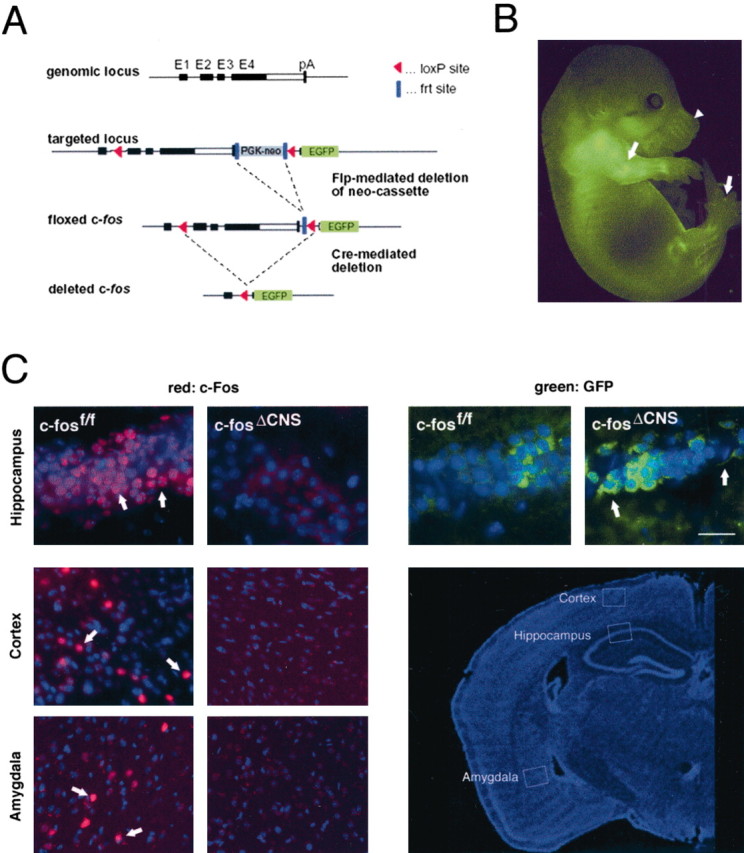
Figure 1.
Figure 1.
Generation of mice deficient for c-fos in the nervous system. A, Targeting strategy: structure of the wild-type c-fos locus, the targeted locus after recombination in embryonic stem cells, and the floxed allele after Flp-mediated deletion of the PGKneo cassette. Cre expression results in deletion of exons 2-4 and expression of the EGFP gene under the control of the c-fos promoter. Exons (E1-E4) are in boxes, coding areas are in black, and pA indicates the transcriptional stop of the c-fos gene. B, Developmental expression (E14.5) of the EGFP reporter in heterozygous c-fosΔ/+ mice. Arrows indicate expression in bones and between the digits; arrowhead indicates expression in the hair follicles of the whiskers. C, Immunohistochemical analysis of c-Fos expression in the hippocampus, cortex, and amygdala of c-fosf/f and c-fosΔCNS mice (left). After intraperitoneal kainic acid injection, violet rhodamine staining shows nuclear c-Fos expression in c-fosf/f but not in c-fosΔCNS mice. In contrast, green FITC labeling revealed cytoplasmic EGFP expression in c-fosΔCNS but not in c-fosf/f mice (right). The white rectangles in the low-magnification image (bottom right) indicate the areas selected for immunohistochemistry. Scale bar, 50 μm.
Figure 2.
Figure 2.
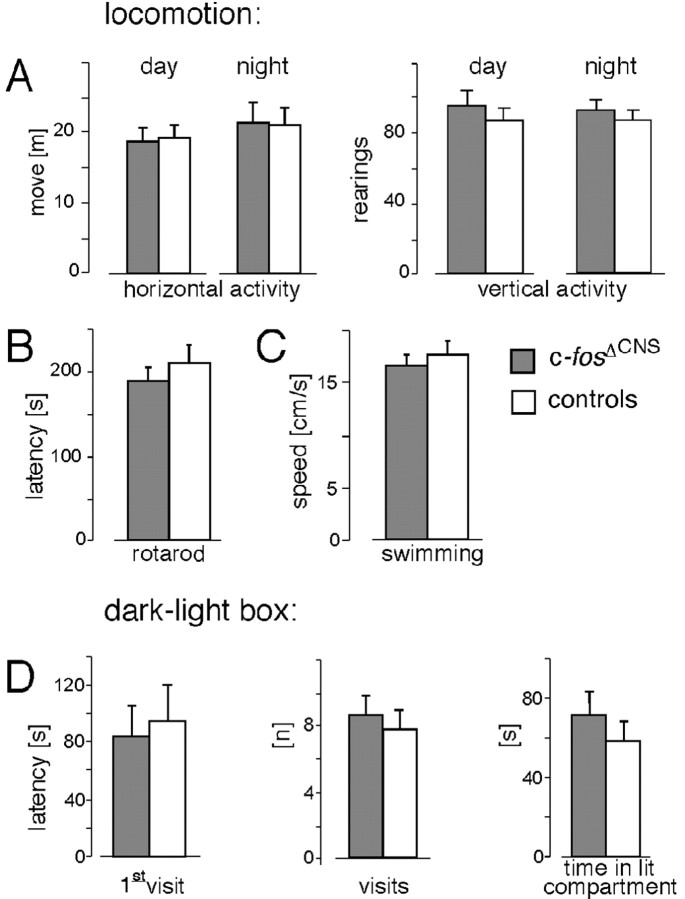
Normal locomotion, motor skills, and anxiety-related behaviors in c-fosΔCNS mice. A, In locomotor activity boxes, c-fosΔCNS mice demonstrate horizontal and vertical locomotor activity similar to that seen for control littermates during the day and night. B, On the rotarod test, c-fosΔCNS mice and controls show the same retention time. C, The Morris water maze reveals no difference between c-fosΔCNS and control mice in swimming speed. D, In the dark-light box test, c-fosΔCNS mice and control littermates have similar latencies to visit the anxiety-related light compartment, similar numbers of visits to this compartment, and similar time spent therein.
Figure 3.
Figure 3.
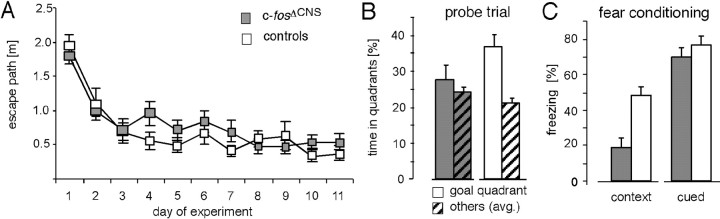
c-fosΔCNS mice show deficits in spatial learning and in context-dependent fear conditioning. A, No differences between c-fosΔCNS and control mice (p = 0.846) are found in analyses of swim path lengths needed to localize the platform during daily training. B, In contrast, a group comparison of probe trials by repeated two-way ANOVA exhibits a difference between c-fos mutants and controls (p < 0.05). The probe trial on day 12 demonstrates that control mice search specifically in the former goal quadrant (36% of time; chance level, 25%; p < 0.01), whereas c-fosΔCNS mice search randomly for the platform (avg., average). C, The freezing response on a contextual fear conditioning test 24 hr after training is significantly reduced in c-fosΔCNS mice (18 vs 47% in controls; p < 0.01). In cued (tone) conditioning, however, c-fosΔCNS mice and control littermates have similar scores (70 vs 77%; not significant).
Figure 4.
Figure 4.
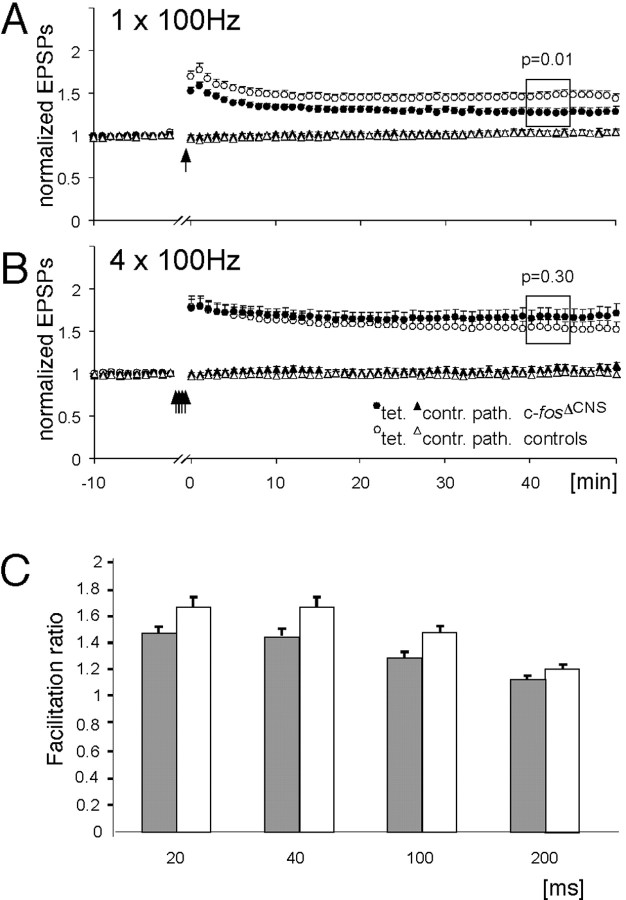
Long-term potentiation is impaired in c-fosΔCNS mice. A, Summary graph of extracellular EPSP slopes in c-fosΔCNS mice (filled symbols) and control littermates (open symbols) when a single tetanization was used to induce LTP. The circles represent the tetanized pathway (tet.), and the triangles represent the untetanized control pathway (contr. path.). LTP in slices from c-fosΔCNS mice (tetanized pathway, 1.27 ± 0.05; control pathway, 1.04 ± 0.02; n = 25) is significantly reduced (p = 0.01) when compared with LTP in control mice (tetanized pathway, 1.46 ± 0.05; control pathway, 1.03 ± 0.02; n = 23). The arrow indicates the time point of tetanic stimulation. Error bars represent SEM. B, As in A; however, data are from experiments in which a 4× tetanization paradigm was used. The period between the first and the fourth tetanization (15 min) has been removed. The amount of LTP is comparable in the two genotypes (c-fosΔCNS mice, 1.67 ± 0.09, n = 16; control littermates, 1.54 ± 0.08, n = 16). C, Mean paired-pulse ratios for c-fosΔCNS (filled columns) and wild-type (open columns) mice at four interstimulus intervals (20, 50, 100, and 200 msec). At all four intervals, a slight reduction of paired-pulse facilitation is present in c-fosΔCNS mice (p < 0.05, respectively). Error bars indicate SEM.
Figure 5.
Figure 5.
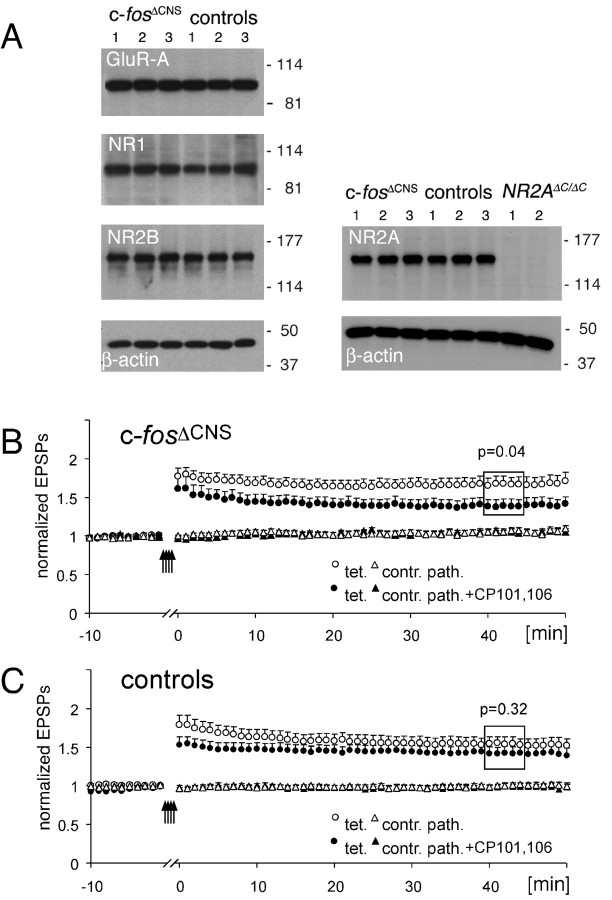
Restoration of LTP induction in c-fosΔCNS mice depends on NR2B-type NMDA receptors. A, Western blot experiments with hippocampal protein extracts demonstrate regular expression levels of the NMDA receptor subunits NR1, NR2A, and NR2B, as well as of the AMPA receptor subunit GluRA. Protein extracts from three different c-fosΔCNS and three control mice were analyzed, respectively. Extracts from NR2AΔC/ΔC mice, which lack the C-terminal epitope recognized by the NR2A antibody, served as a control for the specificity of the antibody reaction. Molecular masses are indicated in kilodaltons on the right, and β-actin levels show that similar amounts of total protein were used. B, Summary graph of extracellular EPSP slopes in c-fosΔCNS mice in the presence (filled symbols) and absence (open symbols) of the NR2B blocker CP-101,606 (10 μm). The circles represent the tetanized pathway (tet.), and the triangles represent the untetanized control pathway (contr. path.). A 4× tetanization procedure was used to induce LTP. The magnitude of LTP is reduced in the presence of CP-101,606 (tetanized pathway with CP-101,606, 1.39 ± 0.09, n = 11; tetanized pathway without CP-101,606, 1.67 ± 0.09, n = 16; p = 0.04). Error bars represent SEM. Arrows indicate time points of tetanic stimulation. The period between the first and the fourth tetanization (15 min) has been removed. C, As in A; however, from control animals. The magnitude of LTP in control animals is unchanged in the presence of CP-101,606 (tetanized pathway with CP-101,606, 1.42 ± 0.08, n = 15; tetanized pathway without CP-101,606, 1.54 ± 0.08, n = 16; p = 0.32).

References

    1. Andersen P ( 1960) Interhippocampal impulses. II. Apical dendritic activation of CA1 neurons. Acta Physiol Scand 48: 178-208. - PubMed
    1. Bannerman DM, Good MA, Butcher SP, Ramsay M, Morris RG ( 1995) Distinct components of spatial learning revealed by prior training and NMDA receptor blockade. Nature 378: 182-186. - PubMed
    1. Chiu R, Boyle WJ, Meek J, Smeal T, Hunter T, Karin M ( 1988) The c-Fos protein interacts with c-Jun/AP-1 to stimulate transcription of AP-1 responsive genes. Cell 54: 541-552. - PubMed
    1. Dymecki SM ( 1996) Flp recombinase promotes site-specific DNA recombination in embryonic stem cells and transgenic mice. Proc Natl Acad Sci USA 93: 6191-6196. - PMC - PubMed
    1. Foster TC, McNaughton BL ( 1991) Long-term enhancement of CA1 synaptic transmission is due to increased quantal size, not quantal content. Hippocampus 1: 79-91. - PubMed

Publication types

MeSH terms

Substances