Compliance therapy: a randomised controlled trial in schizophrenia
- PMID: 14551096
- PMCID: PMC214016
- DOI: 10.1136/bmj.327.7419.834
Compliance therapy: a randomised controlled trial in schizophrenia
Abstract
Objective: To evaluate the efficacy of "compliance therapy" for improving adherence to prescribed drug treatment among patients with schizophrenia.
Design: Randomised controlled trial.
Setting: Urban catchment area psychiatric service.
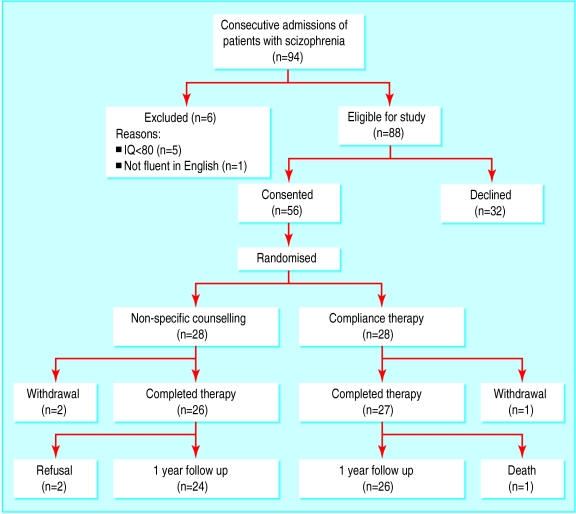
Participants: 94 consecutive admissions of patients with schizophrenia, 56 agreed to participate.
Intervention: Compliance therapy and non-specific counselling, each consisting of 5 sessions lasting 30-60 minutes.
Main outcome measures: Compliance with drug treatment at one year; attitudes to treatment, symptomatology, insight, and quality of life at one year; length of "survival" in the community, bed days, and rehospitalisation rates at two years.
Results: Compliance therapy did not confer a major advantage over non-specific therapy in improving compliance at one year (43% (12/28) v 54% (15/28), difference -11% (95% confidence interval -37% to 15%) or in any of the secondary outcome measures-symptomatology, attitudes to treatment, insight, global assessment of functioning, and quality of life.
Conclusion: Compliance therapy may not be of benefit to patients with schizophrenia. Attitudes to treatment at baseline predicted adherence one year later and may be a clinically useful tool.
Figures
References
-
- Lewis CF, Tandon R, Shipley JE, DeQuardo JR, Jibson M, Taylor SF, et al. Biological predictors of suicidality in schizophrenia. Acta Psychiatr Scand 1996;94: 416-20. - PubMed
-
- Adams SG Jr, Howe JT. Predicting medication compliance in a psychotic population. J Nerv Ment Dis 1993;181: 558-60. - PubMed
-
- Fenton WS, Blyler CR, Heinssen RK. Determinants of medication compliance in schizophrenia: empirical and clinical findings. Schizophr Bull 1997;23: 637-51. - PubMed
-
- Kamali M, Kelly L, Gervin M, Browne S, Larkin C, O'Callaghan E. Psychopharmacology: insight and comorbid substance misuse and medication compliance among patients with schizophrenia. Psychiatr Serv 2001;52: 161-3, 166. - PubMed
Publication types
MeSH terms
LinkOut - more resources
Full Text Sources
Medical