


Multiple, recurring origins of aposematism and diet specialization in poison frogs
- PMID: 14555763
- PMCID: PMC240697
- DOI: 10.1073/pnas.2133521100
Multiple, recurring origins of aposematism and diet specialization in poison frogs
Abstract
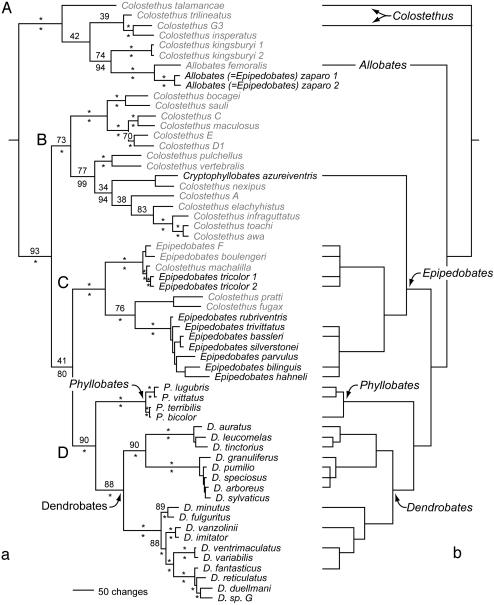
Aposematism is the association, in a prey organism, of the presence of a warning signal with unprofitability to predators. The origin of aposematism is puzzling, because of its predicted low probability of establishment in a population due to the prey's increased conspicuousness. Aposematism is a widespread trait in invertebrate taxa, but, in vertebrates, it is mostly evident in amphibians, reptiles, and fishes. Poison frogs (Dendrobatidae) are one of the most well known examples of the co-occurrence of warning coloration and toxicity. This monophyletic group of mostly diurnal leaf-litter Neotropical anurans has both toxic/colorful and palatable/cryptic species. Previous studies suggested a single origin of toxicity and warning coloration, dividing the family in two discrete groups of primitively cryptic and more derived aposematic frogs. Recent molecular phylogenetic analyses using mostly aposematic taxa supported this conclusion and proposed a single tandem origin of toxicity and conspicuous warning coloration. By using expanded taxon and character sampling, we reexamined the phylogenetic correlation between the origins of toxicity and warning coloration. At least four or five independent origins of aposematism have occurred within poison frogs; by using simulations, we rejected hypotheses of one, two, or three origins of aposematism (P < 0.002). We also found that diet specialization is linked with the evolution of aposematism. Specialization on prey, such as ants and termites, may have evolved independently at least two times.
Figures

Comment in
-
Convergent evolution of bright coloration and toxicity in frogs.Proc Natl Acad Sci U S A. 2003 Oct 28;100(22):12533-4. doi: 10.1073/pnas.2335928100. Epub 2003 Oct 20. Proc Natl Acad Sci U S A. 2003. PMID: 14569014 Free PMC article. No abstract available.
References
-
- Mallet, J. & Joron, M. (1999) Annu. Rev. Ecol. Syst. 30 201–233.
-
- Yachi, S. & Higashi, M. (1998) Nature 394 882–884.
-
- Komárek, S. (1998) Mimicry, Aposematism, and Related Phenomena in Animals and Plants. Bibliography 1800–1990 (Vesmir, Prague).
-
- Guilford, T. (1988) Am. Nat. 131 7–21.
-
- Lindström, L., Alatalo, R. V., Mappes, J., Riipi, M. & Vertainen, L. (1999) Nature 397 249–251.
Publication types
MeSH terms
Substances
Associated data
- Actions
- Actions
- Actions
- Actions
- Actions
- Actions
- Actions
- Actions
- Actions
- Actions
- Actions
- Actions
- Actions
- Actions
- Actions
- Actions
- Actions
- Actions
- Actions
- Actions
- Actions
- Actions
- Actions
- Actions
- Actions
- Actions
- Actions
- Actions
- Actions
- Actions
- Actions
- Actions
- Actions
- Actions
- Actions
- Actions
- Actions
- Actions
- Actions
- Actions
- Actions
- Actions
- Actions
LinkOut - more resources
Full Text Sources
