. 2003 Nov;122(5):521-39.
doi: 10.1085/jgp.200308885. Epub 2003 Oct 13.

The role of loop 5 in acetylcholine receptor channel gating

Affiliations

The role of loop 5 in acetylcholine receptor channel gating

Sudha Chakrapani et al. J Gen Physiol. 2003 Nov.

Abstract

Nicotinic acetylcholine receptor channel (AChR) gating is an organized sequence of molecular motions that couples a change in the affinity for ligands at the two transmitter binding sites with a change in the ionic conductance of the pore. Loop 5 (L5) is a nine-residue segment (mouse alpha-subunit 92-100) that links the beta4 and beta5 strands of the extracellular domain and that (in the alpha-subunit) contains binding segment A. Based on the structure of the acetylcholine binding protein, we speculate that in AChRs L5 projects from the transmitter binding site toward the membrane along a subunit interface. We used single-channel kinetics to quantify the effects of mutations to alphaD97 and other L5 residues with respect to agonist binding (to both open and closed AChRs), channel gating (for both unliganded and fully-liganded AChRs), and desensitization. Most alphaD97 mutations increase gating (up to 168-fold) but have little or no effect on ligand binding or desensitization. Rate-equilibrium free energy relationship analysis indicates that alphaD97 moves early in the gating reaction, in synchrony with the movement of the transmitter binding site (Phi = 0.93, which implies an open-like character at the transition state). alphaD97 mutations in the two alpha-subunits have unequal energetic consequences for gating, but their contributions are independent. We conclude that the key, underlying functional consequence of alphaD97 perturbations is to increase the unliganded gating equilibrium constant. L5 emerges as an important and early link in the AChR gating reaction which, in the absence of agonist, serves to increase the relative stability of the closed conformation of the protein.


Figures
F<sc>igure</sc> 1.
Figure 1.
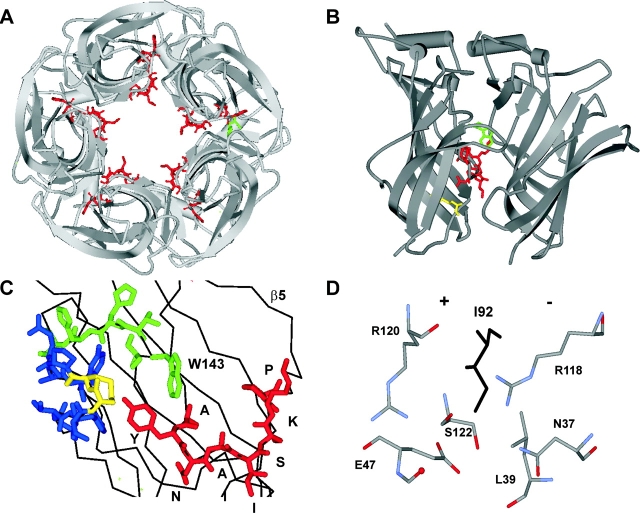
Structure of L5 in AChBP. (A) View along the fivefold axis of symmetry, from the Cys-loop (in AChR, from the membrane). L5 (binding segment A) is red, and W143 at the TBS is green. The apex residue I92 (which aligns with αD97 in AChRs) projects into the lumen. (B) View perpendicular to the fivefold axis of symmetry (“+” side, left). L5 (red) lies at the subunit interface and spans the distance between the TBS (W143, green) and the Cys-loop disulfide (yellow). (C) View of the TBS, from the “−” side. L5 is red (apex residue is I92), L8 (binding segment B) is green, and L10 (binding segment C) is blue (disulfide is yellow). See Table I for sequences. (D) Close up of I92 at a subunit interface. Atoms from three side chains and one backbone carbonyl on the “+” side and three side chains on the “−” side are within 6 Å of the δC of I92 (black).
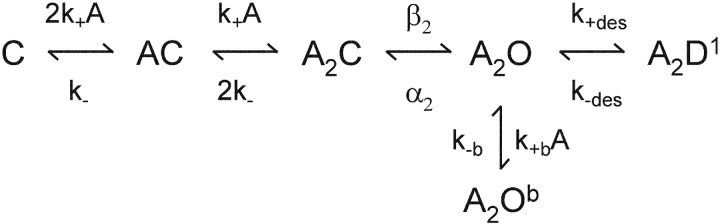
SCHEME I
SCHEME I
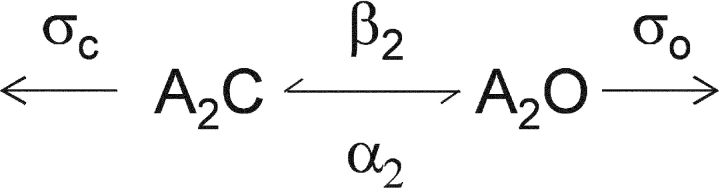
SCHEME II
SCHEME II
F<sc>igure</sc> 2.
Figure 2.
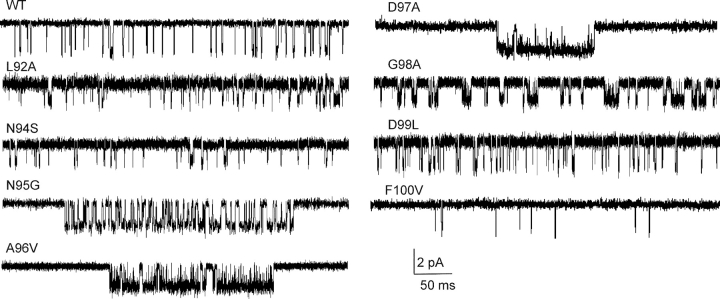
Mutational scan of α-subunit L5 residues. Currents were recorded at 20 mM choline (open is down; filtered at 2 kHz for display). Several mutations in this loop increase the cluster open probability because they increase the diliganded equilibrium gating constant L2. Of the 27 α-subunit L5 mutants that were studied, αD97A caused the largest increase in L2 (168-fold). L5 mutations in the non-α-subunits had no effect on gating.
F<sc>igure</sc> 3.
Figure 3.
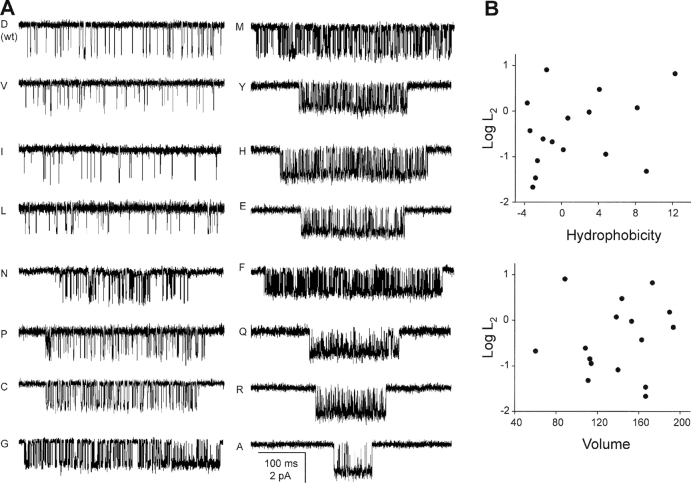
αD97 mutations increase diliganded gating. (A) Example clusters elicited by a saturating concentration (20 mM) of choline. Most mutations increase the cluster Popen, mainly by reducing the closed-interval durations. (B) There is no apparent correlation between side chain hydrophobicity or volume and the effect on the diliganded gating equilibrium constant, L2 (Table II).
F<sc>igure</sc> 4.
Figure 4.
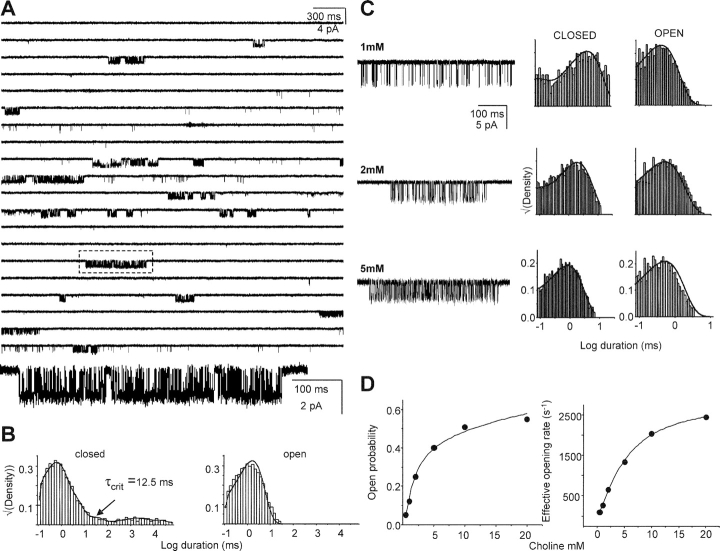
Kinetic analysis of αD97E. (A) Low time-resolution view of currents elicited by 20 mM choline. The openings are clustered (boxed cluster shown on an expanded time scale, below). The single-channel current amplitude is reduced approximately by half because of open-channel blockade by choline. (B) Interval duration histograms for the entire record. Clusters of openings were defined and selected for further kinetic analysis using the indicated value of τcrit. (C) Example clusters and interval duration histograms elicited by different choline concentrations. The solid lines over the histograms are density functions calculated from the rate constants of the model, obtained from a joint fit of a single model to all concentrations, with the association rate constant scaled linearly by the concentration. (Table III). (D) Dose–response analysis. The solid lines are the fits by Eq. 1 and 2. From the Popen data, Kd = 3.2 mM and L2 = 2.9. From the saturation of the effective opening rate data, β2 = 2,875 s−1 (wt values are Kd ≈ 2 mM, L2 = 0.05, and β2 = 100 s−1).
F<sc>igure</sc> 5.
Figure 5.
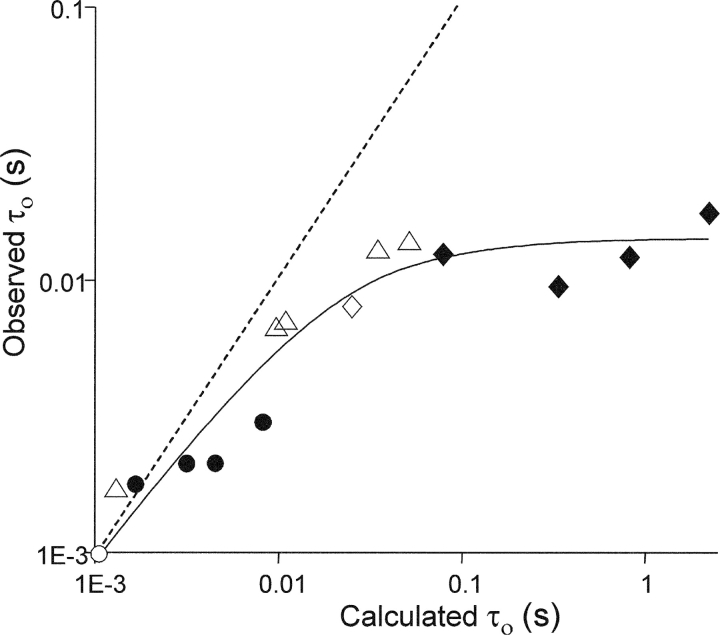
αD97 mutations do not affect agonist dissociation from diliganded-open AChRs. Currents were elicited by 1 μM ACh from AChRs having wt/mutations (open/filled) at α97. Different background mutations were used (○, wt; ⋄, δL265T; Δ, δS268G, C, T, V or N) that had known effects on the gating rate constants (Table IV). The α97 side chains were D (δS268 series and δL265T); N, C, M, Y (wt background); and C, E, Q, A (δL265T background). The x-axis is the burst lifetime (τb) calculated assuming that there is no exit path from the diliganded-open state (Eq. 4), and the y-axis is the experimentally measured value of τb. The points deviate from the dashed line (slope = 1) because of agonist-dissociation and desensitization from diliganded-open AChRs. The solid line is a fit by Eq. 3, with the parameters k-2 = 45,216 ± 15,551 s−1 and σO = 70.3 ± 3.5 s−1.
F<sc>igure</sc> 6.
Figure 6.
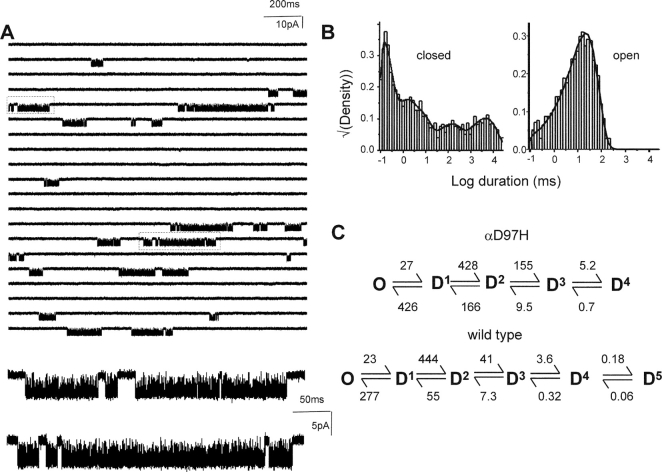
αD97H does not affect desensitization. (A) Low time-resolution view of currents elicited by 100 μM ACh. Below, higher time-resolution view of boxed clusters. (B) Dwell time histograms that pertain to all intervals in the record. The fastest closed-interval component reflects activation and the remaining four components reflect desensitization. (C) The desensitization rate constants were similar to those estimated for wt AChRs (Elenes and Auerbach, 2002; see Table V).
F<sc>igure</sc> 7.
Figure 7.
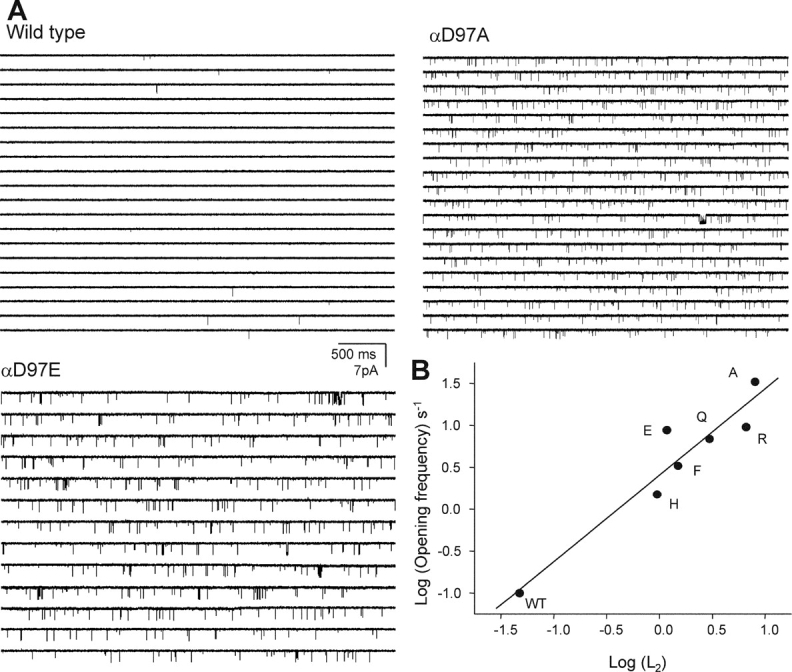
Unliganded gating of αD97 mutants. (A) Spontaneous openings in wild-type, αD97E, and αD97A mutant AChRs. (B) The log of the spontaneous opening frequency (Table VI) is correlated with the log of the diliganded gating equilibrium constant (L2, from Table II) (R = 0.95).
F<sc>igure</sc> 8.
Figure 8.
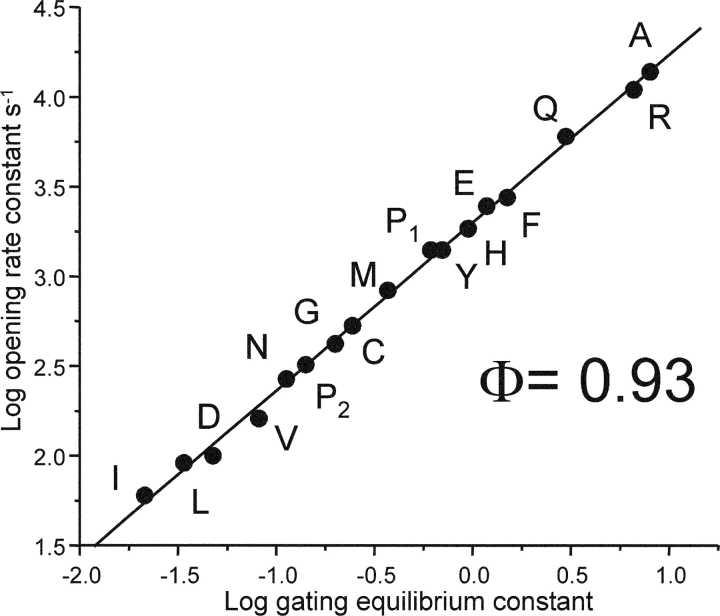
REFER plot for the αD97 mutant series. The Φ-value (the slope) is 0.936 ± 0.012, which is the same as that for the transmitter binding site (Φ = 0.931 ± 0.035). The Φ-value indicates that α97 moves early (relative to the transition state) during channel-opening, in synchrony with the low-to-high affinity change at the transmitter binding site. The subscripts for proline refer to its two kinetic modes.
F<sc>igure</sc> 9.
Figure 9.
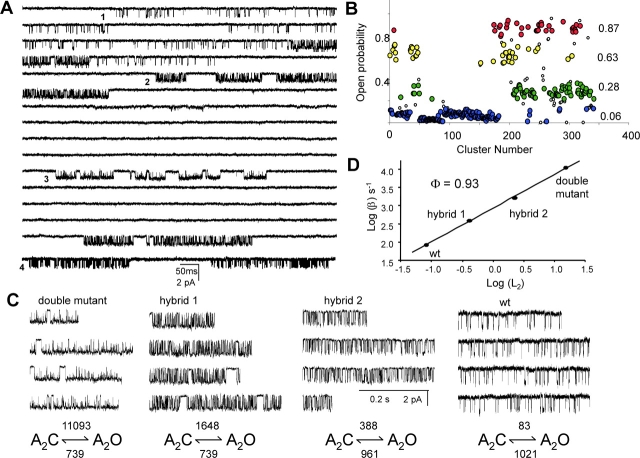
Hybrid αD97A receptors. (A) Single-channel currents elicited by 20 mM choline showing heterogeneous clusters in a cell transfected with both wild-type and αD97A mutant α subunits. Four different types of clusters are apparent (numbered 1–4). The data are continuous except for the bottom trace (which is from the same patch). (B) A plot of cluster open probabilities (Popen) for all the clusters in the patch (τcrit = 50 ms). Four distinct populations are apparent. The highest Popen population corresponds to the double αD97A mutant (red) and the lowest to the wild-type (blue). Clusters from hybrid AChRs (one wild-type α-subunit and one D97A α-subunit) are yellow and green. The open symbols represent clusters that were >1.5 SD from their population means and were not analyzed further. (C) High resolution views of clusters. The diliganded opening and closing rate constants for each type of cluster are shown below (the apparent closing rate constants are reduced ∼2-fold because of channel block by choline). ΔΔG0 values (kcal mol−1) for channel gating, computed as 0.59 ln(L2 wt/L2 mut), are: 3.09 (double mutant), 1.96 (hybrid 1), 0.95 (hybrid 2). The ΔΔG0 values for the two hybrids are different, which indicates that the residue contributes unequally toward gating at the α–δ and α–ɛ subunit interfaces. The sum of ΔΔG0 values of the two hybrids is close to that of the double mutant, which indicates that the two sites contribute independently to the overall gating reaction. (D) REFER analyses for each cluster population. The two α97 residues move synchronously in the gating reaction.
F<sc>igure</sc> 10.
Figure 10.
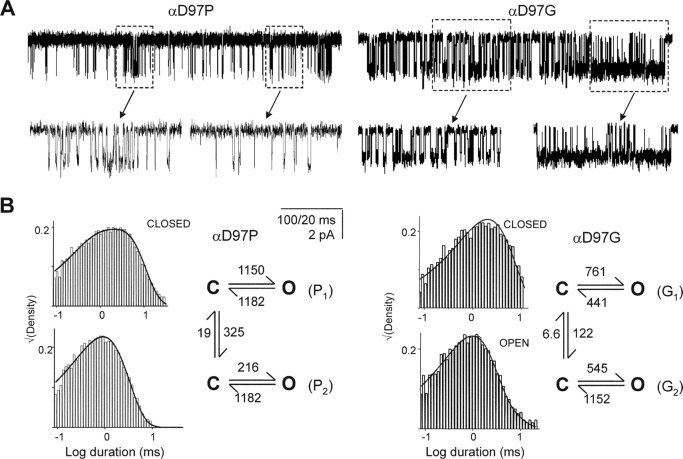
αD97P and αD97G display modal gating kinetics. (A) Example clusters elicted by 20 mM choline. High and low periods of activity (boxed areas) are apparent and are shown at higher resolution, below. (B) Closed and open interval dwell time histograms and superimposed curves calculated from the corresponding models. For αD97P, the closing rate constants were constrained to be equal. For both mutants, the closing rate constants are ∼2-fold slower than the low concentration measurements (Table II) because of unresolved, fast channel block by choline.
F<sc>igure</sc> 11.
Figure 11.
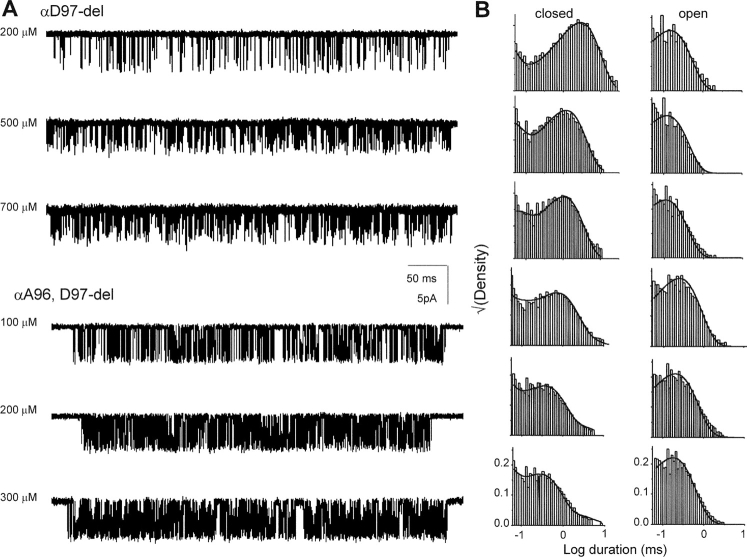
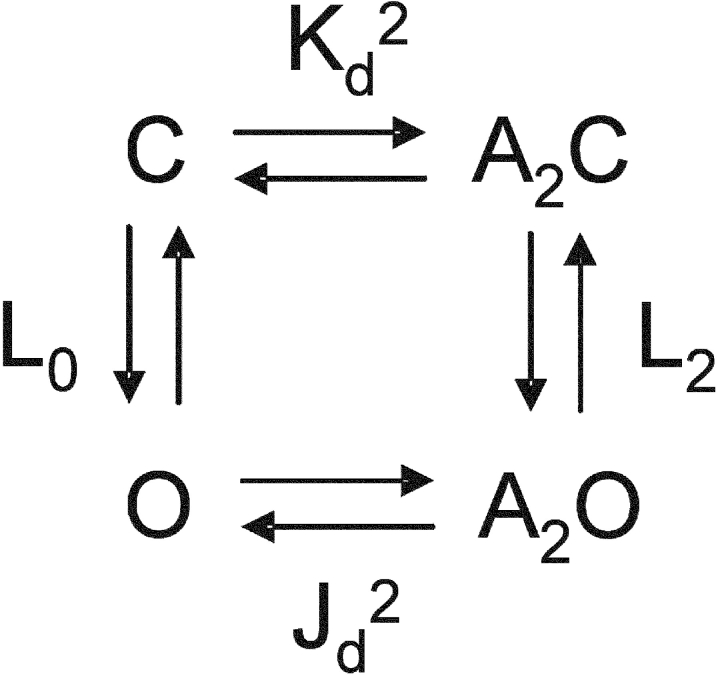
L5 deletion mutants. (A) Single channel currents elicited by various concentrations of ACh. (B) Interval histograms. The solid lines are from the global fit using Scheme I (Table VI).
F<sc>igure</sc> 12.
Figure 12.
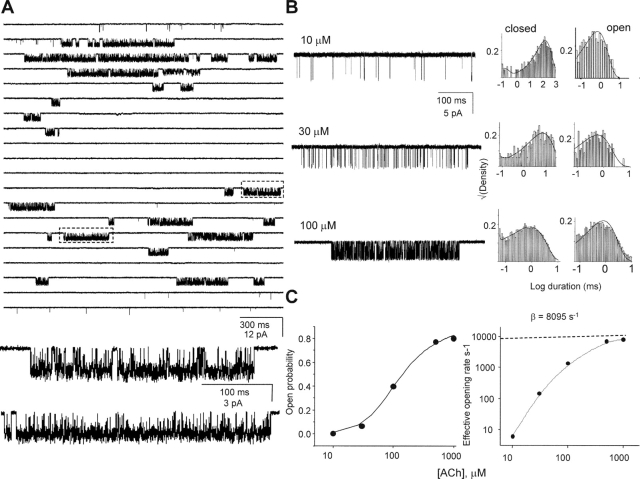
Kinetic analysis of αF100V. (A) A continuous single-channel current trace of αF100V activated by 1 mM ACh. Boxed areas are shown below at higher resolution. (B) Current traces elicited at different concentrations of ACh and the corresponding interval duration histograms. The solid lines are from the global fit using Scheme I (k+ = 7.8 × 10⁷ M−1s−1 and k = 16,845 s−1, corresponding to a KD of 215 μM). (C) Macroscopic dose–response analyses. Left, cluster Popen vs. [ACh]. Solid line is fit by Eq. 2 (L2 = 5.27 ± 0.9 and KD 189 ± 31 μM). Right, effective opening rate vs. [ACh]. The high-concentration limit is an estimate of β2 (8,095 s−1).
SCHEME III
SCHEME III

References

    1. Akk, G. 2001. Aromatics at the murine nicotinic receptor agonist binding site: mutational analysis of the alpha Y93 and alpha W149 residues. J. Physiol. (Lond). 535:729–740. - PMC - PubMed
    1. Akk, G., and A. Auerbach. 1996. Inorganic, monovalent cations compete with agonists for the transmitter binding site of nicotinic acetylcholine receptors. Biophys. J. 70:2652–2658. - PMC - PubMed
    1. Akk, G., S. Sine, and A. Auerbach. 1996. Binding sites contribute unequally to the gating of mouse nicotinic alpha D200N acetylcholine receptors. J. Physiol. 496:185–196. - PMC - PubMed
    1. Akk, G., M. Zhou, and A. Auerbach. 1999. A mutational analysis of the acetylcholine receptor channel transmitter binding site. Biophys. J. 76:207–218. - PMC - PubMed
    1. Auerbach, A., and G. Akk. 1998. Desensitization of mouse nicotinic acetylcholine receptor channels. A two-gate mechanism. J. Gen. Physiol. 112:181–197. - PMC - PubMed

Publication types

Substances