


A pharmacological analysis of an associative learning task: 5-HT(1) to 5-HT(7) receptor subtypes function on a pavlovian/instrumental autoshaped memory
- PMID: 14557609
- PMCID: PMC218002
- DOI: 10.1101/lm.60503
A pharmacological analysis of an associative learning task: 5-HT(1) to 5-HT(7) receptor subtypes function on a pavlovian/instrumental autoshaped memory
Abstract
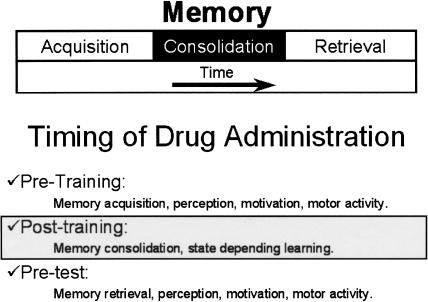
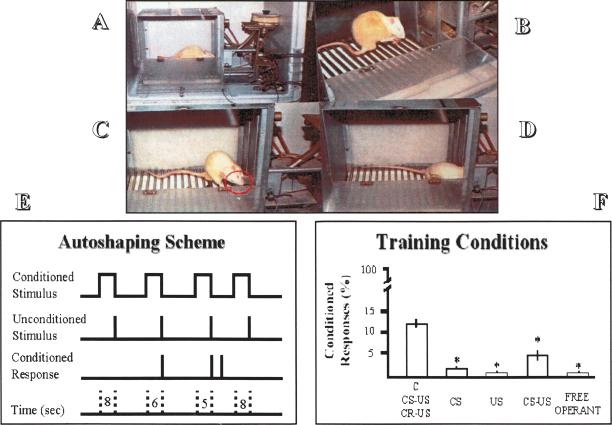
Recent studies using both invertebrates and mammals have revealed that endogenous serotonin (5-hydroxytryptamine [5-HT]) modulates plasticity processes, including learning and memory. However, little is currently known about the mechanisms, loci, or time window of the actions of 5-HT. The aim of this review is to discuss some recent results on the effects of systemic administration of selective agonists and antagonists of 5-HT on associative learning in a Pavlovian/instrumental autoshaping (P/I-A) task in rats. The results indicate that pharmacological manipulation of 5-HT1-7 receptors or 5-HT reuptake sites might modulate memory consolidation, which is consistent with the emerging notion that 5-HT plays a key role in memory formation.
Figures
Similar articles
-
The effects of the 5-HT(6) receptor agonist EMD and the 5-HT(7) receptor agonist AS19 on memory formation.Behav Brain Res. 2008 Dec 16;195(1):112-9. doi: 10.1016/j.bbr.2007.11.023. Epub 2007 Dec 7. Behav Brain Res. 2008. PMID: 18191236
-
Tianeptine: 5-HT uptake sites and 5-HT(1-7) receptors modulate memory formation in an autoshaping Pavlovian/instrumental task.Neurosci Biobehav Rev. 2002 May;26(3):309-19. doi: 10.1016/s0149-7634(02)00005-2. Neurosci Biobehav Rev. 2002. PMID: 12034133 Review.
-
8-OH-DPAT facilitated memory consolidation and increased hippocampal and cortical cAMP production.Behav Brain Res. 2004 Jan 5;148(1-2):179-84. doi: 10.1016/s0166-4328(03)00186-4. Behav Brain Res. 2004. PMID: 14684258
-
Effects of the 5-HT7 receptor antagonists SB-269970 and DR 4004 in autoshaping Pavlovian/instrumental learning task.Behav Brain Res. 2004 Dec 6;155(2):275-82. doi: 10.1016/j.bbr.2004.04.026. Behav Brain Res. 2004. PMID: 15364487
-
Serotonergic regulation of associative learning.Behav Brain Res. 1996;73(1-2):47-50. doi: 10.1016/0166-4328(96)00068-x. Behav Brain Res. 1996. PMID: 8788476 Review.
Cited by
-
5-HT7 receptor activation: procognitive and antiamnesic effects.Psychopharmacology (Berl). 2015 Feb;232(3):595-603. doi: 10.1007/s00213-014-3693-0. Epub 2014 Jul 31. Psychopharmacology (Berl). 2015. PMID: 25074446
-
Cognitive impairment in Chinese traumatic brain injury patients: from challenge to future perspectives.Front Neurosci. 2024 Mar 11;18:1361832. doi: 10.3389/fnins.2024.1361832. eCollection 2024. Front Neurosci. 2024. PMID: 38529265 Free PMC article. Review.
-
Dual roles of dopaminergic pathways in olfactory learning and memory in the oriental fruit fly, Bactrocera dorsalis.Pestic Biochem Physiol. 2024 Mar;200:105825. doi: 10.1016/j.pestbp.2024.105825. Epub 2024 Feb 9. Pestic Biochem Physiol. 2024. PMID: 38582589 Free PMC article.
-
Serotonin-mediated modulation of Na+/K+ pump current in rat hippocampal CA1 pyramidal neurons.BMC Neurosci. 2012 Jan 19;13:10. doi: 10.1186/1471-2202-13-10. BMC Neurosci. 2012. PMID: 22257758 Free PMC article.
-
Copolymer-1 enhances cognitive performance in young adult rats.PLoS One. 2018 Mar 1;13(3):e0192885. doi: 10.1371/journal.pone.0192885. eCollection 2018. PLoS One. 2018. PMID: 29494605 Free PMC article.
References
-
- Adell, A., Celada, P., Abellán, M.T., and Artigas, F. 2002. Origin and functional role of extracellular serotonin in the midbrain raphe nuclei. Brain Res. Rev. 39: 154–180. - PubMed
-
- Ahlander-Luttgen, M., Madjid, N., Schoot, P.A., Sandin, J., and Ogren, S.O. 2003. Analysis of the role of the 5-HT1B receptor in spatial and aversive learning in the rat. Neuropsychopharmacology 28: 1642–1655. - PubMed
-
- Arshavsky, Y.I. 2003. Cellular and network properties in the functioning of the nervous system: From central pattern generators to cognition. Brain Res. Rev. 41: 229–267. - PubMed
-
- Barbas, D., Zappulla, J.P., Angers, S., Bouvier, M., Castellucci, V.F., and DesGroseillers, L. 2002. Functional characterization of a novel serotonin receptor (5-HTap2) expressed in the CNS of Aplysia californica. J. Neurochem. 80: 335–345. - PubMed
Publication types
MeSH terms
Substances
Grants and funding
LinkOut - more resources
Full Text Sources
Other Literature Sources
Medical