. 2003 Nov;77(21):11436-47.
doi: 10.1128/jvi.77.21.11436-11447.2003.

Dengue 2 PDK-53 virus as a chimeric carrier for tetravalent dengue vaccine development

Affiliations

Dengue 2 PDK-53 virus as a chimeric carrier for tetravalent dengue vaccine development

Claire Y-H Huang et al. J Virol. 2003 Nov.

Abstract

Attenuation markers of the candidate dengue 2 (D2) PDK-53 vaccine virus are encoded by mutations that reside outside of the structural gene region of the genome. We engineered nine dengue virus chimeras containing the premembrane (prM) and envelope (E) genes of wild-type D1 16007, D3 16562, or D4 1036 virus within the genetic backgrounds of wild-type D2 16681 virus and the two genetic variants (PDK53-E and PDK53-V) of the D2 PDK-53 vaccine virus. Expression of the heterologous prM-E genes in the genetic backgrounds of the two D2 PDK-53 variants, but not that of wild-type D2 16681 virus, resulted in chimeric viruses that retained PDK-53 characteristic phenotypic markers of attenuation, including small plaque size and temperature sensitivity in LLC-MK(2) cells, limited replication in C6/36 cells, and lack of neurovirulence in newborn ICR mice. Chimeric D2/1, D2/3, and D2/4 viruses replicated efficiently in Vero cells and were immunogenic in AG129 mice. Chimeric D2/1 viruses protected adult AG129 mice against lethal D1 virus challenge. Two tetravalent virus formulations, comprised of either PDK53-E- or PDK53-V-vectored viruses, elicited neutralizing antibody titers in mice against all four dengue serotypes. These antibody titers were similar to the titers elicited by monovalent immunizations, suggesting that viral interference did not occur in recipients of the tetravalent formulations. The results of this study demonstrate that the unique attenuation loci of D2 PDK-53 virus make it an attractive vector for the development of live attenuated flavivirus vaccines.


Figures
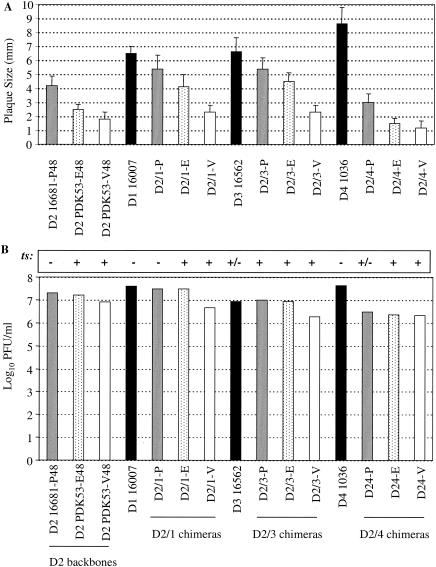
FIG. 1.
FIG. 1.
Growth characteristics of chimeras in LLC-MK2 cells. (A) Mean (± standard deviation) plaque diameters. Values were calculated from 10 individual plaques of each virus on day 10 after infection. (B) Temperature sensitivity (ts) and peak titers of viruses on day 6, 8, or 10 after infection. The ts scores were based on the reduction of the virus titers at 38.7°C versus the titers at 37°C (+ indicates titer reduction of 90% or greater at 38.7°C; +/− indicates reduction in the range that crosses the 90% cutting point from multiple experiments). The graph bar heights represent the log10 titers of the viruses at 37°C. The MOI was approximately 0.001 PFU/cell. Gray bars, D2 16681-P48 virus and chimeras containing that background; stippled bars, viruses containing the D2 PDK53-E48 background; white bars, D2 PDK53-V48 virus and chimeras with that background; black bars, wild-type D1, D3, and D4 viruses.
FIG. 2.
FIG. 2.
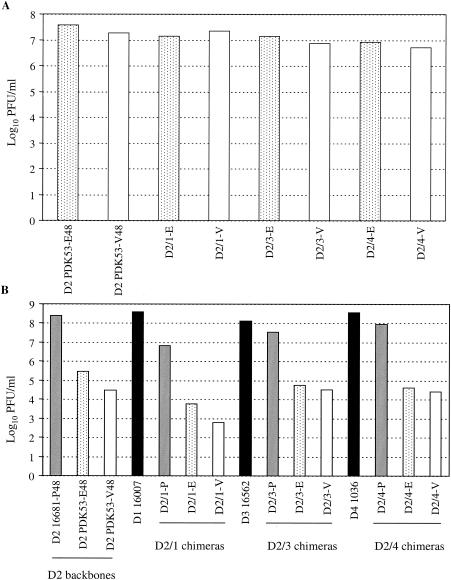
Growth characteristics of chimeras in Vero or C6/36 cells. Cells were infected at an approximate MOI of 0.001 PFU/ml. (A) Peak titers of chimeric E and V viruses in Vero cells at day 10 postinfection. (B) Peak titers of viruses in C6/36 cells within 12-day cultures. Gray bars, D2 16681-P48 virus and the chimeras within that background; stipple bars, D2 PDK53-E48 virus and the chimeras within that carrier; white bars, D2 PDK53-V48 virus and chimeras with that backbone; black bars, wild-type D1, D3, and D4 viruses.
FIG. 3.
FIG. 3.
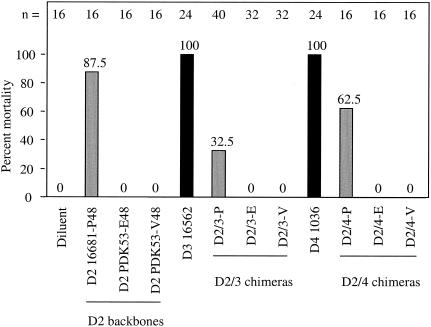
Neurovirulence of chimeric D2/3 and D2/4 viruses in newborn mice. Newborn ICR mice were inoculated with 104 PFU of virus by the intracranial route. Percent mortality is indicated directly over each graph bar. Gray bars, D2 16681-P48 virus and the chimeras within that background; black bars, wild-type D3 and D4 viruses. n, number of mice per group, indicated at the top of the figure. Average survival times of D2 16681-P48, D3 16562, D2/3-P, D4 1036, and D2/4-P viruses were 15.6 ± 2.6, 14.1 ± 2.1, 19 ± 2.1, 8.6 ± 0.6, and 17.8 ± 2.8 days, respectively.

References

    1. Allison, S. L., K. Stiasny, K. Stadler, C. W. Mandl, and F. X. Heinz. 1999. Mapping of functional elements in the stem-anchor region of tick-borne encephalitis virus envelope protein E. J. Virol. 73:5605-5612. - PMC - PubMed
    1. Arroyo, J., F. Guirakhoo, S. Fenner, Z. X. Zhang, T. P. Monath, and T. J. Chambers. 2001. Molecular basis for attenuation of neurovirulence of a yellow fever virus/Japanese encephalitis virus chimera vaccine (ChimeriVax-JE). J. Virol. 75:934-942. - PMC - PubMed
    1. Bhamarapravati, N., and Y. Sutee. 2000. Live attenuated tetravalent dengue vaccine. Vaccine 18(Suppl. 2):44-47. - PubMed
    1. Bhamarapravati, N., and S. Yoksan. 1997. Live attenuated tetravalent vaccine, p. 367-377. In D. J. Gubler and G. Kuno (ed.), Dengue and dengue hemorrhagic fever. CAB International, Wallingford, United Kingdom.
    1. Bhamarapravati, N., and S. Yoksan. 1989. Study of bivalent dengue vaccine in volunteers. Lancet i:1077. - PubMed

MeSH terms

LinkOut - more resources