. 2003 Nov;77(21):11546-54.
doi: 10.1128/jvi.77.21.11546-11554.2003.

A molecularly cloned Schwarz strain of measles virus vaccine induces strong immune responses in macaques and transgenic mice

Affiliations

A molecularly cloned Schwarz strain of measles virus vaccine induces strong immune responses in macaques and transgenic mice

Chantal Combredet et al. J Virol. 2003 Nov.

Abstract

Live attenuated RNA viruses make highly efficient vaccines. Among them, measles virus (MV) vaccine has been given to a very large number of children and has been shown to be highly efficacious and safe. Therefore, this vaccine might be a very promising vector to immunize children against both measles and other infectious agents, such as human immunodeficiency virus. A vector was previously derived from the Edmonston B strain of MV, a vaccine strain abandoned 25 years ago. Sequence analysis revealed that the genome of this vector diverges from Edmonston B by 10 amino acid substitutions not related to any Edmonston subgroup. Here we describe an infectious cDNA for the Schwarz/Moraten strain, a widely used MV vaccine. This cDNA was constructed from a batch of commercial vaccine. The extremities of the cDNA were engineered in order to maximize virus yield during rescue. A previously described helper cell-based rescue system was adapted by cocultivating transfected cells on primary chicken embryo fibroblasts, the cells used to produce the Schwarz/Moraten vaccine. After two passages the sequence of the rescued virus was identical to that of the cDNA and of the published Schwarz/Moraten sequence. Two additional transcription units were introduced in the cDNA for cloning foreign genetic material. The immunogenicity of rescued virus was studied in macaques and in mice transgenic for the CD46 MV receptor. Antibody titers and T-cell responses (ELISpot) in animals inoculated with low doses of rescued virus were identical to those obtained with commercial Schwarz MV vaccine. In contrast, the immunogenicity of the previously described Edmonston B strain-derived MV clone was much lower. This new molecular clone will allow for the production of MV vaccine without having to rely on seed stocks. The additional transcription units allow expressing heterologous antigens, thereby providing polyvalent vaccines based on an approved, safe, and efficient MV vaccine strain that is used worldwide.


Figures
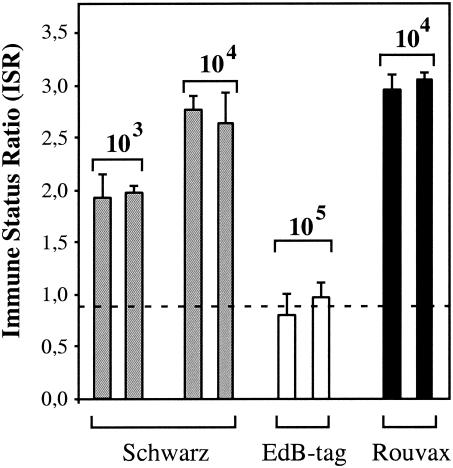
FIG. 1.
FIG. 1.
Detection of anti-MV antibodies in macaques immunized with different MV vaccine strains. Anti-MV antibodies were detected by ELISA 1 month after immunization of rhesus macaques (two monkeys per group) with Schwarz virus (gray bars), EdB-tag virus (white bars), and Rouvax vaccine (black bars) at the doses indicated. ISR were calculated as described in Materials and Methods. Only ISR values higher than 0.9 were considered positive (determinations were done in triplicate on 1/20 dilution of serum samples, and results are expressed as the mean values ± standard deviations).
FIG. 2.
FIG. 2.
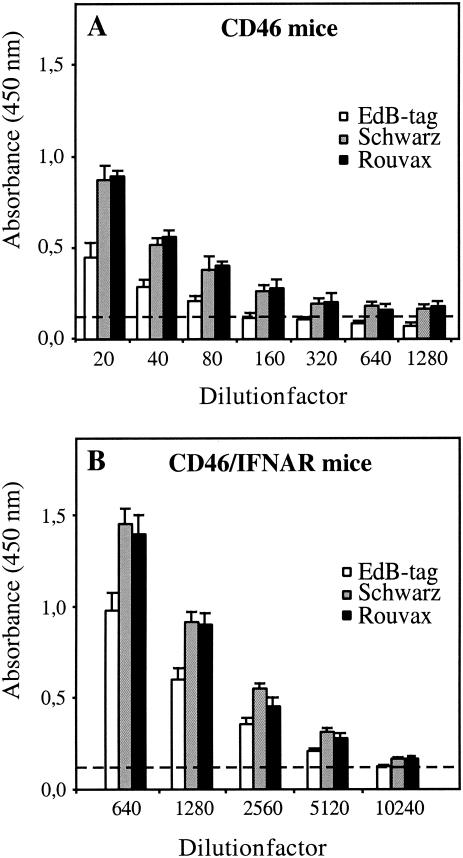
Antibody titers to MV in mice immunized with different MV vaccine strains. Anti-MV antibodies were detected by ELISA 1 month after immunization of CD46 (A) and CD46/IFNAR (B) mice with 104 TCID50 of EdB-tag virus (white bars), Schwarz virus (gray bars), and Rouvax vaccine (black bars). Results are expressed as mean optical density values ± standard deviations (four mice per group) determined in serial dilutions of sera.
FIG. 3.
FIG. 3.
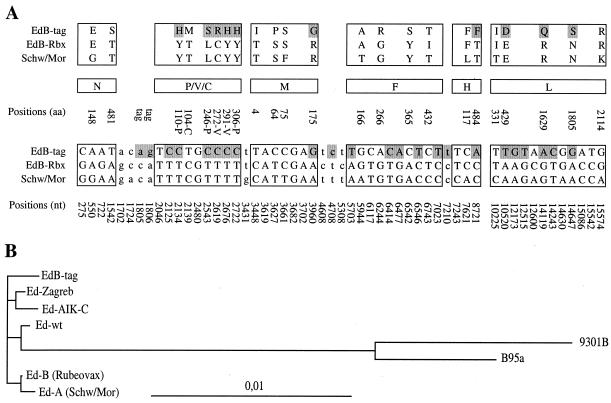
Sequence comparison of MV genomes. (A) Nucleotide changes for each coding region (capital letters in boxes) and in noncoding regions (lowercase letters) are shown in the lower part. Amino acid changes are shown in the upper part (one-letter amino acid symbol). The nucleotide (nt) and amino acid (aa) changes that are present only in the EdB-tag sequence are highlighted in gray. Nucleotide changes in positions 1805 and 1806 of EdB-tag correspond to the tag introduced. (B) Phylogenetic tree showing the EdB-tag among the Edmonston group (24) and two wild-type isolates (31, 32). The sequences were aligned using Clustal W (34). Nucleotide sequence distances were determined with Dnadist of the Phylip package, version 3.5 (9). The tree was derived by neighbor-joining analysis applied to pairwise sequence distances calculated by using a variety of methods, including the Kimura two-parameter method to generate unrooted trees. The final output was generated with Treeview (21).
FIG. 4.
FIG. 4.
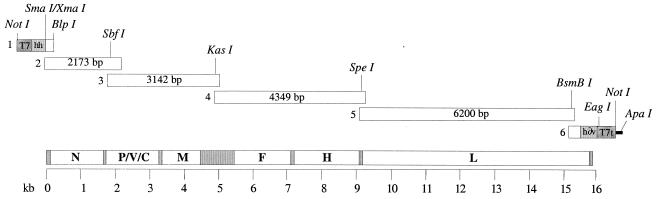
Schematic map of the Schwarz MV cDNA. The six fragments generated to construct the pTM-MVSchw plasmid are shown in the upper part with the restriction sites used to assemble the complete cDNA. T7, T7 promoter; hh, hammerhead ribozyme; h∂v, hepatitis delta ribozyme; T7t, T7 RNA polymerase terminator (T7, hh, h∂v, and T7t are not represented at the same scale). A schematic map of MV genome is shown in the lower part (grayed portions represent the intergenic regions).
FIG. 5.
FIG. 5.
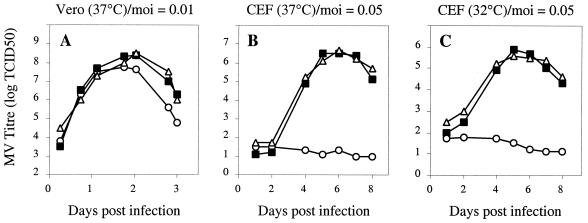
Growth kinetics of rescued Schwarz and EdB-tag viruses on Vero and CEF cells. Cells on 35-mm-diameter dishes were infected with Schwarz MV rescued from pTM-MVSchw plasmid (▪), EdB-tag MV (○), and industrial Schwarz virus (▵) at different MOI (as indicated). At each time point cells were collected, and cell-associated virus titers were determined by using the TCID50 method on Vero cells. (A) Vero cells incubated at 37°C; (B) CEF incubated at 37°C; (C) CEF incubated at 32°C.
FIG. 6.
FIG. 6.
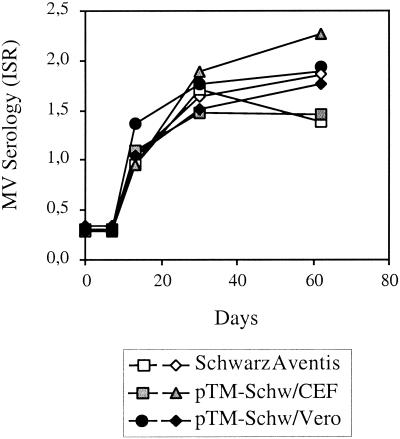
Detection of anti-MV antibodies in macaques immunized with different Schwarz MV preparations. Anti-MV antibodies were detected by ELISA at different time points after immunization of cynomolgus macaques (two monkeys per group) with 104 TCID50 of bulk industrial Schwarz virus (white marks) and Schwarz virus rescued from pTM-MVSchw plasmid and grown on CEF (gray bars) or Vero cells (black bars). ISR were calculated as described in Materials and Methods.
FIG. 7.
FIG. 7.
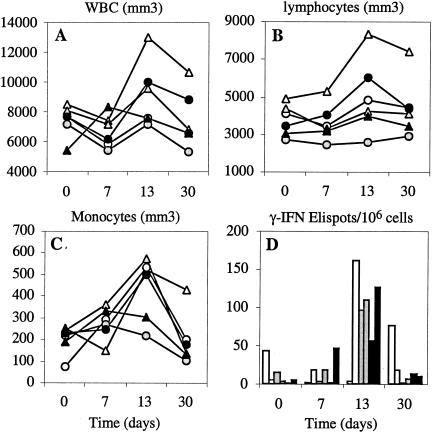
Changes in the number of circulating leukocytes and MV-specific T-cell response in macaques immunized with different Schwarz MV preparations. Enumeration of white blood cells (A), lymphocytes (B), monocytes (C), and MV hemagglutinin-specific IFN-γ-ELISpots (D) in PBMC of cynomolgus macaques collected at different time points after immunization with 104 TCID50 of bulk industrial Schwarz virus (white marks) or Schwarz virus rescued from pTM-MVSchw plasmid and grown on CEF (gray bars) or Vero cells (black bars). IFN-γ-ELISpots were detected after stimulation of PBMC for 24 h with a recombinant MVA expressing the MV hemagglutinin. The background obtained with MVA-wt stimulation was subtracted, and the results are expressed as MVA-HMV-specific IFN-γ-producing cells per million PBMC. WBC, white blood cells.
FIG. 8.
FIG. 8.
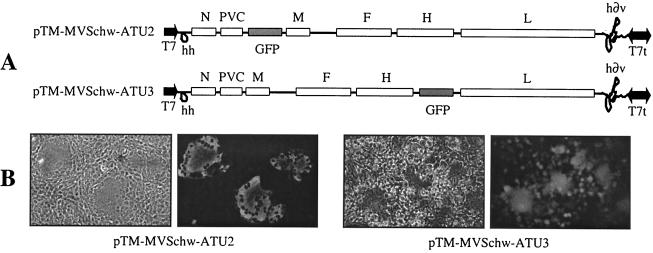
Schematic representation of the pTM-MVSchw-ATU plasmids (A) and GFP expression in Vero cells infected by rescued recombinant viruses (B). Vero cells were infected with recombinant Schwarz MV-GFP either in position ATU2 (left side) or position ATU3 (right side), and the GFP fluorescence was observed in syncytia.

References

    1. Andino, R., D. Silvera, S. D. Suggett, P. L. Achacoso, C. J. Miller, D. Baltimore, and M. B. Feinberg. 1994. Engineering poliovirus as a vaccine vector for the expression of diverse antigens. Science 265:1448-1451. - PubMed
    1. Auvaerter, P. G., P. A. Rota, W. R. Elkins, R. J. Adams, T. DeLozier, Y. Shi, W. J. Bellini, B. R. Murphy, and D. E. Griffin. 1999. Measles virus infection in rhesus macaques: altered immune responses and comparison of the virulence of six different virus strains. J. Infect. Dis. 180:950-958. - PubMed
    1. Ballart, I., D. Eschle, R. Cattaneo, A. Schmid, M. Metzler, J. Chan, S. Pifko-Hirst, S. A. Udem, and M. A. Billeter. 1990. Infectious measles virus from cloned cDNA. EMBO J. 9:379-384. - PMC - PubMed
    1. Buynak, E., R. Weibel, W. J. Je, J. Stokes, Jr., and M. Hilleman. 1969. Combined live measles, mumps, and rubella virus vaccines. JAMA 207:2259-2262. - PubMed
    1. Calain, P., and L. Roux. 1993. The rule of six, a basic feature for efficient replication of Sendai virus defective interfering RNA. J. Virol. 67:4822-4830. - PMC - PubMed

Publication types

MeSH terms

LinkOut - more resources