


Capture of an intermediate in the catalytic cycle of L-aspartate-beta-semialdehyde dehydrogenase
- PMID: 14559965
- PMCID: PMC240666
- DOI: 10.1073/pnas.1634958100
Capture of an intermediate in the catalytic cycle of L-aspartate-beta-semialdehyde dehydrogenase
Abstract
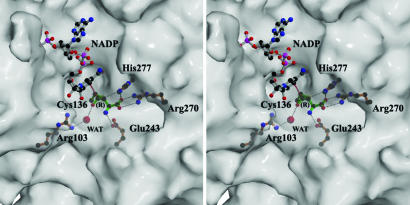
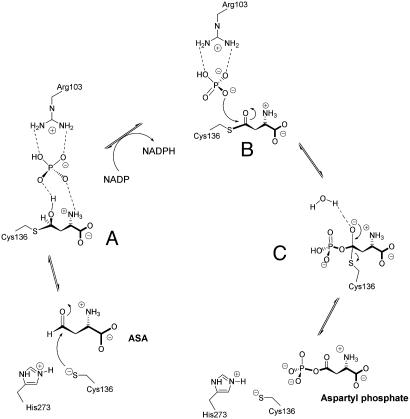
The structural analysis of an enzymatic reaction intermediate affords a unique opportunity to study a catalytic mechanism in extraordinary detail. Here we present the structure of a tetrahedral intermediate in the catalytic cycle of aspartate-beta-semialdehyde dehydrogenase (ASADH) from Haemophilus influenzae at 2.0-A resolution. ASADH is not found in humans, yet its catalytic activity is required for the biosynthesis of essential amino acids in plants and microorganisms. Diaminopimelic acid, also formed by this enzymatic pathway, is an integral component of bacterial cell walls, thus making ASADH an attractive target for the development of new antibiotics. This enzyme is able to capture the substrates aspartate-beta-semialdehyde and phosphate as an active complex that does not complete the catalytic cycle in the absence of NADP. A distinctive binding pocket in which the hemithioacetal oxygen of the bound substrate is stabilized by interaction with a backbone amide group dictates the R stereochemistry of the tetrahedral intermediate. This pocket, reminiscent of the oxyanion hole found in serine proteases, is completed through hydrogen bonding to the bound phosphate substrate.
Figures
References
-
- Cohen, G. N. (1983) in Amino Acids: Biosynthesis and Genetic Regulation, eds. Herrmann, K. M. & Somerville, R. L. (Addison–Wesley, Reading, MA), pp. 147–171.
-
- Viola, R. E. (2001) Acc. Chem. Res. 34 339–349. - PubMed
-
- Patte, J. C. (1983) in Amino Acids: Biosynthesis and Genetic Regulation, eds. Herrmann, K. M. & Somerville, R. L. (Addison–Wesley, Reading, MA), pp. 213–228.
-
- Cox, R. J., Hadfield, A. T. & Mayo-Martin, M. B. (2001) Chem. Commun. 18 1710–1711. - PubMed
Publication types
MeSH terms
Substances
Associated data
- Actions
- Actions
- Actions
LinkOut - more resources
Full Text Sources
