Comparative Study
. 2003 Oct 17:4:50.
doi: 10.1186/1471-2105-4-50.

Eval: a software package for analysis of genome annotations

Affiliations
Comparative Study

Eval: a software package for analysis of genome annotations

Evan Keibler et al. BMC Bioinformatics. .

Abstract

Summary: Eval is a flexible tool for analyzing the performance of gene annotation systems. It provides summaries and graphical distributions for many descriptive statistics about any set of annotations, regardless of their source. It also compares sets of predictions to standard annotations and to one another. Input is in the standard Gene Transfer Format (GTF). Eval can be run interactively or via the command line, in which case output options include easily parsable tab-delimited files.

Availability: To obtain the module package with documentation, go to http://genes.cse.wustl.edu/ and follow links for Resources, then Software. Please contact brent@cse.wustl.edu


Figures
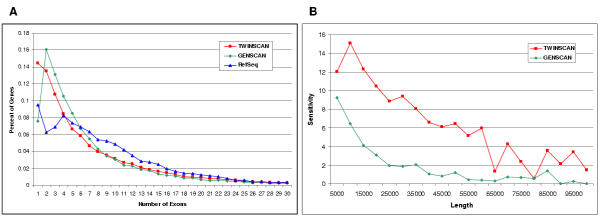
Figure 1
Figure 1
Panel A. Distributions of exons-per-gene for TWINSCAN [4] and GENSCAN [5] gene predictions and RefSeq mRNA sequences aligned to the genome. The plot reveals that, although TWINSCAN predicts too few genes in the 5–20 exon range, it predicts the right proportion of genes with more than 25 exons. Panel B. Fraction of RefSeq genes that TWINSCAN and GENSCAN predict exactly right, as a function of the genomic length of the RefSeq, excluding UTRs. Both figures were made in Excel by importing Eval output as tab-separated files. Data in both panes was generated using the NCBI34 version of the human genome and TWINSCAN 1.2.

References

    1. Guigó R, Agarwal P, Abril JF, Burset M, Fickett JW. An assessment of gene prediction accuracy in large DNA sequences. Genome Res. 2000;10:1631–1642. doi: 10.1101/gr.122800. - DOI - PMC - PubMed
    1. Burset M, Guigo R. Evaluation of gene structure prediction programs. Genomics. 1996;34:353–367. doi: 10.1006/geno.1996.0298. - DOI - PubMed
    1. Flicek P, Keibler E, Hu Ping, Korf Ian, Brent Michael R. Leveraging the mouse genome for gene prediction in human: From whole-genome shotgun reads to a global synteny map. Genome Res. 2003;13:46–54. doi: 10.1101/gr.830003. - DOI - PMC - PubMed
    1. Korf I, Flicek P, Duan D, Brent MR. Integrating genomic homology into gene structure prediction. Bioinformatics. 2001;17 Suppl 1:S140–8. - PubMed
    1. Burge C, Karlin S. Prediction of complete gene structures in human genomic DNA. J Mol Biol. 1997;268:78–94. doi: 10.1006/jmbi.1997.0951. - DOI - PubMed

Publication types

MeSH terms

LinkOut - more resources
