


The adhesin Hwp1 and the first daughter cell localize to the a/a portion of the conjugation bridge during Candida albicans mating
- PMID: 14565982
- PMCID: PMC284795
- DOI: 10.1091/mbc.e03-04-0264
The adhesin Hwp1 and the first daughter cell localize to the a/a portion of the conjugation bridge during Candida albicans mating
Abstract
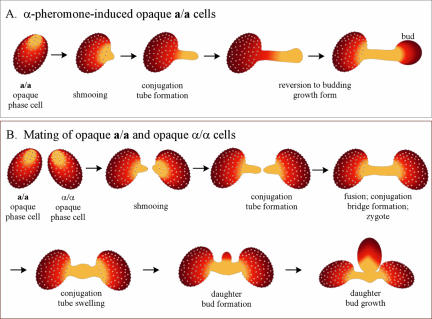
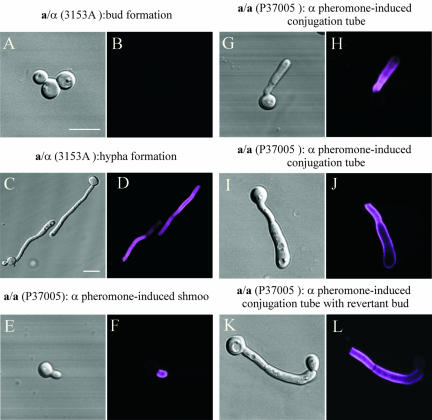
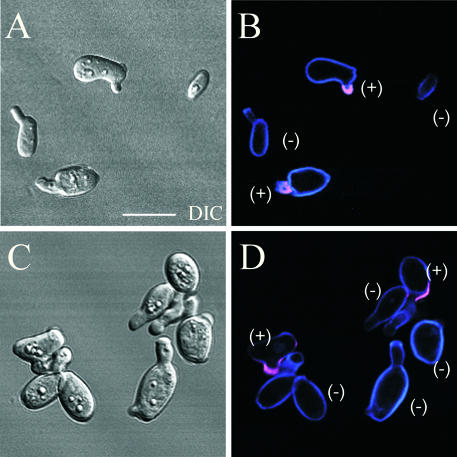
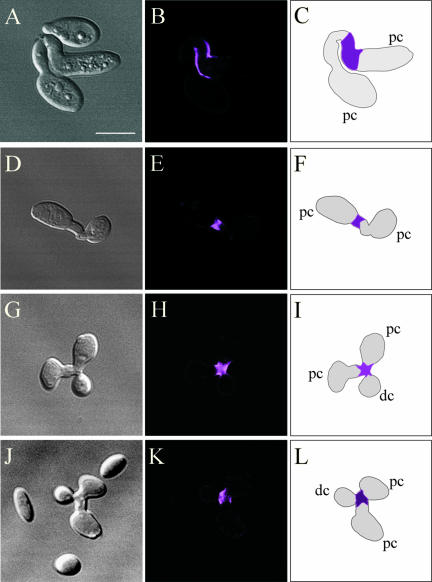
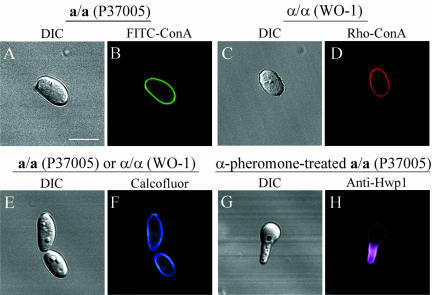
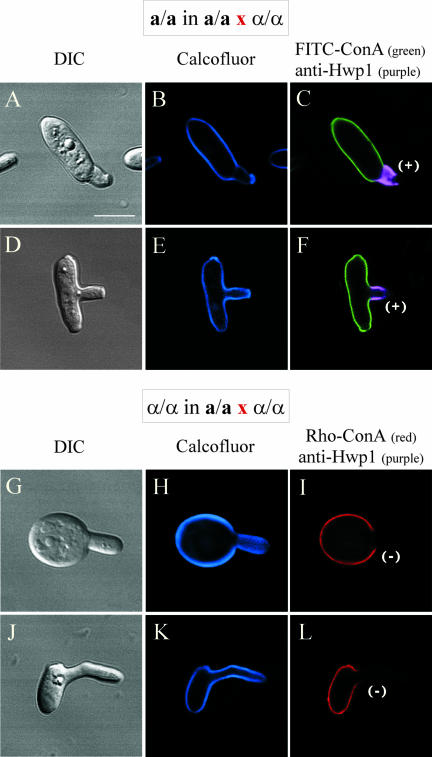
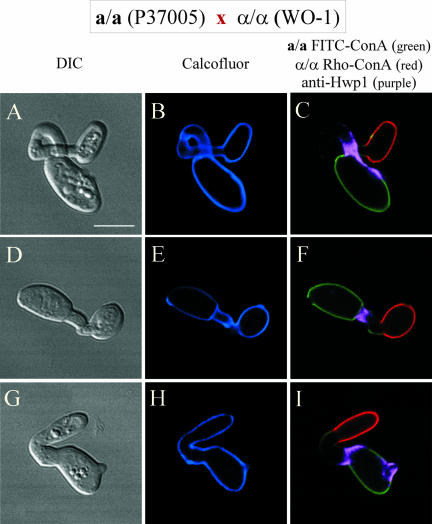
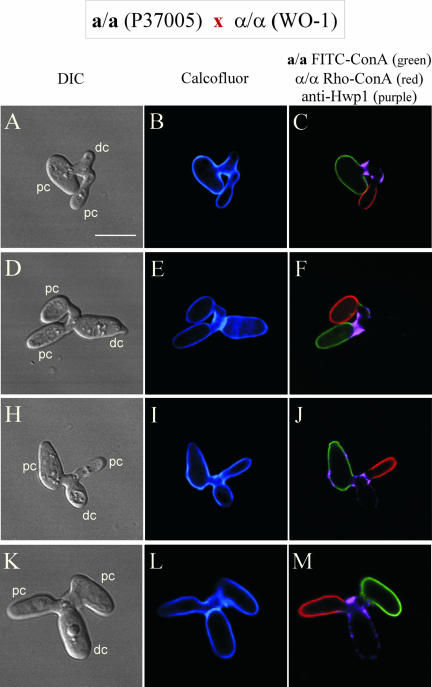
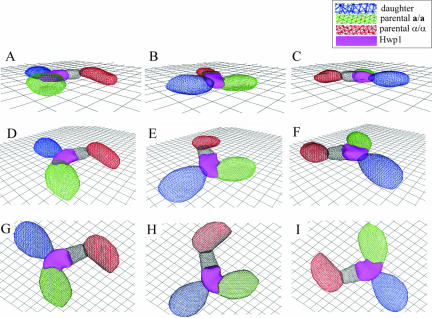
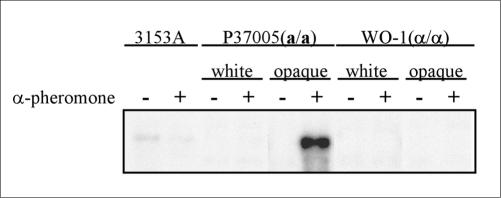
The cell wall protein Hwp1 was originally demonstrated to be expressed exclusively in hyphae of Candida albicans and cross-linked to human epithelium by mammalian transglutaminase. Hwp1 is expressed on the walls of hyphae formed by a/alpha, a/a, and alpha/alpha cells. Hence, it is expressed on hyphae independently of mating type. However, Hwp1 is selectively expressed on the wall of conjugation tubes formed by a/a cells, but not alpha/alpha cells, in the mating process. This was demonstrated in all possible crosses between four unrelated natural a/a strains and four unrelated alpha/alpha strains. In zygotes, Hwp1 is restricted to that portion of the wall of the conjugation bridge contributed by the a/a parent cell. Hwp1 staining further revealed that the first daughter bud that emerges from the conjugation bridge does so from the a/a-contributed portion. Hwp1 expression and localization during the mating process is, therefore, mating type specific, opaque phase specific, and alpha-pheromone induced. These results indicate that the mating type-specific contributions to the conjugation bridge during the mating process in C. albicans are qualitatively and functionally distinct and that the a/a portion of the bridge, which selectively contains Hwp1, bears the first daughter cell in the mating process.
Figures
References
-
- Buffo, J., Herman, M., and Soll, D.R. (1984). A characterization of pH-regulated dimorphism in Candida albicans. Mycopathologia 85, 21–30. - PubMed
-
- Casamayor, A., and Snyder, M. (2002). Bud site selection and cell polarity in budding yeast. Curr. Opin. Microbiol. 5, 179–186. - PubMed
-
- Cole, G.M., and Reed, S.I. (1991). Pheromone-induced phosphorylation of a G protein beta subunit in S. cerevisiae is associated with an adaptive response to mating pheromone. Cell 64, 703–716. - PubMed
Publication types
MeSH terms
Substances
Grants and funding
LinkOut - more resources
Full Text Sources
Molecular Biology Databases
