. 2003 Nov;51(11):1545-55.
doi: 10.1177/002215540305101114.

Cell-specific expression of CYP2A5 in the mouse respiratory tract: effects of olfactory toxicants

Affiliations

Cell-specific expression of CYP2A5 in the mouse respiratory tract: effects of olfactory toxicants

Elena Piras et al. J Histochem Cytochem. 2003 Nov.

Abstract

We performed a detailed analysis of mouse cytochrome P450 2A5 (CYP2A5) expression by in situ hybridization (ISH) and immunohistochemistry (IHC) in the respiratory tissues of mice. The CYP2A5 mRNA and the corresponding protein co-localized at most sites and were predominantly detected in the olfactory region, with an expression in sustentacular cells, Bowman's gland, and duct cells. In the respiratory and transitional epithelium there was no or only weak expression. The nasolacrimal duct and the excretory ducts of nasal and salivary glands displayed expression, whereas no expression occurred in the acini. There was decreasing expression along the epithelial linings of the trachea and lower respiratory tract, whereas no expression occurred in the alveoli. The hepatic CYP2A5 inducers pyrazole and phenobarbital neither changed the CYP2A5 expression pattern nor damaged the olfactory mucosa. In contrast, the olfactory toxicants dichlobenil and methimazole induced characteristic changes. The damaged Bowman's glands displayed no expression, whereas the damaged epithelium expressed the enzyme. The CYP2A5 expression pattern is in accordance with previously reported localization of protein and DNA adducts and the toxicity of some CYP2A5 substrates. This suggests that CYP2A5 is an important determinant for the susceptibility of the nasal and respiratory epithelia to protoxicants and procarcinogens.


Figures
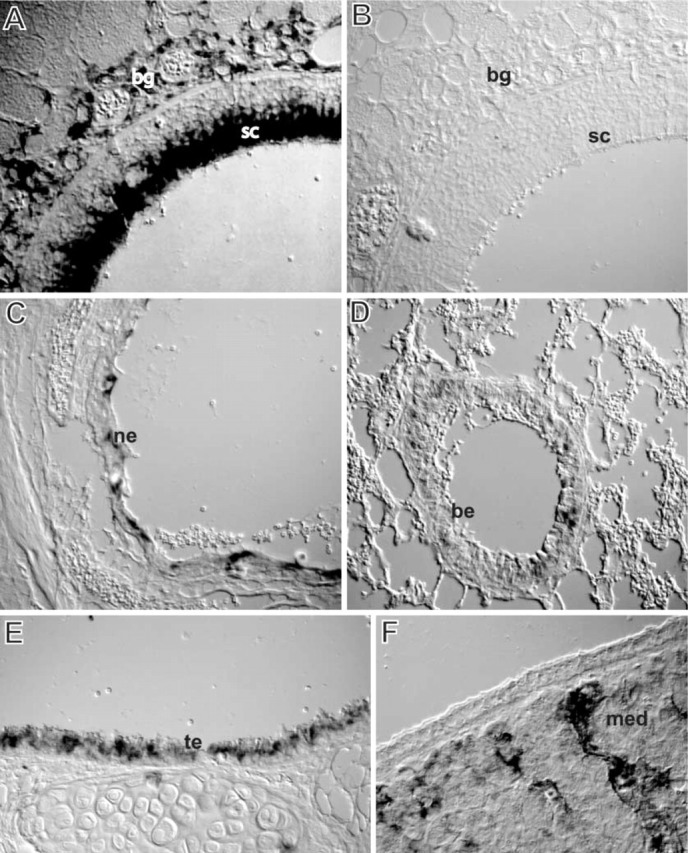
Figure 1
Figure 1
In situ hybridization of CYP2A5 mRNA in selected tissues of NMRI mice. (A) Olfactory mucosa (dorsal meatus): intense staining of the apical part of the sustentacular cells and of the Bowman's glands. (B) Olfactory mucosa (dorsal meatus): control (sense probe) no staining. (C) Nasolacrimal duct: staining of the squamous epithelium. (D) Lung: staining of the bronchiolar columnar epithelium but no staining of the alveolar part. (E) Trachea: staining of the columnar epithelium. (F) Maxillary nasal gland: staining of the excretory ducts but no staining of the acini. bg, Bowman's glands; sc, sustentacular cell; ne, nasolacrimal duct epithelium; be, bronchiolar epithelium; te, tracheal epithelium; med, maxillary nasal gland excretory duct. Original magnification ×400. Nomarski differential interference technique was used on tissue sections that had not been counterstained.
Figure 2
Figure 2
Immunohistochemical staining of CYP2A5 in selected tissues of NMRI mice. (A) Olfactory mucosa (dorsal meatus): intense staining of the apical part of the sustentacular cells and their foot processes and of the Bowman's glands and their excretory ducts. (B) Olfactory mucosa (dorsal meatus): control (substitution of the primary antibody with normal serum) no staining. (C) Nasolacrimal duct: staining of the squamous epithelium. (D) Sublingual salivary gland: staining of the excretory ducts but no staining of acini. Original magnification ×400. (E) Trachea: staining of the columnar epithelium. (F) Lung: staining of the bronchiolar columnar epithelium but no staining of the alveolar part. Original magnification ×200. Nomarski differential interference technique was used on tissue sections that had not been counterstained. bg, Bowman's glands; sc, sustentacular cell; ne, nasolacrimal duct epithelium; sed, sublingual gland excretory duct; te, tracheal epithelium; be, bronchiolar epithelium.
Figure 3
Figure 3
Immunohistochemical staining of CYP2A5 in the olfactory mucosa of NMRI mice treated with the olfactory toxicants dichlobenil or methimazole. (A) Vehicle-treated (saline) control. Olfactory mucosa (dorsal meatus): intense staining of the apical part of the sustentacular cells and their foot processes and of the Bowman's glands and their excretory ducts in the lamina propria. (B) Vehicle-treated (DMSO) control. Olfactory mucosa (dorsal meatus): intense staining of the apical part of the sustentacular cells and their foot processes. Intense staining of the Bowman's glands and their excretory ducts in the lamina propria. (C) Four days after treatment with methimazole (2 × 50 mg/kg). Olfactory mucosa (dorsal meatus): weak staining of the damaged olfactory epithelium and no staining of the damaged lamina propria. (D) Four days after treatment with dichlobenil (2 × 25 mg/kg). Olfactory mucosa (dorsal meatus): weak staining of the thin and disorganized epithelium. No staining in the damaged lamina propria. (E) Two weeks after treatment with methimazole (2 × 50 mg/kg). Olfactory mucosa (dorsal meatus): sustentacular cells are stained as well as columnar cells in the disorganized epithelium in the dorsomedial part. The staining of the Bowman's glands is similar to control. (F) Two weeks after treatment with dichlobenil (2 × 25 mg/kg). Olfactory mucosa (dorsal meatus): staining of the atypical respiratory-like epithelium and invaginations into the lamina propria. No staining of the fibrotic lamina propria. bg, Bowman's glands; sc, sustentacular cell; in, invagination; ep, epithelium. Original magnification ×400. Nomarski differential interference technique was used on tissue sections that had not been counterstained.

References

    1. Adams DR, Jones AM, Plopper CG, Serabjit—Singh CJ, Philpot RM. (1991) Distribution of cytochrome P-450 monoxygenase enzymes in the nasal mucosa of hamster and rat. Am J Anat 190:291–298 - PubMed
    1. Bakke JE, Larsen GL, Struble C, Feil VJ, Brandt I, Brittebo EB. (1988) Metabolism of 2,6-dichlorobenzonitrile, 2,6-dichlorothiobenzamide in rodents and goats. Xenobiotica 18:1063–1075 - PubMed
    1. Belinsky SA, Foley JF, White CM, Anderson MW, Maronpot RR. (1990) Dose-response relationship between O6-methylguanine formation in Clara cells and induction of pulmonary neoplasia in the rat by 4-(methylnitrosamino)-1-(3-pyridyl)-1-butanone. Cancer Res 50:3772–3780 - PubMed
    1. Belinsky SA, Walker VE, Maronpot RR, Swenberg JA, Anderson MW. (1987) Molecular dosimetry of DNA adduct formation and cell toxicity in rat nasal mucosa following exposure to the tobacco specific nitrosamine 4-(N-methyl-N-nitrosamino)-1-(3-pyridyl)-1-butanone and their relationship to induction of neoplasia. Cancer Res 47:6058–6065 - PubMed
    1. Bereziat JC, Raffalli F, Schmezer P, Frei E, Geneste O, Lang MA. (1995) Cytochrome P450 2A of nasal epithelium: regulation and role in carcinogen metabolism. Mol Carcinogen 14:130–139 - PubMed

Publication types

MeSH terms
