


A subset of familial colorectal neoplasia kindreds linked to chromosome 9q22.2-31.2
- PMID: 14566058
- PMCID: PMC240727
- DOI: 10.1073/pnas.2132286100
A subset of familial colorectal neoplasia kindreds linked to chromosome 9q22.2-31.2
Abstract
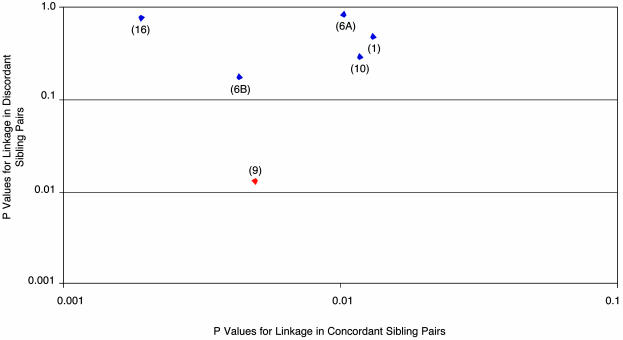
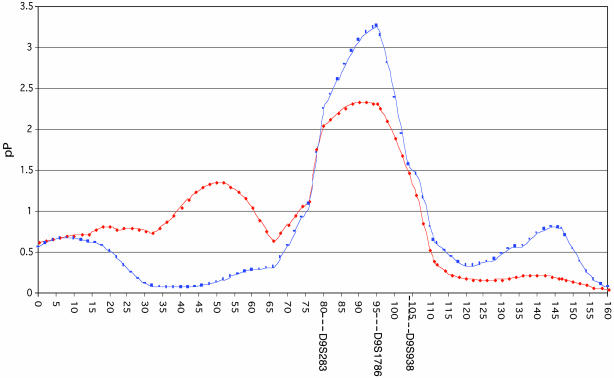
Colorectal cancer is the second most leading cause of cancer death among adult Americans. Two autosomal dominant hereditary forms of the disease, familial adenomatous polyposis and hereditary nonpolyposis colorectal cancer, together account for perhaps 5% of all cases. However, in approximately 20% of additional colon cancer cases, the affected individuals report a family history of colon cancer in a first-degree relative. Similar familial clusters of colon cancer and early-onset colon adenomas have also been reported. To determine whether such familial aggregations arise by chance or reflect a hereditary colon cancer susceptibility, we conducted a whole genome scan to test for genetic linkage in 53 kindreds in which two or more siblings were affected by age 65 or younger with colon cancer or with advanced colon adenomas that were >1 cm in size or that showed high-grade dysplasia. In this cohort we found genetic linkage of disease (P = 0.00045) to chromosomal region 9q22.2-31.2 in a pattern consistent with autosomal dominant disease alleles. These data suggest that a single locus can contribute to disease susceptibility in a subset of patients with nonsyndromic forms of familial colorectal neoplasia.
Figures
References
-
- Greenlee, R. T., Hill-Harmon, M. B., Murray, T. & Thun, M. (2001) CA Cancer J. Clin. 51, 15-36. - PubMed
-
- Kinzler, K. & Vogelstein, B. (2002) in The Genetic Basis of Human Cancer, eds. Vogelstein, B. & Kinzler, K. (McGraw–Hill, New York), pp. 583-612.
-
- Markowitz, S., Dawson, D. M., Willis, J. & Willson, J. K. (2002) Cancer Cell 1, 233-236. - PubMed
-
- Kolodner, R. (1996) Genes Dev. 10, 1433-1442. - PubMed
-
- Burt, R. & Peterson, G. M. (1996) in Prevention and Early Detection of Colorectal Cancer, eds. Young, G., Rozen, P. & Levin, B. (Saunders, Philadelphia), pp. 171-194.
Publication types
MeSH terms
Substances
Grants and funding
- N01 HG 65403/HG/NHGRI NIH HHS/United States
- R37 GM028356/GM/NIGMS NIH HHS/United States
- P41 RR003655/RR/NCRR NIH HHS/United States
- N01 HG065403/HG/NHGRI NIH HHS/United States
- U01 CA 82901/CA/NCI NIH HHS/United States
- P30 CA 43703/CA/NCI NIH HHS/United States
- P30 CA043703/CA/NCI NIH HHS/United States
- P41 RR 03655/RR/NCRR NIH HHS/United States
- GM 28356/GM/NIGMS NIH HHS/United States
- M01 RR000080/RR/NCRR NIH HHS/United States
- U01 CA082901/CA/NCI NIH HHS/United States
- K23 CA081308/CA/NCI NIH HHS/United States
- R01 GM028356/GM/NIGMS NIH HHS/United States
- 1K23 CA 81308/CA/NCI NIH HHS/United States
- M01 RR 00080/RR/NCRR NIH HHS/United States
LinkOut - more resources
Full Text Sources
Medical
Molecular Biology Databases
