. 2003 Nov;4(11):1079-83.
doi: 10.1038/sj.embor.embor7400010. Epub 2003 Oct 17.

Hexameric ring structure of the full-length archaeal MCM protein complex

Affiliations

Hexameric ring structure of the full-length archaeal MCM protein complex

Tillmann Pape et al. EMBO Rep. 2003 Nov.

Abstract

In eukaryotes, a family of six homologous minichromosome maintenance (MCM) proteins has a key function in ensuring that DNA replication occurs only once before cell division. Whereas all eukaryotes have six paralogues, in some Archaea a single protein forms a homomeric assembly. The complex is likely to function as a helicase during DNA replication. We have used electron microscopy to obtain a three-dimensional reconstruction of the full-length MCM from Methanobacterium thermoautotrophicum. Six monomers are arranged around a sixfold axis, generating a ring-shaped molecule with a large central cavity and lateral holes. The channel running through the molecule can easily accommodate double-stranded DNA. The crystal structure of the amino-terminal fragment of MCM and a model for the AAA+ hexamer have been docked into the map, whereas additional electron density suggests that the carboxy-terminal domain is located at the interface between the two domains. The structure suggests that the MCM complex is likely to act in a different manner to traditional hexameric helicases and is likely to bear more similarity to the SV40 large T antigen or to double-stranded DNA translocases.


Figures
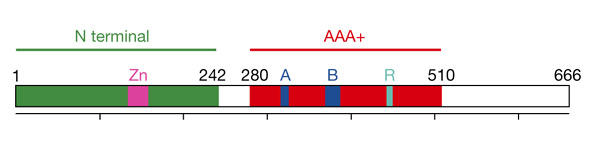
Figure 1
Figure 1
A schematic representation of the Methanobacterium thermoauto-trophicum MCM sequence. The sequence of the MtMCM consists of 666 amino-acid residues and can be divided into an amino-terminal domain (in green, amino acids 1–242), including a Zn motif (in magenta), and an AAA+ ATPases domain (in red, amino acids 280–510), which includes the Walker A and B motifs (A and B, in blue) and the arginine finger (R, in cyan). The ticks on the scale bar correspond to 100 amino-acid residues.
Figure 2
Figure 2
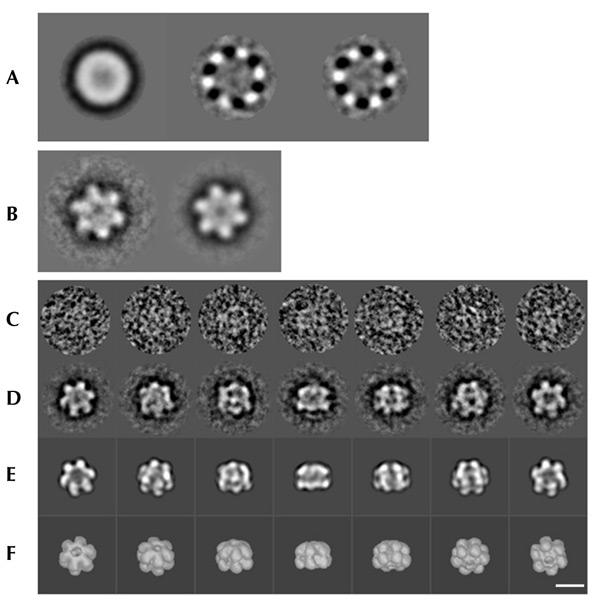
Overview of the three-dimensional reconstruction procedure. (A) The three predominant eigenimages. The first closely resembles the total average of the data set used as a first reference for the translational alignment; the two subsequent eigenimages illustrate the most important differences existing within the data set, providing clear evidence of sixfold symmetry. (B) Average of 100 top-view images rotationally aligned to the first class averages at the beginning of the image processing analysis, without (left) and with (right) sixfold symmetry imposed. (C) Examples of original images of MtMCM stained with uranyl acetate. These images are members of the class averages shown in the row below (protein is white). (D) Class averages (characteristic views) obtained by multi-reference alignment and classification. (E) Reprojections of the 3D structure in the Euler-angle directions found for the class averages in (C). (F) Surface representations of the 3D reconstruction viewed from directions identical to the Euler directions assigned to the corresponding class averages in (C). The far-left images correspond to the top view; the far-right images to the bottom view. Scale bar, 100 Å.
Figure 3
Figure 3
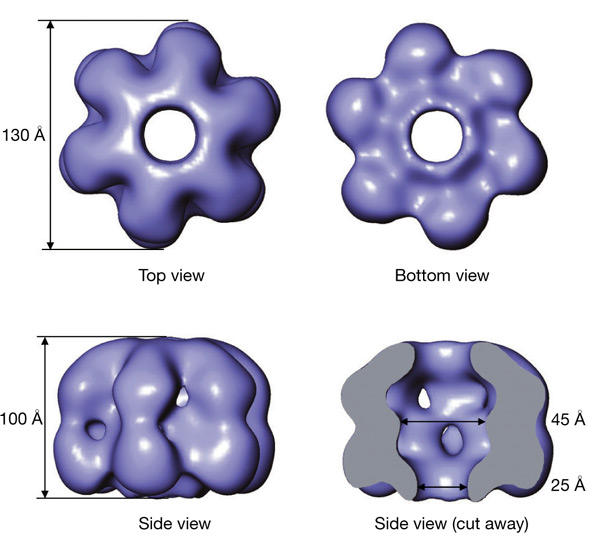
Three-dimensional reconstruction of MtMCM at 23-Å resolution. A surface representation including 100% of the expected volume of the electron density obtained from the three-dimensional reconstruction of the MtMCM complex is shown in different orientations. The overall dimensions for the complex are given. The protein monomers assemble into a hexameric ring around a wide central channel, with a clear asymmetry between the top and bottom views. A side view has been cut open to reveal the large central chamber and the channel spanning the entire length of the molecule.
Figure 4
Figure 4
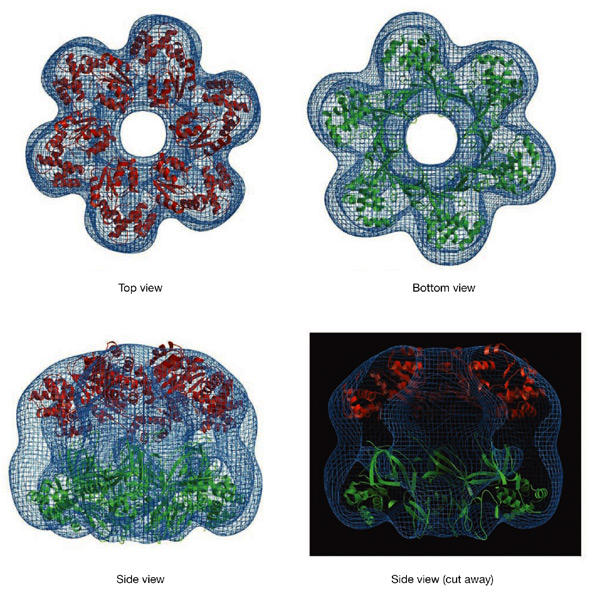
Model fitting. The electron density obtained for the MtMCM reconstruction is shown in blue. The crystal structure of the amino-terminal domain of MtMCM, shown in green, has been placed in the bottom half of the reconstruction, with the Zn motifs fitting into the ridge surrounding the bottom aperture of the central channel. A hexameric model of the core AAA+ domain of RuvB has been placed in the top half of the density (shown in red).
Figure 5
Figure 5
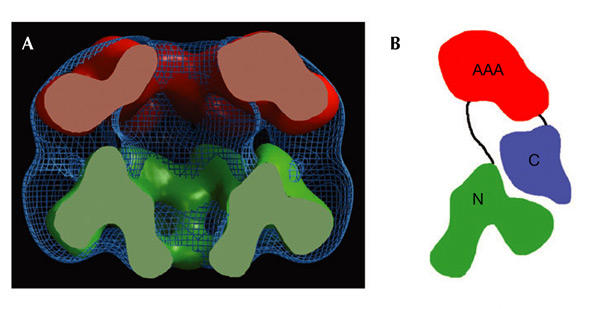
Location of the MtMCM carboxy-terminal domain. (A) The three-dimensional reconstruction of the full-length MtMCM (in blue) is compared with electron density maps calculated to 20 Å from the atomic coordinates of the amino-terminal domain (in green) and the AAA+ domain (in red). A 'belt' of unassigned electron density is located at the interface between the two domains and could accommodate the C-terminal 150 amino-acid residues (Fig. 1). (B) Schematic diagram showing the proposed arrangement of the C-terminal domain (in blue) in a MtMCM monomer.

References

    1. Carpentieri F. De Felice M. De Falco M. Rossi M. & Pisani F.M. ( 2002) Physical and functional interaction between the mini-chromosome maintenance-like DNA helicase and the single-stranded DNA binding protein from the crenarchaeon Sulfolobus solfataricus. J. Biol. Chem. 277, 12118–12127. - PubMed
    1. Chong J.P. Hayashi M.K. Simon M.N. Xu R.M. & Stillman B. ( 2000) A double-hexamer archaeal minichromosome maintenance protein is an ATP-dependent DNA helicase. Proc. Natl Acad. Sci. USA 97, 1530–1535. - PMC - PubMed
    1. Dube P. Tavares P. Lurz R. & van Heel M. ( 1993) The portal protein of bacteriophage SPP1: a DNA pump with 13-fold symmetry. EMBO J. 12, 1303–1309. - PMC - PubMed
    1. Fletcher R.J. Bishop B.E. Leon R.P. Sclafani R.A. Ogata C.M. & Chen X.S. ( 2003) The structure and function of MCM from archaeal M. thermoautotrophicum. Nature Struct. Biol. 10, 160–167. - PubMed
    1. Hyrien O. Marheineke K. & Goldar A. ( 2003) Paradoxes of eukaryotic DNA replication: MCM proteins and the random completion problem. BioEssays, 25, 116–125. - PubMed

Publication types

Substances