. 2003 Oct 28;100(22):12666-71.
doi: 10.1073/pnas.1835726100. Epub 2003 Oct 20.

The Tat/TAR-dependent phosphorylation of RNA polymerase II C-terminal domain stimulates cotranscriptional capping of HIV-1 mRNA

Affiliations

The Tat/TAR-dependent phosphorylation of RNA polymerase II C-terminal domain stimulates cotranscriptional capping of HIV-1 mRNA

Meisheng Zhou et al. Proc Natl Acad Sci U S A. .

Abstract

The HIV type 1 (HIV-1) Tat protein stimulates transcription elongation by recruiting P-TEFb (CDK9/cyclin T1) to the transactivation response (TAR) RNA structure. Tat-induced CDK9 kinase has been shown to phosphorylate Ser-5 of RNA polymerase II (RNAP II) C-terminal domain (CTD). Results presented here demonstrate that Tat-induced Ser-5 phosphorylation of CTD by P-TEFb stimulates the guanylyltransferase activity of human capping enzyme and RNA cap formation. Sequential phosphorylation of CTD by Tat-induced P-TEFb enhances the stimulation of human capping enzyme guanylyltransferase activity and RNA cap formation by transcription factor IIH-mediated CTD phosphorylation. Using an immobilized template assay that permits isolation of transcription complexes, we show that Tat/TAR-dependent phosphorylation of RNAP II CTD stimulates cotranscriptional capping of HIV-1 mRNA. Upon transcriptional induction of latently infected cells, accumulation of capped transcripts occurs along with Ser-5-phosphorylated RNAP II in the promoter proximal region of the HIV-1 genome. Therefore, these observations suggest that Tat/TAR-dependent phosphorylation of RNAP II CTD is crucial not only in promoting transcription elongation but also in stimulating nascent viral RNA capping.


Figures
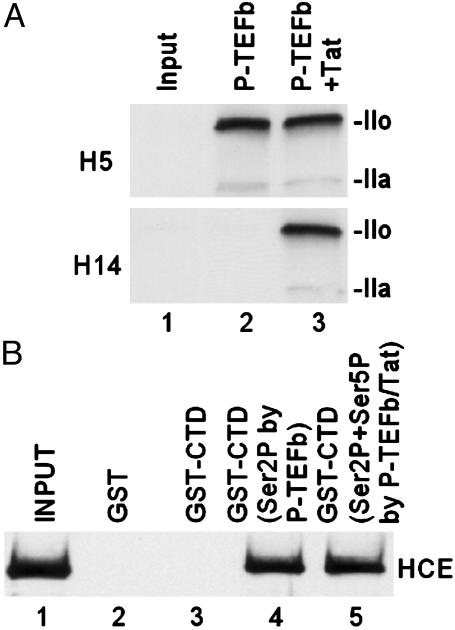
Fig. 1.
Fig. 1.
Interaction between HCE and CTD phosphorylated by P-TEFb. (A) Tat modifies the substrate specificity of CDK9. In vitro kinase assays were performed by incubating purified RNAP II with P-TEFb and ATP (100 μM) in the absence or presence of Tat. Phosphorylated CTD was analyzed by Western blot with specific antibody H5 (α-phosphoserine 2) or H14 (α-phosphoserine 5). The hypophosphorylated (IIa) and hyperphosphorylated (IIo) forms of the largest subunit of RNAP II are indicated. (B) Interaction of HCE and CTD phosphorylated by P-TEFb. HCE was incubated with bead-bound GST-CTD. Bead-bound proteins were eluted by boiling in SDS loading buffer and then analyzed by Western blot with α-CE antibody.
Fig. 2.
Fig. 2.
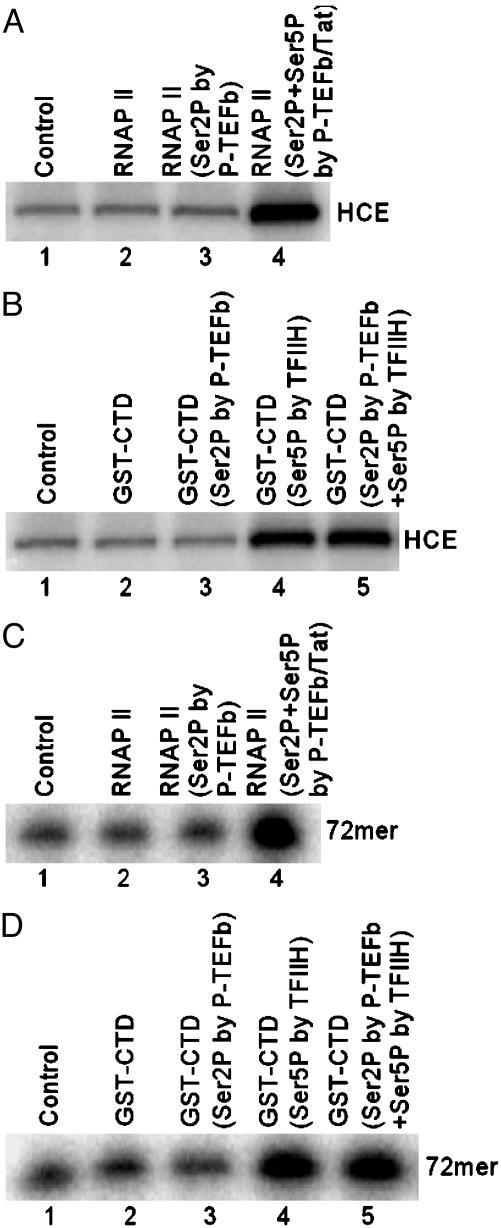
Tat-induced Ser-5 phosphorylation of CTD by P-TEFb stimulates the GT activity of HCE and RNA cap formation. (A) CTD phosphorylation by P-TEFb/Tat stimulates the GT activity of HCE. HCE was incubated with [α-32P]GTP in the absence or presence of bead-bound RNAP II. Guanylylation of HCE was assessed by SDS/PAGE followed by autoradiography. (B) Ser-2 phosphorylation does not influence the effect of CTD Ser-5 phosphorylation on HCE activation. Guanylylation of HCE was performed by incubating HCE with [α-32P]GTP in the absence or presence of bead-bound GST-CTD and then resolved by SDS/PAGE followed by autoradiography. (C) CTD phosphorylation by P-TEFb/Tat stimulates RNA cap formation. A T7 polymerase run-off RNA (72-mer) was incubated with HCE and [α-32P]GTP in the absence or presence of bead-bound RNAP II. GMP-labeled RNA was then analyzed by electrophoresis through 10% polyacrylamide gels containing 7 M urea in TBE buffer followed by autoradiography. (D) CTD Ser-2 phosphorylation does not influence the effect of CTD Ser-5 phosphorylation on RNA cap formation. Transfer of GMP was performed by incubating RNA with HCE and [α-32P]GTP in the absence or presence of bead-bound GST-CTD. GMP-labeled RNA was then analyzed by electrophoresis through 10% polyacrylamide gels containing 7 M urea in TBE buffer followed by autoradiography.
Fig. 3.
Fig. 3.
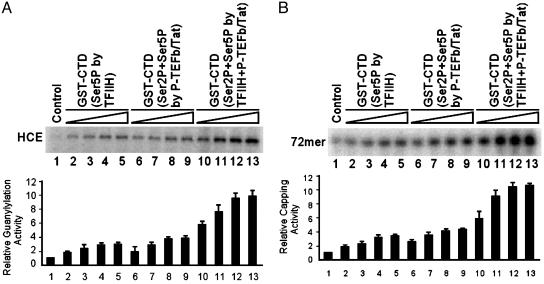
Additive effects of CTD phosphorylation sequentially by TFIIH and Tat-induced P-TEFb on the stimulation of the GT activity of HCE and RNA cap formation. (A) Stimulation of the GT activity of HCE. Guanylylation of HCE was performed by incubating HCE with [α-32P]GTP in the absence (lane 1) or presence of bead-bound GST-CTD phosphorylated by TFIIH (lanes 2–5), P-TEFb/Tat (lanes 6–9), or sequentially by TFIIH and P-TEFb/Tat (lanes 10–13) and then assessed by SDS/PAGE followed by autoradiography. Quantitation of three independent assays performed under similar conditions is shown at the bottom of the panel. (B) Stimulation of RNA cap formation. Transfer of GMP to RNA was performed by incubating RNA with HCE and [α-32P]GTP in the absence (lane 1) or presence of bead-bound GST-CTD phosphorylated by TFIIH (lanes 2–5), P-TEFb/Tat (lanes 6–9), or sequentially by TFIIH and P-TEFb/Tat (lanes 10–13) and then analyzed by electrophoresis through 10% polyacrylamide gels containing 7 M urea in TBE buffer followed by autoradiography. Quantitation of three independent assays performed under similar conditions is shown below.
Fig. 4.
Fig. 4.
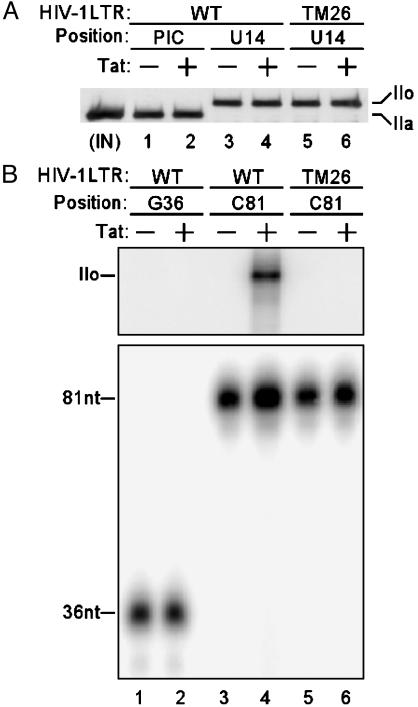
Tat/TAR-dependent phosphorylation of the RNAP II CTD stimulates HIV-1 transcription elongation. (A) RNAP II CTD is phosphorylated during the initiation stage or early stage of elongation. RNAP II associated with PICs or TECs stalled at U14 was analyzed by Western blot with α-RNAP II antibody N-20. The WT and TAR mutant (TM26) HIV-1 LTR templates and the hypophosphorylated (IIa) and hyperphosphorylated (IIo) forms of the large subunit of RNAP II are indicated. IN, input. (B) Tat/TAR-dependent phosphorylation of RNAP II CTD by P-TEFb stimulates transcription elongation. RNAP II CTD was labeled with [γ-32P]ATP during stepwise transcription elongation and immunoprecipitated with α-RNAP II antibody N-20. Incorporation of 32P into RNAP II was assessed by SDS/PAGE followed by autoradiography (Upper). Nascent transcripts were labeled with [α-32P]UTP and analyzed by electrophoresis through 10% polyacrylamide gels containing 7 M urea in TBE buffer followed by autoradiography (Lower).
Fig. 5.
Fig. 5.
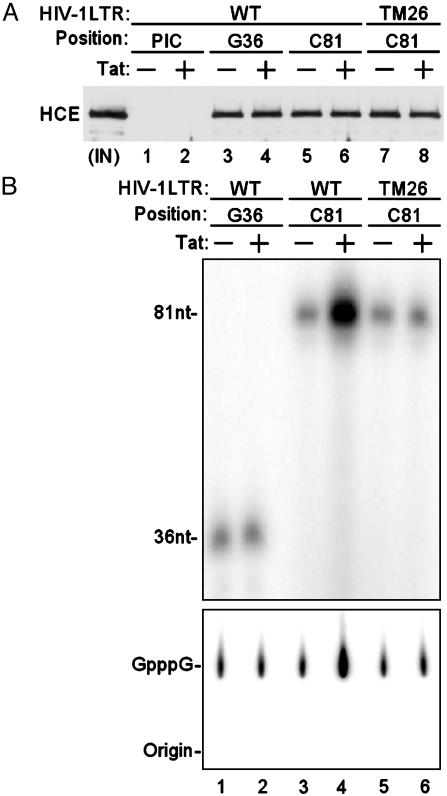
Tat/TAR-dependent phosphorylation of the RNAP II CTD stimulates cotranscriptional capping of viral mRNA. (A) HCE is recruited into HIV-1 TECs through phosphorylated RNAP II CTD. PICs were analyzed by Western blotting with α-CE antibody. TECs stalled at G36 and C81 were incubated with HCE and extensively washed to remove unbound proteins before Western blot analysis with α-CE antibody. The WT and TAR mutant (TM26) HIV-1 LTR templates are indicated. IN, input. (B) Tat/TAR-dependent phosphorylation of the RNAP II CTD stimulates capping of viral mRNA. The indicated TECs were supplemented with HCE and then incubated with [α-32P]GTP. GMP-labeled transcripts were analyzed by electrophoresis through 10% polyacrylamide gels containing 7 M urea in TBE buffer followed by autoradiography (Upper). GMP-labeled RNAs isolated from the indicated TECs were analyzed by S1 nuclease digestion followed by polyethyleneimine-cellulose TLC (Lower).
Fig. 6.
Fig. 6.
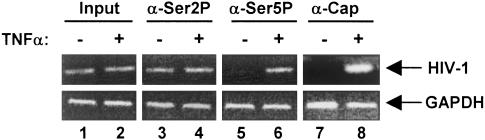
Increase of capped HIV-1 transcripts coupled with accumulation of Ser-5 phosphorylation in infected cells. OM10.1 cells were treated with TNFα to induce virus production and then subjected to ChIP assays. Transcription complexes were immunoprecipitated with antibody α-CTD H5 or H14 or α-2,2,7-trimethylguanosine, and recovered DNA was used for PCR amplification of the HIV-1 and GAPDH promoter regions.

References

    1. Furuichi, Y. & Shatkin, A. J. (2000) Adv. Virus Res. 55 135–184. - PMC - PubMed
    1. Shuman, S. (2001) Prog. Nucleic Acid Res. Mol. Biol. 66 1–40. - PubMed
    1. Yue, Z., Maldonado, E., Pillutla, R., Cho, H., Reinberg, D. & Shatkin, A. J. (1997) Proc. Natl. Acad. Sci. USA 94 12898–12903. - PMC - PubMed
    1. McCracken, S., Fong, N., Rosonina, E., Yankulov, K., Brothers, G., Siderovski, D., Hessel, A., Foster, S., Shuman, S. & Bentley, D. L. (1997) Genes Dev. 11 3306–3318. - PMC - PubMed
    1. Cho, E. J., Takagi, T., Moore, C. R. & Buratowski, S. (1997) Genes Dev. 11 3319–3326. - PMC - PubMed

Publication types

MeSH terms

LinkOut - more resources