Liver fibrosis is not associated with steatosis but with necroinflammation in French patients with chronic hepatitis C
- PMID: 14570735
- PMCID: PMC1773870
- DOI: 10.1136/gut.52.11.1638
Liver fibrosis is not associated with steatosis but with necroinflammation in French patients with chronic hepatitis C
Abstract
Background: In chronic hepatitis C, it has been suggested that steatosis could accelerate progression of fibrosis. However, results of the few published studies are controversial.
Aim: To determine the characteristics (epidemiological, biological, and histological) associated with steatosis and its relationship with liver lesions (grade of necroinflammation and stage of fibrosis) in patients with chronic hepatitis C.
Methods: From November 2000 to July 2001, untreated consecutive adults with chronic hepatitis C admitted for liver biopsy were included in this study. On the day of liver biopsy, a questionnaire for risk factors was completed prospectively, and a blood sample was obtained for laboratory analysis.
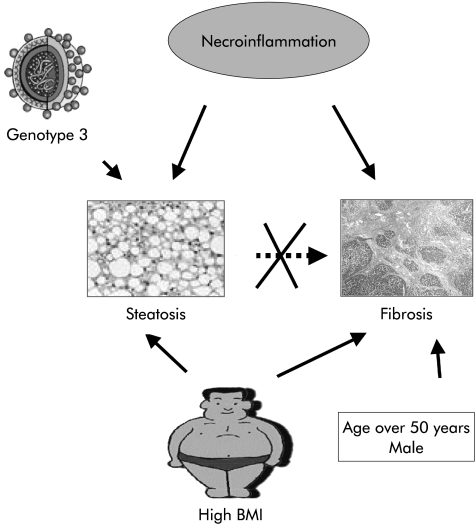
Results: Our study included 290 patients (143 men, 147 women). Mean body mass index (BMI) was 24 (3.8) kg/m(2). Proportions of patients with genotypes 1 and 3 were, respectively, 48% and 18%. A total of 135 patients (46.6%) had steatosis. Liver steatosis, in multivariate analysis, was associated with hepatitis C virus genotype 3, higher grade of necroinflammation, and higher BMI. There was no significant association between stage of fibrosis and liver steatosis. In multivariate analysis, high stage of fibrosis was associated with male sex, age over 50 years, high BMI, and high grade of necroinflammation.
Conclusion: In our population of patients with chronic hepatitis C, steatosis does not seem to be an important determinant of liver fibrosis. High grade of necroinflammation is associated with a high stage of fibrosis.
Figures
References
-
- Wasley A, Alter MJ. Epidemiology of hepatitis C: geographic differences and temporal trends. Semin Liver Dis 2000;20:1–16. - PubMed
-
- Marcellin P, Asselah T, Boyer N. Fibrosis and disease progression in hepatitis C. Hepatology 2002;36:S47–56. - PubMed
-
- Poynard T, Bedossa P, Opolon P. Natural history of liver fibrosis progression in patients with chronic hepatitis C. The OBSVIRC, METAVIR, CLINIVIR, and DOSVIRC groups. Lancet 1997;349:825–32. - PubMed
-
- Adinolfi LE, Gambardella M, Andreana A, et al. Steatosis accelerates the progression of liver damage of chronic hepatitis C patients and correlates with specific HCV genotype and visceral obesity. Hepatology 2001;33:1358–64. - PubMed
-
- Hourigan LF, Macdonald GA, Purdie D, et al. Fibrosis in chronic hepatitis C correlates significantly with body mass index and steatosis. Hepatology 1999;29:1215–19. - PubMed
Publication types
MeSH terms
LinkOut - more resources
Full Text Sources
Medical