


Quantitative trait loci in Anopheles gambiae controlling the encapsulation response against Plasmodium cynomolgi Ceylon
- PMID: 14577840
- PMCID: PMC280672
- DOI: 10.1186/1471-2156-4-16
Quantitative trait loci in Anopheles gambiae controlling the encapsulation response against Plasmodium cynomolgi Ceylon
Abstract
Background: Anopheles gambiae females are the world's most successful vectors of human malaria. However, a fraction of these mosquitoes is refractory to Plasmodium development. L3-5, a laboratory selected refractory strain, encapsulates transforming ookinetes/early oocysts of a wide variety of Plasmodium species. Previous studies on these mosquitoes showed that one major (Pen1) and two minor (Pen2, Pen3) autosomal dominant quantitative trait loci (QTLs) control the melanotic encapsulation response against P. cynomolgi B, a simian malaria originating in Malaysia.
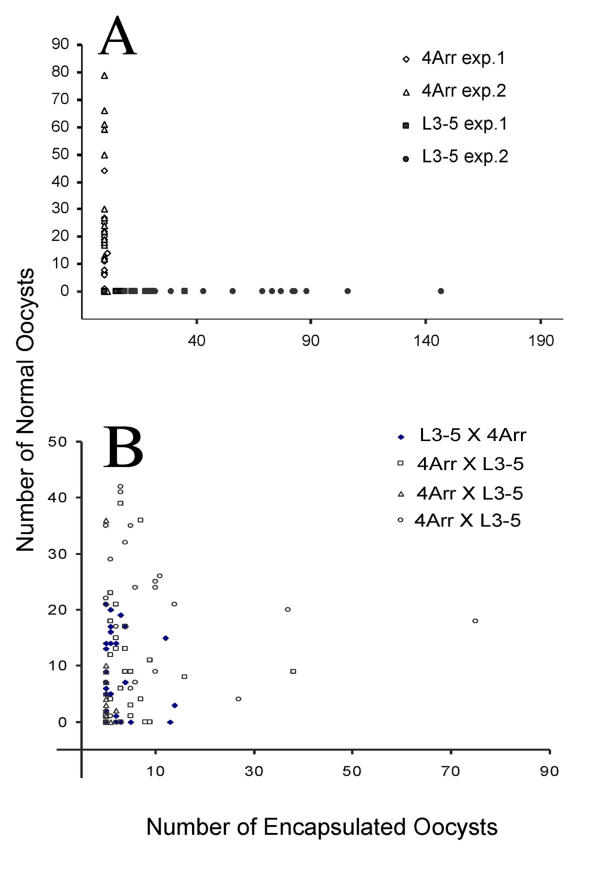
Results: We have investigated the response of L3-5 to infection with P. cynomolgi Ceylon, a different but related parasite species, in crosses with the susceptible strain 4Arr. Refractoriness to this parasite is incompletely recessive. Infection and genotyping of F2 intercross females at genome-spanning microsatellite loci revealed that 3 autosomal QTLs control encapsulation of this species. Two loci map to the regions containing Pen2 and Pen3. The novel QTL maps to chromosome 3R, probably to polytene division 32 or 33. Thus the relative contribution of any QTL to oocyst encapsulation varies with the species of parasite. Further, different QTLs were most readily identified in different F2 families. This, like the F1 data, suggests that L3-5 is not genetically homogeneous and that somewhat different pathways may be used to achieve an encapsulation response.
Conclusion: We have shown here that different QTLs are involved in responses against different Plasmodium parasites.
Figures

References
-
- Götz P, Vey A. Humoral encapsulation in insects. In: AP Gupta, editor. Hemocytic and Humoral Immunity in Arthropods. New York, Wiley and Sons; 1986. pp. 407–429.
-
- Götz P, Boman HG. Insect immunity. In: GA Kerkut and LI Gilbert, editor. Comprehensive Insect Physiology, Biochemistry and Pharmacology. Vol. 3. Oxford, Pergamon Press; 1985.
-
- Götz P. Mechanisms of encapsulation in dipteran hosts. In: AM Lackie, editor. Immune Mechanisms in Invertebrate Vectors. Oxford, Oxford University Press; 1986. pp. pp.1–20.
Publication types
MeSH terms
Grants and funding
LinkOut - more resources
Full Text Sources
Miscellaneous
