. 2003 Nov;77(22):11910-7.
doi: 10.1128/jvi.77.22.11910-11917.2003.

Resistance of human hepatitis delta virus RNAs to dicer activity

Affiliations

Resistance of human hepatitis delta virus RNAs to dicer activity

Jinhong Chang et al. J Virol. 2003 Nov.

Abstract

The endonuclease dicer cleaves RNAs that are 100% double stranded and certain RNAs with extensive but <100% pairing to release approximately 21-nucleotide (nt) fragments. Circular 1,679-nt genomic and antigenomic RNAs of human hepatitis delta virus (HDV) can fold into a rod-like structure with 74% pairing. However, during HDV replication in hepatocytes of human, woodchuck, and mouse origin, no approximately 21-nt RNAs were detected. Likewise, in vitro, purified recombinant dicer gave <0.2% cleavage of unit-length HDV RNAs. Similarly, rod-like RNAs of potato spindle tuber viroid (PSTVd) and avocado sunblotch viroid (ASBVd) were only 0.5% cleaved. Furthermore, when a 66-nt hairpin RNA with 79% pairing, the putative precursor to miR-122, which is an abundant liver micro-RNA, replaced one end of HDV genomic RNA, it was poorly cleaved, both in vivo and in vitro. In contrast, this 66-nt hairpin, in the absence of appended HDV sequences, was >80% cleaved in vitro. Other 66-nt hairpins derived from one end of genomic HDV, PSTVd, or ASBVd RNAs were also cleaved. Apparently, for unit-length RNAs of HDV, PSTVd, and ASBVd, it is the extended structure with <100% base pairing that confers significant resistance to dicer action.


Figures
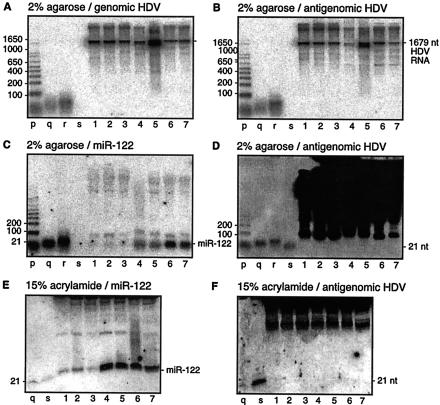
FIG. 1.
FIG. 1.
Northern gel analyses of RNAs from various sources of HDV genome replication. The seven sources of RNA are those listed in Table 2. As indicated, RNAs were separated in gels of either 2% agarose-formaldehyde (A to D) or 15% acrylamide-7 M urea (E and F). (A and B) Analysis to detect HDV genomic and antigenomic RNAs, respectively. (C to F) The amount of RNA analyzed was increased from 1 to 20 μg and the exposure times were increased 10-fold. Panels D and F show hybridization to detect antigenomic RNA, but under low-stringency conditions. Panels C and E show hybridization at low stringency to detect miR-122 (27). Lanes p to r represent end-labeled markers as follows: p, 1-kb ladder; q, 21-nt RNA; and r, 42-nt DNA. Lane s, 21-nt antigenomic RNA sequence used as a positive control for the ability of our low-stringency hybridization conditions to detect such a species. In panels E and F, the greater sample mass for lanes 1 to 7 slowed migration in 15% acrylamide relative to the standards q and s.
FIG. 2.
FIG. 2.
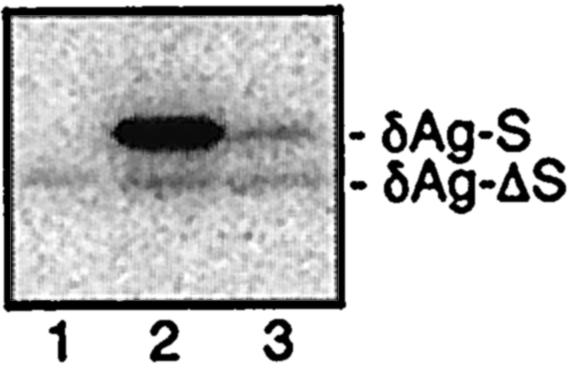
HDV genome replication did not lead to silencing of a related mRNA species. At day 0, cells were transfected with pDL448 to express δAg-ΔS, a form of δAg with a deletion. At days −2 and day 0, some of these cells (lanes 2 and 3, respectively) were transfected with pDL553 to initiate HDV genome replication and the expression of δAg-S. Another culture was not transfected with pDL553 (lane 1). Total protein was harvested at day 3 and examined by immunoblot to detect the two delta protein species.
FIG. 3.
FIG. 3.
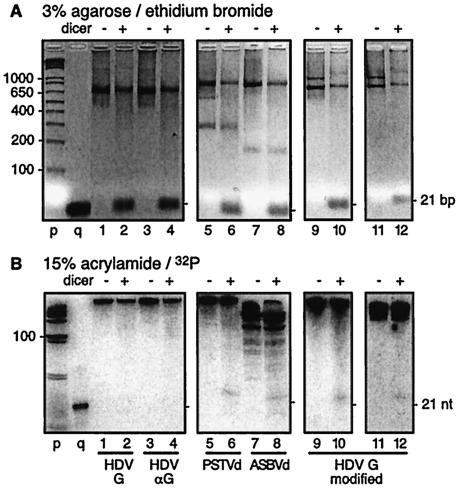
Action of recombinant dicer on HDV and other RNAs. Lanes 1 to 12, RNA samples either with (+) or without (−) dicer during incubation for 16 h at 37°C. Each sample contained 1 μg of double-stranded RNA. To each sample was added a 32P-labeled RNA as follows: lanes 1 and 2, genomic HDV RNA; lanes 3 and 4, antigenomic RNA; lanes 5 and 6, PSTVd RNA; lanes 7 and 8, ASBVd RNA; and lanes 9 and 10, modified genomic HDV RNA. For lanes 11 and 12, we added 1 μg of modified genomic RNA that was not labeled. The modification, as described in the text and in the legend for Fig. 4, was to replace some HDV sequences with those of the predicted precursor to miR-122. (A) Aliquots of each sample were analyzed in nondenaturing gels of 3% agarose followed by ethidium bromide staining and detection by digital imaging. (B) Aliquots were analyzed in gels of 15% polyacrylamide-7 M urea, after which the RNAs were electrotransferred to a nylon membrane. In lanes 11 and 12, miR-122 sequences were detected by low-stringency hybridization using a radiolabeled oligonucleotide probe. 32P was detected by use of bioimager. p, 1-kb DNA ladder; q, 21-bp RNA.
FIG. 4.
FIG. 4.
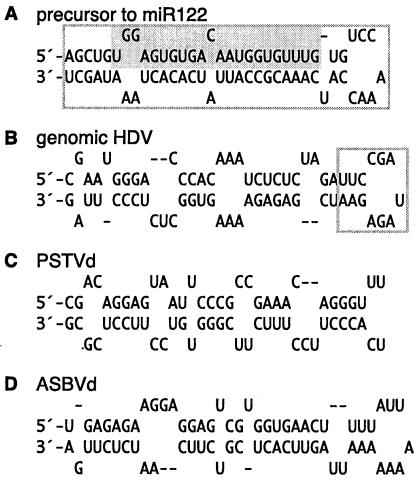
Predicted secondary structures for four different 66-nt hairpin RNAs. (A) Putative precursor to miR-122, as previously reported (27), with a 22-nt miR-122 cleavage product indicated by shading. (B) Structure for nt 760 to 825, one end of the predicted rod-like structure for a published sequence of genomic HDV RNA (25). The boxed sequence on HDV indicates the site at which we removed 13 nt of HDV sequence and replaced it with the 66 nt of the miR-122 precursor. (C) One end of the rod-like folding of PSTVd RNA (22). (D) A similar region from ASBVd RNA (35).
FIG. 5.
FIG. 5.
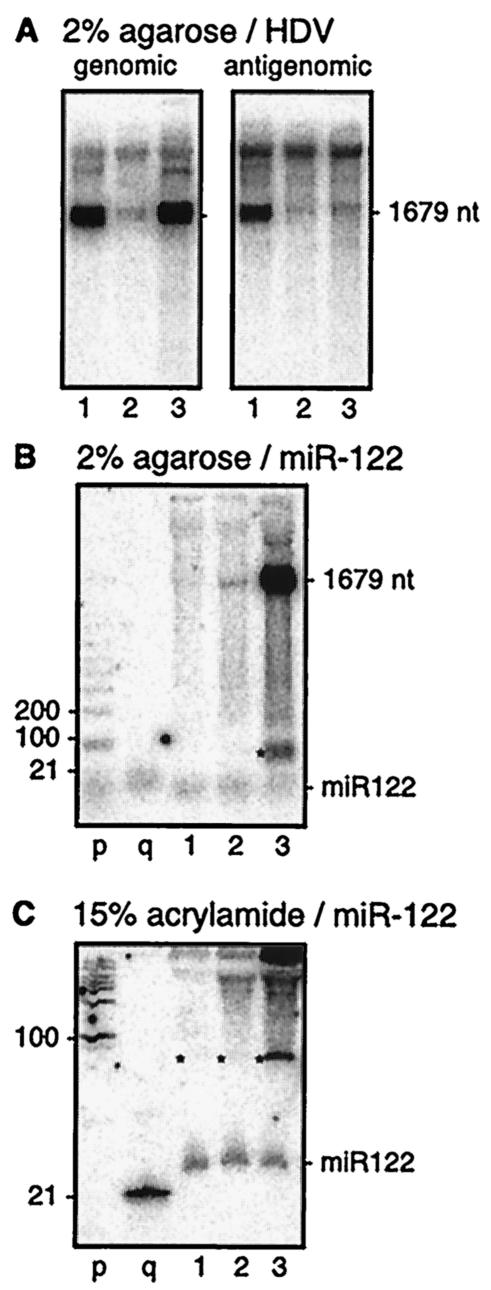
Assays for the replication and processing of an HDV genomic RNA modified to contain the putative precursor to miR-122. Huh7 cells were transfected with a DNA construct to express unmodified HDV (lanes 1) or with a construct containing the 66-nt putative miR-122 precursor (lanes 2 and 3). In lanes 3, the cells were additionally transfected with pSVTVA, a plasmid that creates a 16-fold increase in DNA-directed RNA transcription from the SV40-based expression vector (1). At day 4 after transfection, total RNA was extracted and aliquots were subjected to electrophoresis in gels of either 2% agarose or 15% acrylamide-7 M urea, as indicated. Northern analyses were then used to detect genomic and antigenomic HDV RNAs (A) or miR-122 (B and C). Size markers p and q were as described for Fig. 1. The position of the putative precursor to miR-122 is indicated by an asterisk.
FIG. 6.
FIG. 6.
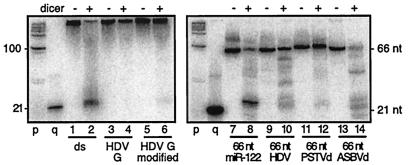
Action of dicer on full-length and 66-nt hairpin forms of HDV and other RNAs. Seven different species of 32P-labeled RNA were analyzed on gels of 15% acrylamide-7 M urea following incubation without (−) or with (+) dicer. The RNAs used were as follows: lanes 1 and 2, 100% double-strand (ds) RNA; lanes 3 and 4, unit-length genomic HDV RNA; lanes 5 and 6, unit-length modified HDV genomic RNA; lanes 7 and 8, 66-nt miR-122 precursor; lanes 9 and 10, 66-nt HDV genomic hairpin; lanes 11 and 12, 66-nt PSTVd RNA hairpin; lanes 13 and 14, 66-nt ASBVd RNA hairpin. After electrophoresis, the RNAs were electrotransferred to a nylon membrane, after which 32P was quantitated by use of a bioimager. Size markers p and q were as described for Fig. 1.

References

    1. Asselbergs, F. A. M., and P. Grand. 1993. A two-plasmid system for transient expression of cDNAs in primate cells. Anal. Biochem. 209:327-331. - PubMed
    1. Bernstein, E., A. A. Caudy, S. M. Hammond, and G. J. Hannon. 2001. Role for a bidentate ribonuclease in the initiation step of RNA interference. Nature 409:363-366. - PubMed
    1. Bevilacqua, A., M. C. Ceriani, S. Capaccioli, and A. Nicolin. 2003. Post-transcriptional regulation of gene expression by degradation of messenger RNAs. J. Cell. Physiol. 195:356-372. - PubMed
    1. Billy, E., V. Brondani, H. Zhang, U. Muller, and W. Filipowicz. 2001. Specific interference with gene expression induced by long, double-stranded RNA in mouse embryonal teratocarcinoma cell lines. Proc. Natl. Acad. Sci. USA 98:14428-14433. - PMC - PubMed
    1. Cattaneo, R. 1994. Biased (adenosine to inosine) hypermutation in animal virus genomes. Curr. Opin. Genet. Dev. 4:895-900. - PubMed

Publication types

MeSH terms