. 2003 Oct 28:4:16.
doi: 10.1186/1471-2121-4-16.

A dominant negative mutant of TLK1 causes chromosome missegregation and aneuploidy in normal breast epithelial cells

Affiliations

A dominant negative mutant of TLK1 causes chromosome missegregation and aneuploidy in normal breast epithelial cells

Gulshan Sunavala-Dossabhoy et al. BMC Cell Biol. .

Abstract

Background: In Arabidopsis thaliana, the gene Tousled encodes a protein kinase of unknown function, but mutations in the gene lead to flowering and leaf morphology defects. We have recently cloned a mammalian Tousled-Like Kinase (TLK1B) and found that it phosphorylates specifically histone H3, in vitro and in vivo. We now report the effects that overexpression of a kinase-dead mutant of TLK1B mediates in a normal diploid cell line.

Results: Expression of a kinase-dead mutant resulted in reduction of phosphorylated histone H3, which could have consequences in mitotic segregation of chromosomes. When analyzed by FACS and microscopy, these cells displayed high chromosome number instability and aneuploidy. This phenomenon was accompanied by less condensed chromosomes at mitosis; failure of a number of chromosomes to align properly on the metaphase plate; failure of some chromosomes to attach to microtubules; and the occasional presentation of two bipolar spindles. We also used a different method (siRNA) to reduce the level of endogenous TLK1, but in this case, the main result was a strong block of cell cycle progression suggesting that TLK1 may also play a role in progression from G1. This block in S phase progression could also offer a different explanation of some of the later mitotic defects.

Conclusions: TLK1 has a function important for proper chromosome segregation and maintenance of diploid cells at mitosis in mammalian cells that could be mediated by reduced phosphorylation of histone H3 and condensation of chromosomes, although other explanations to the phenotype are possible.


Figures

Figure 1
Figure 1
Overexpression of TLK1B-KD reduces the level of phosphorylated histone H3. a. Expression of wt and KD mutant TLK1B assessed by labeling the proteins with [35S]methionine and immunoprecipitation [8]. b. Western blot of histone H3 and phosphorylated H3 in the indicated cell lines, as explained in Methods. The bar-graph is the plot of three different experiments analyzed by densitometry, and shown as the average for each cell line and standard deviation.
Figure 2
Figure 2
Overexpression of TK1B-KD affects the ploidy of MM3MG cells. The cell cycle distribution of the indicated lines was analyzed by PI staining and FACS. The right panels show cells 24 h after treatment with 10 Gy of radiation.
Figure 3
Figure 3
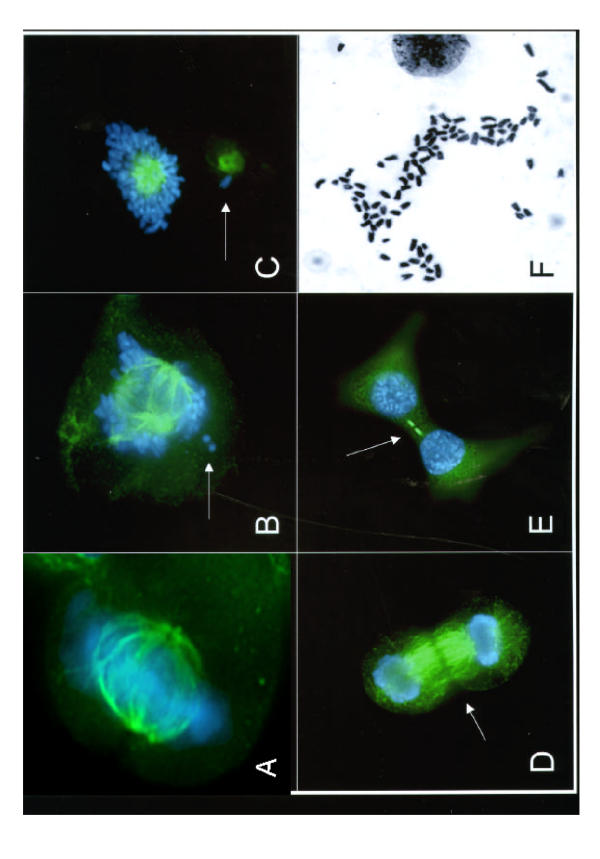
Overexpression of TLK1B-KD results in missegregation of chromosomes and other mitotic abnormalities. a. A normal metaphase in MM3MG-KD cells. b. Multi-polar spindles frequently found in MM3MG-TLK1B-KD cells. c. Unequal segregation of chromosomes in MM3MG-TLK1B-KD cells. d. Persistence of microtubules from the mitotic spindle after metaphase. e. Persistence of microtubules after cytokinesis found frequently in MM3MG-TLK1B-KD cells. f. A representative metaphase chromosome spread with 84 chromosomes from an MM3MG-TLK1B-KD cell.
Figure 4
Figure 4
Overexpression of TLK1B-KD results in reduced histone H3 phosphorylation and poor condensation of metaphase chromosomes. Metaphase spreads from each cell line were prepared, and chromosomes were decorated with anti-histone H3P and FITC-conjugated secondary antiserum. Panels A, C, E are DAPI-stained chromosomes; panels B, D, F are stained with anti-histone H3P. Panels A and B are chromosomes of MM3MG controls; panels C and D are cells overexpressing wt TLK1B; panels E and F are cells expressing the KD mutant. The signal from phosphorylated H3 was analyzed from 10 metaphases and five random fields of each. The values were as follows: MM3MG, median pixel intensity 168 (+/-10.6 SEM); TLK1B-overexpressing cells, median 183 (+/-6.9 SEM); TLK1B-KD cells, median 133 (+/- 7.4 SEM).
Figure 5
Figure 5
Transfection of siRNA against TLK1 mRNA results in slow progression from G1. Cells were transfected with duplex siRNA oligos, control (scrambled sequence: panel A and B) or TLK1 (panel C and D). Forty-eight hours after transfection, cells were treated (panel B and D), or not, with 1 μM nocodazole for 18 h. The inserted panel E is a western blot of TLK1 with and without treatment with siRNA.
Figure 6
Figure 6
Radiation sensitivity in TLK1-KD cells. Cells were exposed to 1, 2, and 4 Gy of gamma radiation and cell survival was measured with a clonogenic assay. The standard errors of mean were calculated at each dose.
Figure 7
Figure 7
TLK1B-KD does not inhibit Aurora B. The reactions in all lanes contained 100 ng of histone H3 (Boehringer Mannheim) and kinase buffer [8]. Lanes 1–4 have 100 ng of Aurora B kinase; Lanes 2–4 have increasing concentration of TLK1-MK, 0.1 μg, 0.3 μg and 1.0 μg respectively. Lanes 5 and 6 are negative controls, lane 5 having only histone H3 while lane 6 has histone H3 and 100 ng of TLK1B-MK (Kinase-dead mutant). The blot was reacted with phospho-histone H3 antiserum.

References

    1. Freeman LL, Aragon-Alcaide L, Strunnikov A. The condensin complex governs chromosome condensation and mitotic transmission of rDNA. J Cell Biol. 2000;149:811–824. doi: 10.1083/jcb.149.4.811. - DOI - PMC - PubMed
    1. Wei Y, Yu L, Bowen J, Gorovsky MA, Allis CD. Phosphorylation of histone H3 is required for proper chromosome condensation and segregation. Cell. 1999;97:99–109. doi: 10.1016/S0092-8674(00)80718-7. - DOI - PubMed
    1. Schmiesing JA, Gregson HC, Zhou S, Yokomori K. A human condensing complex containing hCAP-C-hCAP-E and CNAP1, a homolog of Xenopus XCAP-D2, colocalizes with phosphorylated histone H3 during early stage of mitotic chromosome condensation. Mol Cell Biol. 2000;20:6996–7006. doi: 10.1128/MCB.20.18.6996-7006.2000. - DOI - PMC - PubMed
    1. Roe JL, Rivin CJ, Sessions RA, Feldmann KA, Zambryski PC. The Tousled gene in A. Thaliana encodes a protein kinase homolog that is required for leaf and flower development. Cell. 1993;75:939–950. doi: 10.1016/0092-8674(93)90537-Z. - DOI - PubMed
    1. Roe JL, Nemhauser JL, Zambryski PC. TOUSLED participates in apical tissue formation during gynoecium development in Arabidopsis. Plant Cell. 1997;9:335–353. doi: 10.1105/tpc.9.3.335. - DOI - PMC - PubMed

Publication types

MeSH terms

Associated data

LinkOut - more resources