. 2003 Nov;23(22):7982-91.
doi: 10.1128/MCB.23.22.7982-7991.2003.

Discrete functions of TRAF1 and TRAF2 in Drosophila melanogaster mediated by c-Jun N-terminal kinase and NF-kappaB-dependent signaling pathways

Affiliations

Discrete functions of TRAF1 and TRAF2 in Drosophila melanogaster mediated by c-Jun N-terminal kinase and NF-kappaB-dependent signaling pathways

Guang-Ho Cha et al. Mol Cell Biol. 2003 Nov.

Abstract

Two Drosophila tumor necrosis factor receptor-associated factors (TRAF), DTRAF1 and DTRAF2, are proposed to have similar functions with their mammalian counterparts as a signal mediator of cell surface receptors. However, their in vivo functions and related signaling pathways are not fully understood yet. Here, we show that DTRAF1 is an in vivo regulator of c-Jun N-terminal kinase (JNK) pathway in Drosophila melanogaster. Ectopic expression of DTRAF1 in the developing eye induced apoptosis, thereby causing a rough-eye phenotype. Further genetic interaction analyses revealed that the apoptosis in the eye imaginal disc and the abnormal eye morphogenesis induced by DTRAF1 are dependent on JNK and its upstream kinases, Hep and DTAK1. In support of these results, DTRAF1-null mutant showed a remarkable reduction in JNK activity with an impaired development of imaginal discs and a defective formation of photosensory neuron arrays. In contrast, DTRAF2 was demonstrated as an upstream activator of nuclear factor-kappaB (NF-kappaB). Ectopic expression of DTRAF2 induced nuclear translocation of two Drosophila NF-kappaBs, DIF and Relish, consequently activating the transcription of the antimicrobial peptide genes diptericin, diptericin-like protein, and drosomycin. Consistently, the null mutant of DTRAF2 showed immune deficiencies in which NF-kappaB nuclear translocation and antimicrobial gene transcription against microbial infection were severely impaired. Collectively, our findings demonstrate that DTRAF1 and DTRAF2 play pivotal roles in Drosophila development and innate immunity by differentially regulating the JNK- and the NF-kappaB-dependent signaling pathway, respectively.


Figures
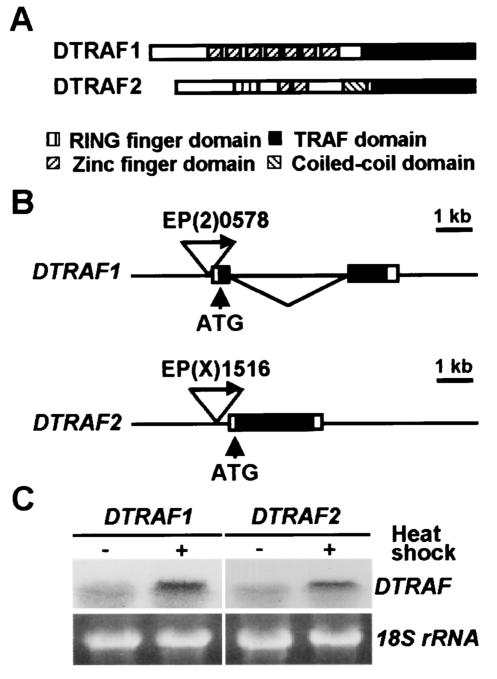
FIG. 1.
FIG. 1.
Characterization of DTRAF overexpression flies. (A) Schematic representation of the protein domains of DTRAF1 and DTRAF2. (B) EP fly lines for DTRAF genes. Two EP lines, EP(2)0578 and EP(X)1516, have a P-element in the 5′ flanking regions of DTRAF1 and DTRAF2, respectively. The triangle with an arrow represents the P-element, and ATG denotes the translational initiation site. Exons are indicated by boxes, and coding regions are highlighted by black boxes. (C) Inducible expression of DTRAFs in vivo. Using a GAL4/UAS system, ectopic expression of DTRAF1 or DTRAF2 was induced by heat shock at 37°C for 3 h, and their transcript levels were determined by Northern blot analysis. (Left panel) DTRAF1 mRNA from hs-GAL4/EP(2)0578; (right panel) DTRAF2 mRNA from EP(X)1516/X; hs-GAL4/+. 18S rRNA (18S rRNA) was used as a loading control.
FIG. 2.
FIG. 2.
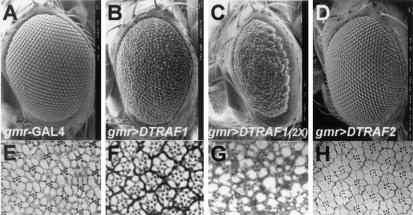
Effects of DTRAF1 on Drosophila eye development. Scanning electron micrographs of the compound eyes (A to D) and their tangential sections (E to H) are shown. (A and E) gmr-GAL4/±; (B and F) gmr-GAL4, EP(2)0578/+; (C and G) gmr-GAL4, EP(2)0578/EP(2)0578; (D and H) EP(X)1516/Y; gmr-GAL4/+. All pictures are shown with anterior to the left and dorsal to the top. Magnifications: A to D, ×200; E to H, ×1,000.
FIG. 3.
FIG. 3.
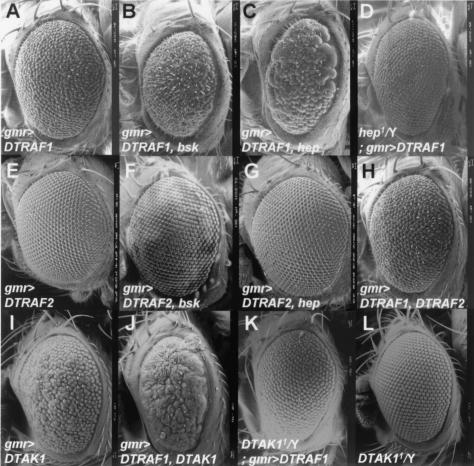
Genetic interactions between DTRAF1 and the JNK signaling pathway components. Scanning electron micrographs of adult eyes are shown. (A) gmr-GAL4, EP(2)0578/+. (B) gmr-GAL4, EP(2)0578/UAS-bsk. (C) gmr-GAL4, EP(2)0578/UAS-hep. (D) hep1/Y; gmr-GAL4, EP(2)0578/+. (E) EP(X)1516/Y; gmr-GAL4/+. (F) EP(X)1516/Y; gmr-GAL4/UAS-bsk. (G) EP(X)1516/Y; gmr-GAL4/UAS-hep. (H) EP(X)1516/Y; gmr-GAL4, EP(2)0578/+. (I) gmr-GAL4/UAS-DTAK1. (J) gmr-GAL4, EP(2)0578/UAS-DTAK1. (K) DTAK11/Y; gmr-GAL4, EP(2)0578/+. (L) DTAK11/Y. Anterior to the left and dorsal to the top. Magnification: ×200.
FIG. 4.
FIG. 4.
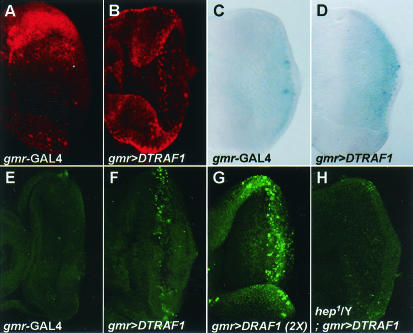
DTRAF1 induces activation of the JNK signaling pathway and apoptosis. (A and B) The eye imaginal discs were immunostained with an anti-phospho-specific JNK antibody as described in Materials and Methods. (A) gmr-GAL4/+. (B) gmr-GAL4, EP(2)0578/+. (C and D) puckered-LacZ reporter assays were also conducted in the eye discs. (C) gmr-GAL4/+; puckered-LacZ/+. (D) gmr-GAL4, EP(2)0578/+; puckered-LacZ/+. (E to H) DTRAF1-induced apoptosis in the eye discs was examined by TUNEL assays. (E) gmr-GAL4/+. (F) gmr-GAL4, EP(2)0578/+. (G) gmr-GAL4, EP(2)0578/EP(2)0578. (H) hep1/Y; gmr-GAL4, EP(2)0578/+.
FIG. 5.
FIG. 5.
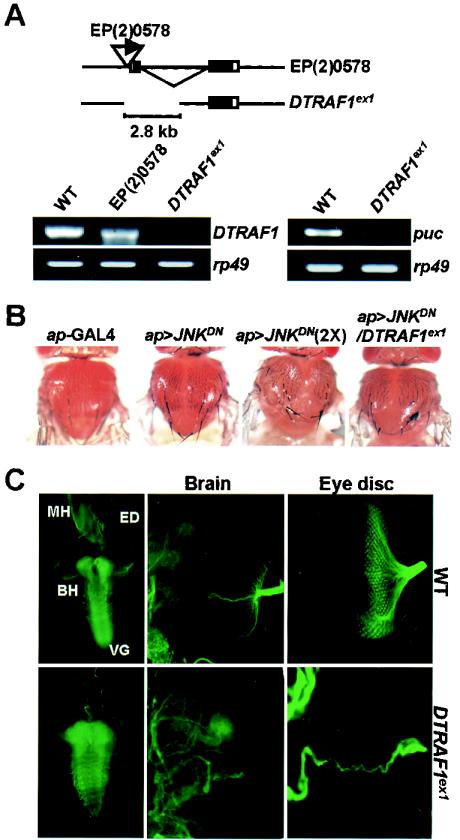
Characterization of DTRAF1-null mutant. (A) Molecular characteristics of DTRAF1ex1 mutant. In the upper panel are shown genomic structures of original EP(2)0578 line and its derivative, DTRAF1ex1 mutant. Exons are indicated by boxes, and coding regions are highlighted by black boxes. The deleted region in DTRAF1ex1 is displayed as a gap. In the lower left panel, the RT-PCR result demonstrated that DTRAF1ex1 lacks DTRAF1 gene expression. In the lower right panel, the RT-PCR results showed the reduction of puckered (puc) transcription level in DTRAF1ex1. Ribosomal protein 49 (rp49) was used as an internal control. Lanes: WT, wild-type w1118; EP(2)0578, EP(2)0578/EP(2)0578; DTRAF1ex1, DTRAF1ex1/DTRAF1ex1. (B) Enhanced thorax closure defects of JNKDN transgenic flies by DTRAF1ex1 mutation. Subpanels: ap-GAL4 (ap-GAL4/+), ap>JNKDN (UAS-JNKDN/X; ap-GAL4/+), ap>JNKDN(2X) (UAS-JNKDN/UAS-JNKDN; ap-GAL4/+), ap>JNKDN/DTRAF1ex1 (UAS-JNKDN/X; ap-GAL4/DTRAF1ex1). (C) DTRAF1 is required for normal development of Drosophila optical system. Photosensory neurons spanning from imaginal eye discs into brain hemisphere were immunostained with monoclonal antibody 22C10 as described in Materials and Methods. WT = wild type, w1118; DTRAF1ex1 = DTRAF1ex1/DTRAF1ex1. The left panels show the brain-eye disc-mouth complex (magnification, ×70). The middle panels show the brain hemisphere (magnification, ×200). The upper right panels show the wild-type eye disc (magnification, ×200). The lower right panel shows the image for the eye imaginal disc of DTRAF1ex1 mutant was further magnified to obtain a better view (magnification, ×600). BH, brain hemisphere; ED, eye disc; MH, mouth hook; VG, ventral ganglia.
FIG. 6.
FIG. 6.
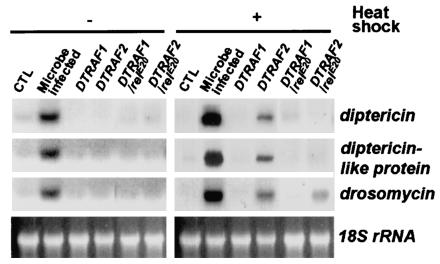
DTRAF2 overexpression induces antimicrobial gene expression. Using the hs-GAL4 driver, DTRAF1 or DTRAF2 were ectopically expressed in wild-type or relE20 homozygous mutant third-instar larvae (−, untreated control; +, heat-shocked at 37°C). Total RNA from each sample was prepared, and Northern blot analysis was completed to determine the expression of diptericin, diptericin-like protein, and drosomycin. Lanes: CTL (hs-GAL4/+, uninfected control,), Microbe infected (hs-GAL4/+, pricked with a concentrated culture of E. coli), DTRAF1 [hs-GAL4/EP(2)0578], DTRAF2 [EP(X)1516/X; hs-GAL4/+], DTRAF1/relE20 [hs-GAL4/EP(2)0578; relE20/relE20], DTRAF2/relE20 [EP(X)1516/X; hs-GAL4/+; relE20/relE20]. 18S rRNA (18S rRNA) was used as a loading control.
FIG. 7.
FIG. 7.
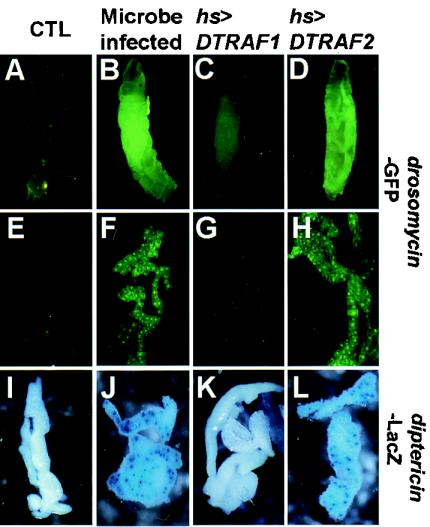
DTRAF2 overexpression induces antimicrobial gene expression in situ. Third-instar larvae of the designated genotypes were either infected with Escherichia coli or heat shocked at 37°C for 3 h as described in Materials and Methods. (A to D) The larvae were examined under a fluorescence microscope to locate the GFP-expressing tissues. (E to H) In addition, the fat bodies dissected from the larvae were examined by using a fluorescence microscope. (I to L) In the case of diptericin-LacZ reporter larvae, the fat bodies were X-Gal stained and observed under light microscope. (A, B, E, and F) drosomycin-GFP/X; hs-GAL4/+. (C and G) drosomycin-GFP/X; hs-GAL4/EP(2)0578. (D and H) EP(X)1516/drosomycin-GFP; hs-GAL4/+. (I and J) diptericin-LacZ/X; hs-GAL4/+. (K) diptericin-LacZ/X; hs-GAL4/EP(2)0578. (L) EP(X)1516/diptericin-LacZ; hs-GAL4/+. Columns: CTL, uninfected control samples; Microbe infected, E. coli-infected control samples; hs>DTRAF1, heat shock-induced DTRAF1-overexpressing samples; hs>DTRAF2, heat shock-induced DTRAF2-overexpressing samples.
FIG. 8.
FIG. 8.
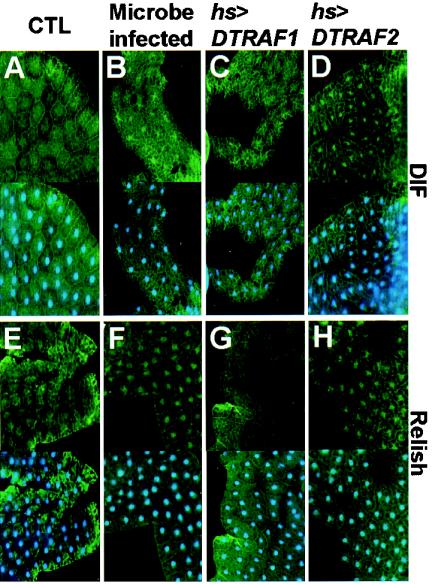
DTRAF2 overexpression induces nuclear translocation of DIF and Relish in fat bodies. (A to D) Immunohistochemcal analysis with anti-DIF antibody. (E to H) Immunohistochemcal analysis with anti-Relish antibody. (A, B, E, and F) hs-GAL4/+. (C and G) hs-GAL4/EP(2)0578. (D and H) EP(X)1516/X; hs-GAL4/+. The top row of panels show antibody staining only; the lower panels show merged images of the upper images with Hoechst-nucleus staining images. Columns: CTL, fat bodies of uninfected control larvae; Microbe infected, fat bodies of E. coli-infected control larvae; hs>DTRAF1, fat bodies of heat shock-induced DTRAF1-overexpressing larvae; hs>DTRAF2, fat bodies of heat shock-induced DTRAF2-overexpressing larvae.
FIG. 9.
FIG. 9.
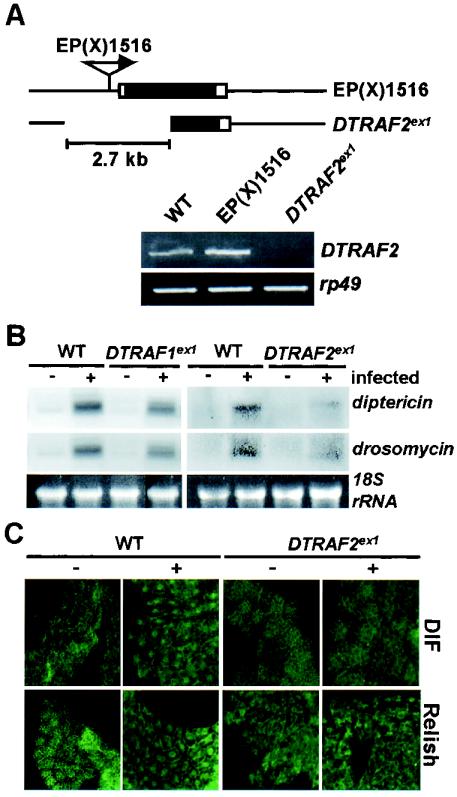
Characterization of DTRAF2-null mutant. (A) Molecular characteristics of DTRAF2ex1 mutant. The upper panel shows genomic structures of original EP(X)1516 and its derivative, the DTRAF2ex1 mutant. The deleted region in DTRAF2ex1 is displayed as a gap. In the lower panel, RT-PCR results showed that DTRAF2ex1 lacks DTRAF2 transcription. (B) Impaired immune responses in DTRAF2ex1 mutant. Wild type (WT, w1118), DTRAF1ex1 mutant (DTRAF1ex1/DTRAF1ex1), and DTRAF2ex1 mutant (DTRAF2ex1/DTRAF2ex1) were infected with E. coli (+), and Northern blot analyses were performed to determine the induction of diptericin and drosomycin transcription. Control groups were not infected (−). 18S rRNA (18S rRNA) was used as a loading control. (C) Impaired nuclear-translocation of DIF and Relish in DTRAF2ex1 mutants. Immunohistochemical analyses were completed with anti-DIF (upper panels) and anti-Relish antibodies (lower panels) to localize DIF and Relish in the fat bodies from uninfected (−) and E. coli-infected (+) wild-type (WT, w1118) and DTRAF2ex1 (DTRAF2ex1/DTRAF2ex1) larvae.

References

    1. Adachi-Yamada, T., K. Fujimura-Kamada, Y. Nishida, and K. Matsumoto. 1999. Distortion of proheximodistal information causes JNK-dependent apoptosis in Drosophila wing. Nature 400:166-169. - PubMed
    1. Adachi-Yamada, T., M. Nakamura, K. Irie, Y. Tomoyasu, Y. Sano, E. Mori, S. Goto, N. Ueno, Y. Nishida, and K. Matsumoto. 1999. p38 mitogen-activated protein kinase can be involved in transforming growth factor beta superfamily signal transduction in Drosophila wing morphogenesis. Mol. Cell. Biol. 19:2322-2329. - PMC - PubMed
    1. Arch, R. H., R. W. Gedrich, and C. B. Thompson. 1998. Tumor necrosis factor receptor-associated factors (TRAFs): a family of adapter proteins that regulates life and death. Genes Dev. 12:2821-2830. - PubMed
    1. Braun, A., J. A. Hoffmann, and M. Meister. 1998. Analysis of the Drosophila host defense in domino mutant larvae, which are devoid of hemocytes. Proc. Natl. Acad. Sci. USA 95:14337-14342. - PMC - PubMed
    1. Bulet, P., J. L. Dimarcq, C. Hetru, M. Lagueux, M. Charlet, G. Hegy, A. Van Dorsselaer, and J. A. Hoffmann. 1993. A novel inducible antibacterial peptide of Drosophila carries an O-glycosylated substitution. J. Biol. Chem. 268:14893-14897. - PubMed

MeSH terms

Substances