. 2003 Nov;23(22):8323-33.
doi: 10.1128/MCB.23.22.8323-8333.2003.

The FACT complex travels with elongating RNA polymerase II and is important for the fidelity of transcriptional initiation in vivo

Affiliations

The FACT complex travels with elongating RNA polymerase II and is important for the fidelity of transcriptional initiation in vivo

Paul B Mason et al. Mol Cell Biol. 2003 Nov.

Erratum in

  • Mol Cell Biol. 2004 Jul;24(14):6536

Abstract

The FACT complex facilitates transcription on chromatin templates in vitro, and it has been functionally linked to nucleosomes and putative RNA polymerase II (Pol II) elongation factors. In Saccharomyces cerevisiae cells, FACT specifically associates with active Pol II genes in a TFIIH-dependent manner and travels across the gene with elongating Pol II. Conditional inactivation of the FACT subunit Spt16 results in increased Pol II density, transcription, and TATA-binding protein (TBP) occupancy in the 3' portion of certain coding regions, indicating that FACT suppresses inappropriate initiation from cryptic promoters within coding regions. Conversely, loss of Spt16 activity reduces the association of TBP, TFIIB, and Pol II with normal promoters. Thus, FACT is required for wild-type cells to restrict initiation to normal promoters, thereby ensuring that only appropriate mRNAs are synthesized. We suggest that FACT contributes to the fidelity of Pol II transcription by linking the processes of initiation and elongation.


Figures
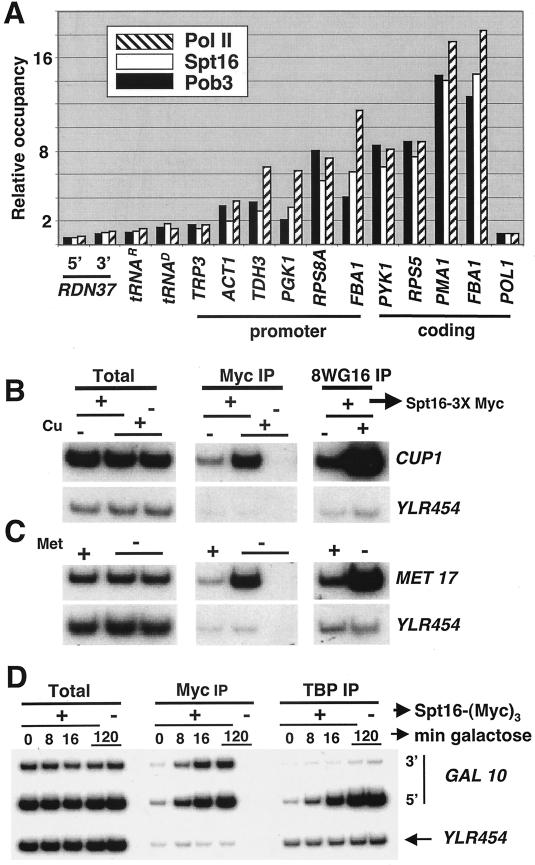
FIG.1.
FIG.1.
FACT associates with active Pol II genes. (A) Cells containing Spt16-(Myc)3 or Pob3-(Myc)3 were examined by chromatin immunoprecipitation with either Myc or 8WG16 antibodies followed by quantitative PCR using primers to the indicated regions. The relative level of Spt16 (white bars), Pob3 (black bars), and Pol II (8WG16) (striped bars) association (defined in arbitrary units as described in Materials and Methods) are shown. (B to D) For induction experiments, cells containing or lacking Spt16-(Myc)3 were induced by 10-min treatment with 1 mM CuSO4 (B), 3 h of growth in medium lacking methionine (C), or a shift from 2% raffinose to 2% galactose medium for the indicated times (D) and analyzed for the levels of Spt16, TBP, and Pol II (8WG16 antibody) at the indicated regions.
FIG. 2.
FIG. 2.
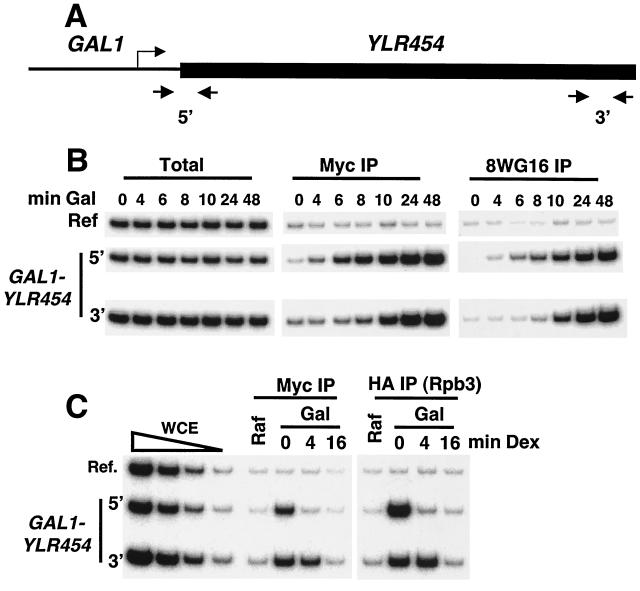
FACT travels with Pol II throughout the mRNA coding region. (A) Schematic representation of the GAL1-YLR454 gene. (B) Spt16 and Pol II association with the indicated regions in cells containing Spt16-(Myc)3 that were grown in 2% raffinose (Raf) medium and shifted to 2% galactose (Gal) medium for the indicated times. (C) Spt16 and Pol II association with the indicated regions in cells containing Spt16-(Myc)3 and HA-Rpb3 that were induced with 2% galactose for 60 min and then repressed with 4% glucose (Dex) for the indicated times. WCE represents chromatin prior to immunoprecipitation.
FIG. 3.
FIG. 3.
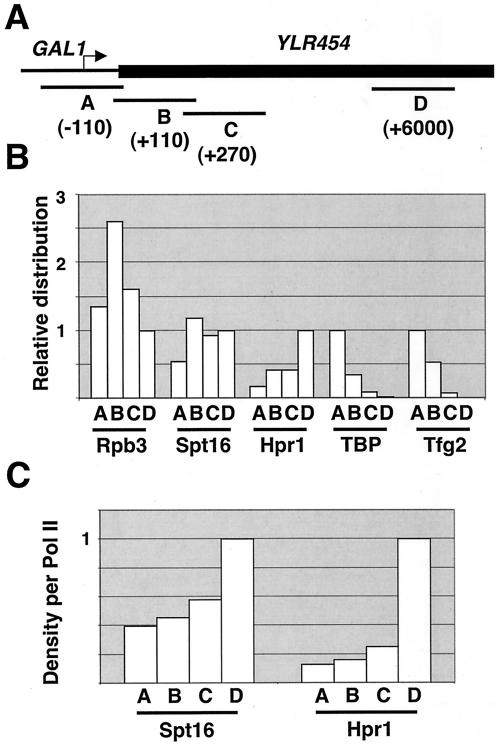
Spt16 association occurs just downstream of promoter. (A) Regions of the GAL1-YLR454 gene used to map protein occupancy at the promoter-proximal region. (B) Chromatin from galactose-induced cells containing either Hpr1-(Myc)13, HA-Rpb3, Spt16-(Myc)3, TBP, or Tfg2-(Myc)3 was immunoprecipitated with appropriate antibodies and analyzed by quantitative PCR. (C) Relative levels of Spt16 and Hpr1 with respect to Pol II at the indicated regions.
FIG. 4.
FIG. 4.
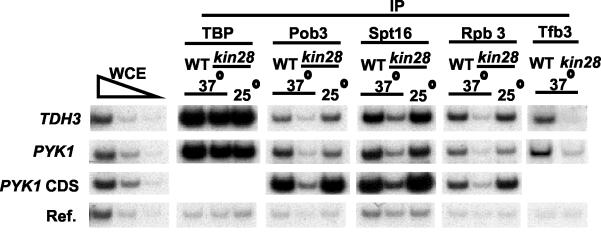
Spt16 association depends on TFIIH. Cross-linked chromatin from wild-type or kin28-ts16 cells grown at 25°C that were or were not shifted to 37°C for 1 h were immunoprecipitated with appropriate antibodies and analyzed by quantitative PCR with primers to the indicated regions.
FIG. 5.
FIG. 5.
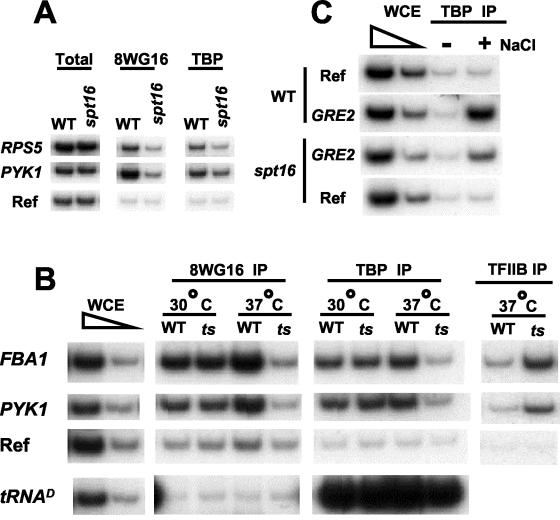
Spt16 depletion results in reduced TBP occupancy at promoters. (A) Strains lacking or containing a copper-inducible Spt16 depletion allele were treated with 0.75 mM copper sulfate for 3 h and analyzed for association of Pol II and TBP at the indicated promoters. (B) Pol II, TBP, and TFIIB association at the indicated promoters in wild-type or spt16-197 cells grown at 30°C and shifted to 37°C for 1 h. (C) TBP association at the GRE2 promoter in wild-type (WT) or copper-treated, Spt16-depleted cells that were or were not treated with 0.4 M NaCl for 5 min.
FIG. 6.
FIG. 6.
Inactivation of Spt16 causes increased Pol II occupancy within the 3′ regions of certain genes. (A) Strains lacking or containing a copper-inducible Spt16-depletion allele were treated with 0.75 mM copper sulfate for 3 h and analyzed for Pol II association (8WG16 antibody) at the indicated regions. (B) Pol II occupancy at the indicated regions in wild-type or spt16-197 cells containing HA-Rpb3 that were shifted to 37°C for 60 min.
FIG. 7.
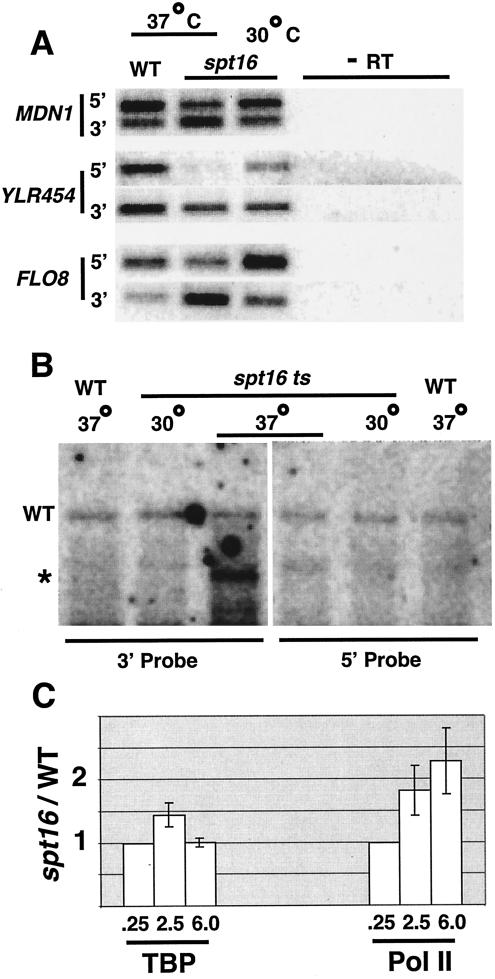
FIG. 7.
Inactivation of Spt16 causes transcription from a cryptic promoter within the YLR454 coding region. Wild-type and spt16-197 cells were shifted to 37°C for 60 min. (A) RNA levels (− RT indicates the absence of reverse transcriptase) at the indicated regions as determined by reverse transcriptase-PCR analysis. (B) Northern blot of mRNA hybridized to probes corresponding to the 5′ and 3′ regions of the YLR454 coding region. The wild-type 8-kb (WT) and internal 5.3-kb (*) transcripts are indicated. Molecular weights were calculated using the ribosomal RNAs as standards. The faint band that appears in all six lanes at a position just above that of the 5.3-kb transcript represents nonspecific hybridization that is unrelated to the YLR454 locus. The very faint band that occurs only under conditions of Spt16 inactivation at a position below that of the 5.3-kb transcript might represent another internal transcript, although we cannot exclude the possibility of nonspecific hybridization. (C) Ratio of TBP and Pol II association at the indicated YLR454 coding regions (defined in kilobases from the ATG initiation codon) in the spt16 strain with respect to the wild-type strain. The ratios for the 2.5 and 6.0 regions were normalized to that of the 0.25 regions, which was defined as 1.0.

References

    1. Akhtar, A., G. Faye, and D. L. Bentley. 1996. Distinct activated and non-activated RNA polymerase II complexes in yeast. EMBO J. 15:4654-4664. - PMC - PubMed
    1. Bentley, D. L., and M. Groudine. 1986. A block to elongation is largely responsible for decreased transcription of c-myc in differentiated HL60 cells. Nature 321:702-706. - PubMed
    1. Brewster, N. K., G. C. Johnston, and R. A. Singer. 2001. A bipartite yeast SSRP1 analog comprised of Pob3 and Nhp6 proteins modulates transcription. Mol. Cell. Biol. 21:3491-3502. - PMC - PubMed
    1. Brewster, N. K., G. C. Johnston, and R. A. Singer. 1998. Characterization of the CP complex, an abundant dimer of Cdc68 and Pob3 proteins that regulates yeast transcriptional activation and chromatin repression. J. Biol. Chem. 273:21972-21979. - PubMed
    1. Cismowski, M., G. Laff, M. Soloman, and S. Reed. 1995. KIN28 encodes a C-terminal domain kinase that controls mRNA transcription in Saccharomyces cerevisiae but lacks cyclin-dependent kinase-activating kinase (CAK) activity. Mol. Cell. Biol. 15:2983-2992. - PMC - PubMed

Publication types

MeSH terms

Substances