. 2003 Nov 3;22(21):5951-61.
doi: 10.1093/emboj/cdg566.

Mss51p promotes mitochondrial Cox1p synthesis and interacts with newly synthesized Cox1p

Affiliations

Mss51p promotes mitochondrial Cox1p synthesis and interacts with newly synthesized Cox1p

Xochitl Perez-Martinez et al. EMBO J. .

Abstract

The post-transcriptional role of Mss51p in mitochondrial gene expression is of great interest since MSS51 mutations suppress the respiratory defect caused by shy1 mutations. SHY1 is a Saccharomyces cerevisiae homolog of human SURF1, which when mutated causes a cytochrome oxidase assembly defect. We found that MSS51 is required for expression of the mitochondrial reporter gene ARG8(m) when it is inserted at the COX1 locus, but not when it is at COX2 or COX3. Unlike the COX1 mRNA-specific translational activator PET309, MSS51 has at least two targets in COX1 mRNA. MSS51 acts in the untranslated regions of the COX1 mRNA, since it was required to synthesize Arg8p when ARG8(m) completely replaced the COX1 codons. MSS51 also acts on a target specified by the COX1 coding region, since it was required to translate either COX1 or COX1:: ARG8(m) coding sequences from an ectopic COX2 locus. Mss51p was found to interact physically with newly synthesized Cox1p, suggesting that it could coordinate Cox1p synthesis with insertion into the inner membrane or cytochrome oxidase assembly.


Figures
None
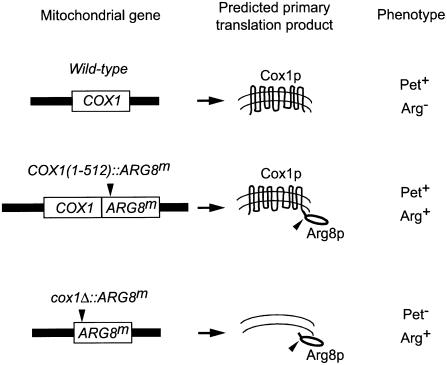
Fig. 1. ARG8m reporter constructs at COX1. The mitochondrial genes, predicted translation products, and arginine and respiratory phenotypes of strains bearing wild-type nuclear genomes are indicated. The open boxes represent the COX1 and ARG8m structural genes. The COX1 5′-UTL and 3′-UTR are indicated as solid boxes. The black triangles indicate the processing site for the pre-Arg8p matrix-targeting signal. In the COX1(1–512)::ARG8m construct, the ARG8m gene was fused in-frame to the complete, 512 COX1 codons, such that the COX1 stop codon was replaced by the initial methionine of the ARG8m gene. In the cox1Δ::ARG8m construct, the ARG8m gene replaced the COX1 codons, and was precisely fused to the COX1 5′-UTL and 3′-UTR.
None
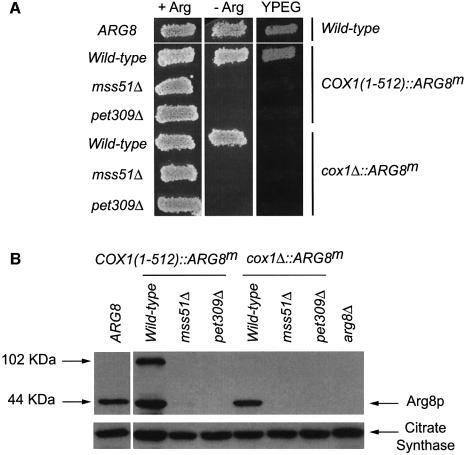
Fig. 2. MSS51 is required for translation of ARG8m when it is inserted at COX1. (A) Growth phenotypes. Relevant nuclear and mitochondrial genotypes are indicated on the left and right side of the panel, respectively. Yeast cells were grown on YPD and replica plated to glucose minimal medium containing (+Arg) or lacking (–Arg) arginine, and complete non-fermentable medium containing ethanol and glycerol (YPEG) as indicated. Cells carrying the nuclear-encoded ARG8 gene were used for arginine growth comparison (ARG8). Cells were grown for 2 days at 30°C. (B) Steady-state accumulation of the reporter Arg8p. A 25µg aliquot of total mitochondrial proteins was separated by 12.5% SDS–PAGE, and the western blot was probed with anti-Arg8p antibody. The membrane was stripped and reprobed with antibody against citrate synthase as a loading control. An arg8 null mutant (arg8Δ) was used as a negative control. Strain details are given in the Supplementary data.
None
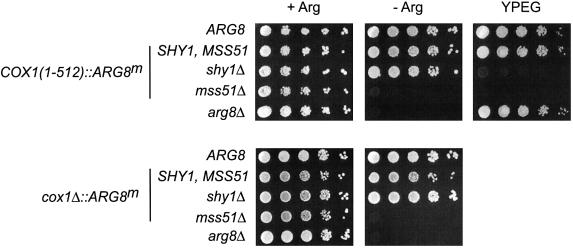
Fig. 3. The shy1Δ mutation does not affect the expression of ARG8m in the COX1(1–512)::ARG8m and cox1Δ::ARG8m mitochondrial genes. Ten-fold serial dilutions of cells bearing the COX1(1–512)::ARG8m or cox1Δ::ARG8m mitochondrial alleles were spotted on glucose minimal medium containing (+Arg) or lacking (–Arg) arginine, or complete ethanol/glycerol medium (YPEG), and incubated for 3 days at 30°C. In addition, a strain that expressed the nuclear-encoded ARG8 gene (ARG8) and an arg8 null mutant (arg8Δ) were included. Strain details are given in the Supplementary data.
None
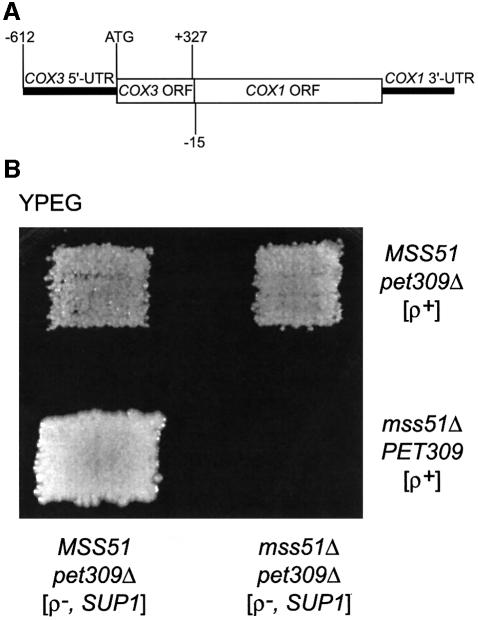
Fig. 4. MSS51 function cannot be bypassed by a pet309Δ suppressor. (A) Representation of the mtDNA rearrangement termed SUP1 (Manthey, 1995) that allows COX1 expression in a pet309Δ background. SUP1 arose from a recombination event between the COX3 locus and the COX1 5′-UTL sequence. The resulting chimeric gene has the entire COX3 5′-UTL sequence and the first 327 nucleotides of the COX3 coding region fused to 15 nucleotides of the COX1 5′-UTR and the rest of COX1. (B) Haploid cells containing a ρ mtDNA bearing the SUP1 gene were patched in vertical stripes. Their relevant nuclear genotypes are indicated. Cells containing wild-type, ρ+ mitochondria were patched on horizontal stripes. Their relevant nuclear genotypes are as indicated. The stripes were cross-printed on YPD medium and allowed to mate. The plate was then printed on non-fermentable YPEG medium and incubated for 5 days at 30°C. Strain details are given in the Supplementary data.
None
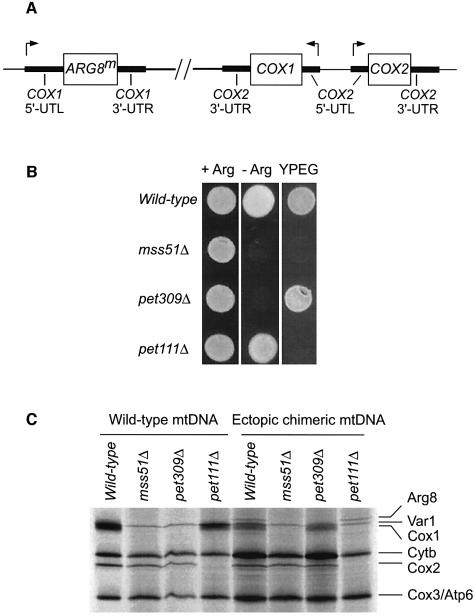
Fig. 5. MSS51 is required to express the COX1 coding sequence when it is fused to the COX2 5′-UTL and 3′-UTR at an ectopic locus. (A) Schematic representation of mtDNA bearing the ectopic chimeric COX1 gene. The COX1 structural gene is flanked by 73 and 119 bp encoding the COX2 5′-UTL and 3′-UTR, respectively (Mireau et al., 2003). This construct was inserted into ρ+ mtDNA, 295 bp upstream of the COX2 gene. The endogenous COX1 gene was replaced with cox1Δ::ARG8m (Materials and methods). Open boxes indicate COX1, COX2 and ARG8m structural genes. The COX1 and COX2 5′-UTLs and 3′-UTRs are indicated as thick lines. The arrows indicate the direction of transcription for each gene. (B) Growth phenotypes of strains carrying the ectopic chimeric COX1 gene. Relevant nuclear genotypes are as indicated. Cells grown on liquid YPD were spotted on glucose minimal medium containing (+Arg) or lacking (–Arg) arginine and on non-fermentable ethanol/glycerol medium (YPEG), and incubated for 2 days at 30°C. The pet111Δ mutation removes the COX2 mRNA-specific translational activator (Poutre and Fox, 1987; Mulero and Fox, 1993). (C) Pulse-labeling of mitochondrial translation products. Cells were labeled with [35S]methionine for 30 min in the presence of cycloheximide, and proteins were analyzed as described in Materials and methods. Cytochrome c oxidase subunit 1, Cox1; subunit 2, Cox2; subunit 3, Cox3; cytochrome b, Cytb; subunit 6 of ATPase, Atp6; ARG8m gene product, Arg8; and the ribosomal protein, Var1. Strain details are given in the Supplementary data.
None
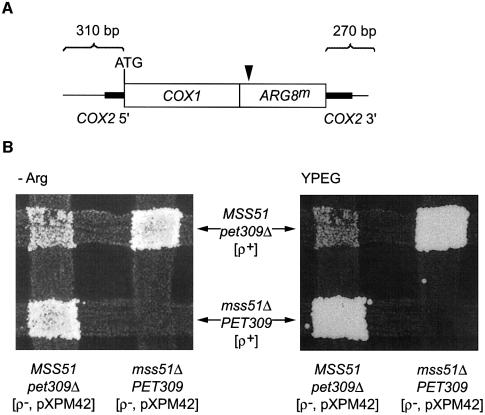
Fig. 6. Mss51p acts through the COX1 coding sequence to promote COX1 translation. (A) Schematic representation of the chimeric COX1 gene present in the plasmid pXPM42. The COX1(1–512)::ARG8m gene (represented as open boxes) was fused to 310 bp of the COX2 5′-UTL and 270 bp of the COX2 3′-UTR. The 54 bp from the COX2 promoter and 75 bp from the COX2 mRNA 3′ end are represented by thick lines. The black triangle indicates the position of the pre-Arg8p targeting signal cleavage site. (B) Expression of the chimeric COX1(1–512)::ARG8m gene in mss51Δ and pet309Δ mutants. Synthetic ρ, haploid strains carrying pXPM42 DNA were patched in vertical stripes on YPD. Cells containing wild-type ρ+ mitochondria were patched on YPD on horizontal stripes. Their relevant genotypes are as indicated. The stripes were cross-printed on YPD and allowed to mate overnight before being replicated to glucose minimal medium lacking arginine (–Arg) and complete non-fermentable ethanol/glycerol medium (YPEG). These plates were incubated for 5 days at 30°C to reveal the phenotype of the resulting heteroplasmic diploid strains. Strain details are given in the Supplementary data.
None
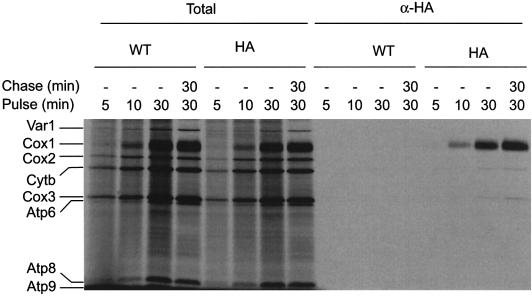
Fig. 7. Mss51p interacts with newly synthezised Cox1p. Translation in mitochondria isolated from MSS51 (WT) or MSS51-HA (HA) strains was performed at 25°C in the presence of [35S]methionine. Samples were removed at the indicated labeling times (pulse). A fourth sample was pulse-labeled for 30 min and then chased by addition of 10 mM cold methionine followed by incubation at 25°C for 30 min (chase). Mitochondria were washed and solubilized, and the solubilized products were immunoprecipitated with anti-HA antibody (α-HA). Translation products were analyzed by SDS–PAGE and autoradiography. The total aliquots represent 10% of the aliquots used for immunoprecipiation. Abbreviations are as in Figure 5C; ATPase subunit 8, Atp8; subunit 9, Atp9. Strain details are given in the Supplementary data.
None
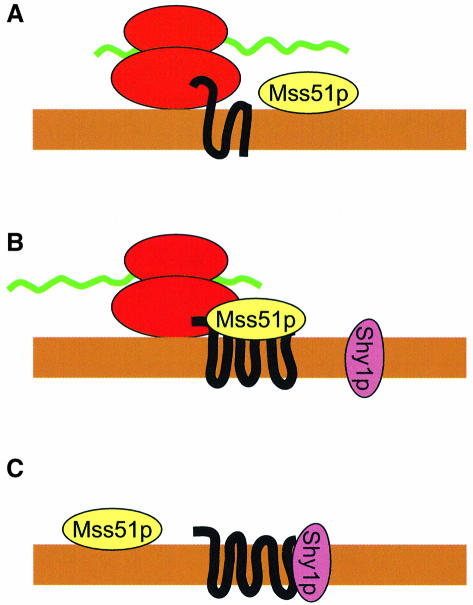
Fig. 8. A model for regulation of Cox1p synthesis based on its physical interaction with Mss51p. This model is based on the possibility that the target specified by the COX1 coding sequence, through which Mss51p promotes Cox1p synthesis, is Cox1p itself. We propose the following. (A) Translation elongation of the COX1 mRNA (green line) may be arrested by interaction of the nascent Cox1p polypeptide (black, thick line) with the ribosome. (B) Interaction of Mss51p with nascent Cox1p allows completed translation. (C) Mss51p ‘hands off’ newly synthesized Cox1p to Shy1p, and possibly other proteins, for assembly. Mss51p is then released and available to interact with another Cox1p nascent polypeptide as shown in (A). The mitochondrial inner membrane is shown as a brown bar. For simplicity, the action of Mss51p through the COX1 mRNA UTRs to promote translation was not included in this model, since the target could involve the COX1 5′-UTR, the 3′-UTR or both.

References

    1. Aldridge P. and Hughes,K.T. (2002) Regulation of flagellar assembly. Curr. Opin. Microbiol., 5, 160–165. - PubMed
    1. Barrientos A., Barros,M.H., Valnot,I., Rotig,A., Rustin,P. and Tzagoloff,A. (2002a) Cytochrome oxidase in health and disease. Gene, 286, 53–63. - PubMed
    1. Barrientos A., Korr,D. and Tzagoloff,A. (2002b) Shy1p is necessary for full expression of mitochondrial COX1 in the yeast model of Leigh’s syndrome. EMBO J., 21, 43–52. - PMC - PubMed
    1. Bonnefoy N. and Fox,T.D. (2000) In vivo analysis of mutated initiation codons in the mitochondrial COX2 gene of Saccharomyces cerevisiae fused to the reporter gene ARG8m reveals lack of downstream reinitiation. Mol. Gen. Genet., 262, 1036–1046. - PubMed
    1. Bonnefoy N. and Fox,T.D. (2001) Genetic transformation of Saccharomyces cerevisiae mitochondria. Methods Cell Biol., 65, 381–396. - PubMed

Publication types

MeSH terms