. 2003 Nov 11;100(23):13579-84.
doi: 10.1073/pnas.1735481100. Epub 2003 Oct 30.

Extensive repetitive DNA facilitates prokaryotic genome plasticity

Affiliations

Extensive repetitive DNA facilitates prokaryotic genome plasticity

Rahul A Aras et al. Proc Natl Acad Sci U S A. .

Abstract

Prokaryotic genomes are substantially diverse, even when from closely related species, with the resulting phenotypic diversity representing a repertoire of adaptations to specific constraints. Within the microbial population, genome content may not be fixed, as changing selective forces favor particular phenotypes; however, organisms well adapted to particular niches may have evolved mechanisms to facilitate such plasticity. The highly diverse Helicobacter pylori is a model for studying genome plasticity in the colonization of individual hosts. For H. pylori, neither point mutation, nor intergenic recombination requiring the presence of multiple colonizing strains, is sufficient to fully explain the observed diversity. Here we demonstrate that H. pylori has extensive, nonrandomly distributed repetitive chromosomal sequences, and that recombination between identical repeats contributes to the variation within individual hosts. That H. pylori is representative of prokaryotes, especially those with smaller (<2 megabases) genomes, that have similarly extensive direct repeats, suggests that recombination between such direct DNA repeats is a widely conserved mechanism to promote genome diversification.


Figures
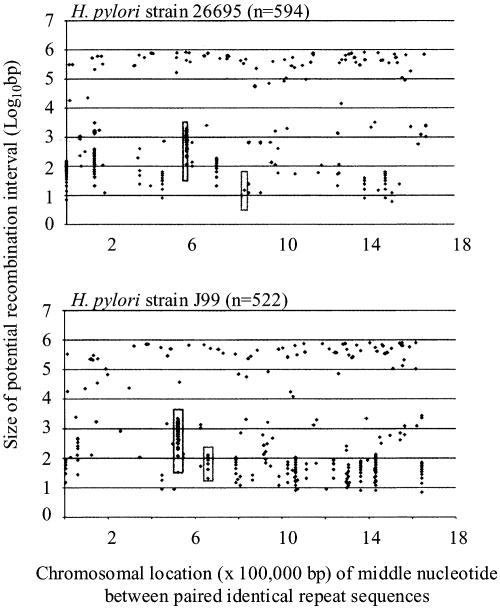
Fig. 2.
Fig. 2.
Genomic locations of paired repeats in H. pylori strains 26695 and J99. The abscissa represents the chromosomal location (×100,000 bp) of the middle nucleotide of the segment flanked by the paired repeats, and the ordinate represents the size of the potential recombination interval. The H. pylori cagY and amiA loci are in long and short boxes, respectively.
Fig. 1.
Fig. 1.
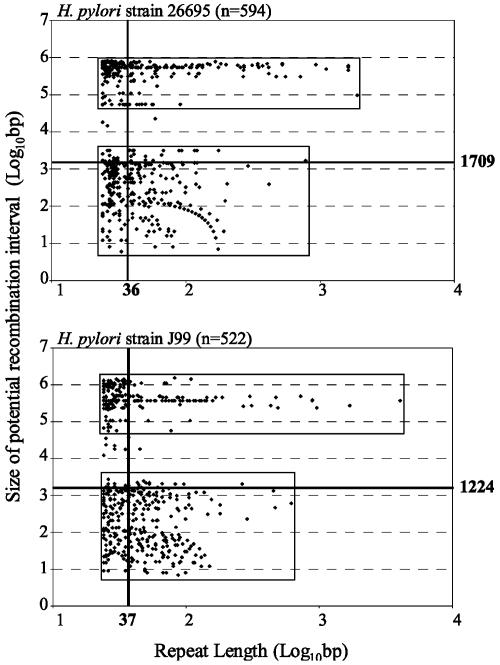
Relation between size of paired repeats and length of chromosomal regions subject to recombination for H. pylori strains 26695 and J99. The abscissa represents the length of the repeated elements, and the ordinate represents the size of the recombination interval (segment between paired repeats plus one repeat); the bold lines represent the median values, with lengths (in bp) indicated.
Fig. 3.
Fig. 3.
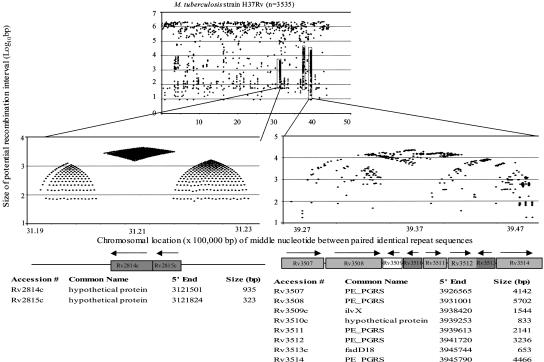
Repeat organization in M. tuberculosis H37Rv potential recombination hotspots. The potential M. tuberculosis recombination hotspots show highly nonrandom distributions of repetitive DNA; the “beehives flanking diamond” pattern observed on the left also is present on the right, but across a wider distance and with less definition. M. tuberculosis strain CDC1551 shows highly similar phenomena (not shown). Below each panel are the annotated gene designations by tigr (www.tigr.org) and a schematic of the locus. Paralogous ORFs are shaded the same color.
Fig. 4.
Fig. 4.
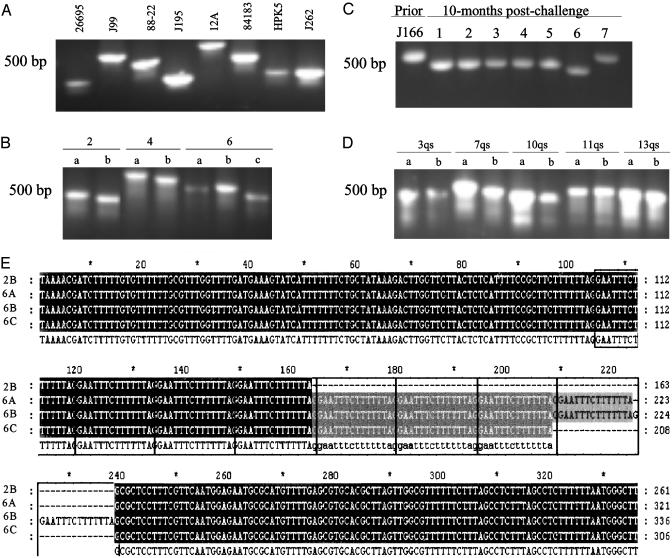
PCR and sequence analysis of H. pylori amiA region with multiple direct repeats. PCR primers (AmiF/AmiR) flank repeat region in A-D. (A) Eight unrelated wild-type strains from different locales. (B) Seven closely related isolates from three members of an extended family. (C) Eight isolates of strain J166 obtained before and 10 months after experimental challenge of a rhesus monkey. (D) Paired isolates obtained 7-10 years apart from five patients. (E) Sequence analysis of isolates 2B, 6A, 6B, and 6C (B) indicates their identity, except that the PCR product size variation is caused by differences in number (4, 8, 9, and 7, respectively) of direct 15-bp repeats (boxed).

References

    1. Dobrindt, U. & Hacker, J. (2001) Curr. Opin. Microbiol. 4, 550-557. - PubMed
    1. Boucher, Y., Nesbo, C. L. & Doolittle, W. F. (2001) Curr. Opin. Microbiol. 4, 285-289. - PubMed
    1. Peek, R. M., Jr., & Blaser, M. J. (2002) Nat. Rev. Cancer 2, 28-37. - PubMed
    1. Li, C., Ha, T., Chi, D. S., Ferguson, D. A., Jr., Jiang, C., Laffan, J. J. & Thomas, E. (1997) J. Clin. Microbiol. 35, 3021-3025. - PMC - PubMed
    1. Israel, D. A. Salama, N., Krishna, U., Rieger, U. M., Atherton, J. C., Falkow, S. & Peek, R. M., Jr. (2001) Proc. Natl. Acad. Sci. USA 98, 14625-14630. - PMC - PubMed

Publication types