. 2003 Nov;112(9):1437-43.
doi: 10.1172/JCI19441.

Induction of FoxP3 and acquisition of T regulatory activity by stimulated human CD4+CD25- T cells

Affiliations

Induction of FoxP3 and acquisition of T regulatory activity by stimulated human CD4+CD25- T cells

Mindi R Walker et al. J Clin Invest. 2003 Nov.

Abstract

CD4+CD25+ regulatory T (TR) cells have been described in both humans and mice. In mice, TR are thymically derived, and lack of TR leads to organ-specific autoimmunity. Recently, the forkhead/winged helix transcription factor, FoxP3, has been shown to be important for the function of TR cells in mice. In this study, human TR cells were examined and, in results similar to those of studies done in mice, expression of FoxP3 was found exclusively in CD4+CD25+ T cells and correlated with the suppressive activity of these cells. In contrast to the mouse studies, activation of human CD4+CD25- T cells led to expression of FoxP3. Expression of FoxP3 in activated human CD4+CD25+ cells also correlated with suppression of proliferation by these cells in freshly isolated CD4+CD25- T cells from the same donor. This suppression was cell-contact dependent and cytokine independent. Thus, in humans, during activation of CD4+CD25- T cells in an immune response, two populations of cells may arise, effector CD4+CD25+ and regulatory CD4+CD25+ T cells, with expression of FoxP3 correlated with regulatory activity. These data also raise the possibility that a failure to generate peripheral TR cells properly may contribute to autoimmune disease and suggest a possible therapeutic role for FoxP3 in the treatment of such diseases.


Figures
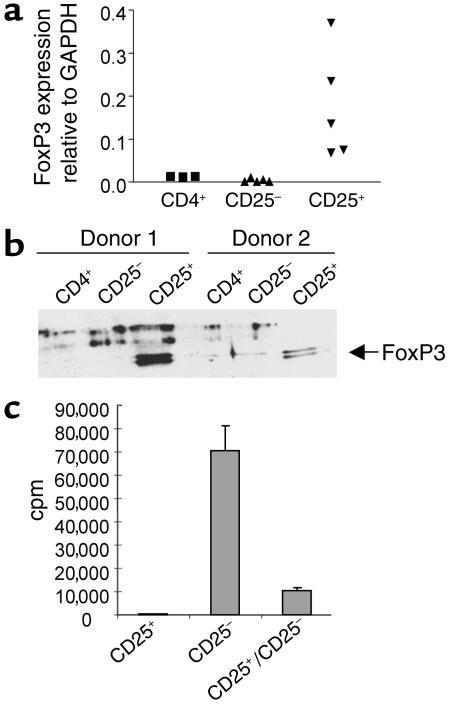
Figure 1
Figure 1
CD4+CD25+ regulatory cells from normal human peripheral blood express FoxP3. (a) Real-time QPCR analysis of FoxP3 gene expression relative to GAPDH expression in purified CD4+, CD4+CD25 (CD25), and CD4+CD25+ (CD25+) T cells from a range of normal donors. (b) Western blot analysis of FoxP3 in purified CD4+, CD4+CD25–, and CD4+CD25+ cells from two separate donors. (c) Proliferation and suppression of purified CD4+CD25– and CD4+CD25+ T cells stimulated with soluble anti-CD3 and anti-CD28. These data are from one experiment but are representative of eight separate experiments with a suppression range of 60–95%.
Figure 2
Figure 2
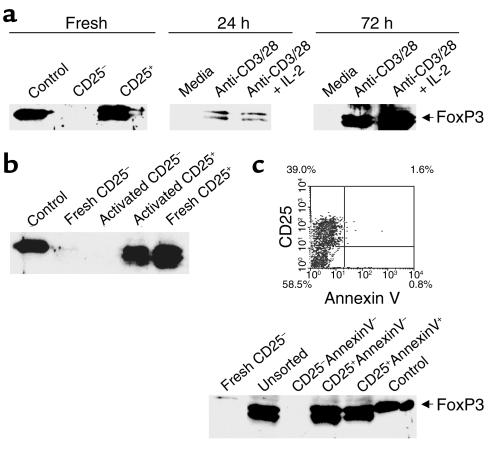
Activation of human CD4+CD25– T cells induces FoxP3 expression. Western blot analysis of FoxP3 expression in (a) freshly isolated, purified CD4+, CD4+CD25+, and CD4+CD25– T cells or CD4+CD25– T cells that have or have not (media) been activated with plate-bound anti-CD3/soluble anti-CD28 (anti-CD3/28) for 24 or 72 hours in the presence or absence of IL-2, (b) freshly isolated CD4+CD25– or CD4+CD25+ and activated CD4+CD25– PBMCs after sorting into CD4+CD25– and CD4+CD25+ T cells. (c) FACS plot showing percentage of cells in each population before sorting. Western blot analysis of FoxP3 expression in freshly isolated CD4+CD25– T cells or activated CD4+CD25– T cells either unsorted or sorted for CD25 and Annexin V staining. Cells were also gated and sorted on live cells by FCS versus SSC. Control cells were 293T cells transfected with a human FoxP3 cDNA clone. Parts a and b show results from one experiment but are representative of four separate experiments. Figure 2c shows results from one experiment.
Figure 3
Figure 3
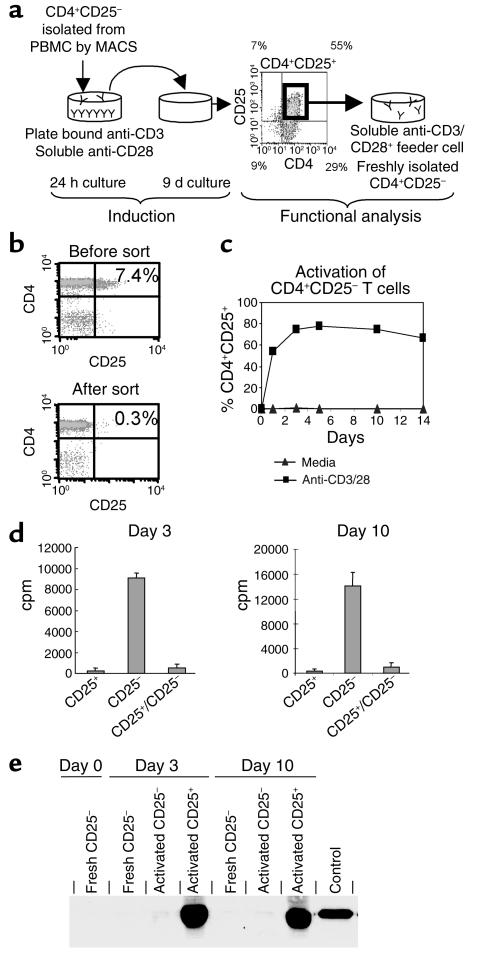
CD4+CD25+ regulatory T cells can be induced by activation of human CD4+CD25– PBMCs. (a) Schematic for generation of regulatory cells from CD4+CD25– cells, including a typical FACS plot with percentages for activated CD4+CD25– cells before sorting. Cells were incubated on plate-bound Ab (Y) for 24 hours and then transferred to a new well without Ab for 9 days. (b) Dot plots showing CD4 versus CD25 staining on CD4+ PBL before and after sorting with CD25 MACS microbeads. (c) Percent of CD4+CD25+ cells over time when CD4+CD25– cells were stimulated with plate-bound anti-CD3/soluble anti-CD28 or media. (d) Proliferation and suppression of freshly isolated CD4+CD25– T cells by CD4+CD25+ cells, which were generated by activating CD4+CD25– PBMCs with plate-bound anti-CD3/soluble anti-CD28 for 3 or 10 days. (e) Western blot analysis of FoxP3 expression on day 3 or day 10 after activation of CD4+CD25– T cells. Control cells were 293T cells transfected with a human FoxP3 cDNA clone. These data are from one experiment and are representative of six separate experiments with a suppression range of 60–95%.
Figure 4
Figure 4
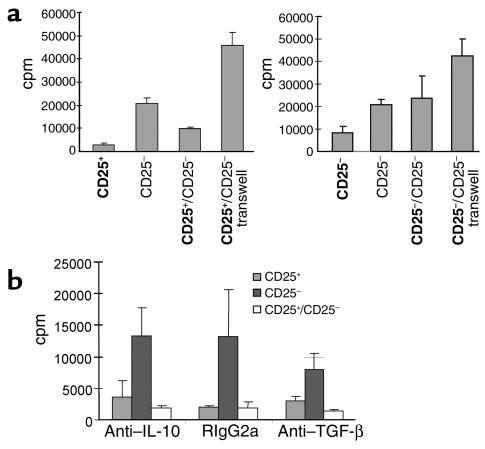
Activation-induced CD4+CD25+ regulatory T cells are cell-contact dependent and cytokine independent. Proliferation and suppression of freshly isolated CD4+CD25– T cells by CD4+CD25+ (a, left panel, and b) or CD4+CD25– (a, right panel) cells, which were generated by activation CD4+CD25– PBMCs with plate-bound anti-CD3/soluble anti-CD28 for 14 days. (a) CD4+CD25+ and CD4+CD25– cells from the same culture were sorted and cultured alone, together with freshly isolated CD25– cells, or separated by a transwell. Sorted cells are indicated in bold type and freshly isolated cells in normal type. (b) Cells were cultured in the presence of 10 μg/ml anti–IL-10, anti-TGF-β, or an isotype control Ab (RIgG2a). These data are from one experiment but are representative of two separate experiments.

Comment in

References

    1. Jameson SC, Bevan MJ. T-cell selection. Curr. Opin. Immunol. 1998;10:214–219. - PubMed
    1. Van Parijs L, Abbas AK. Homeostasis and self-tolerance in the immune system: turning lymphocytes off. Science. 1998;280:243–248. - PubMed
    1. Maloy KJ, Powrie F. Regulatory T cells in the control of immune pathology. Nat. Immunol. 2001;2:816–822. - PubMed
    1. Sakaguchi S, et al. Immunologic tolerance maintained by CD25+ CD4+ regulatory T cells: their common role in controlling autoimmunity, tumor immunity, and transplantation tolerance. Immunol. Rev. 2001;182:18–32. - PubMed
    1. Shevach EM. CD4+ CD25+ suppressor T cells: more questions than answers. Nat. Rev. Immunol. 2002;2:389–400. - PubMed

Publication types

MeSH terms