. 2003 Nov 10;163(3):457-61.
doi: 10.1083/jcb.200306132. Epub 2003 Nov 3.

A function for the mitochondrial chaperonin Hsp60 in the structure and transmission of mitochondrial DNA nucleoids in Saccharomyces cerevisiae

Affiliations

A function for the mitochondrial chaperonin Hsp60 in the structure and transmission of mitochondrial DNA nucleoids in Saccharomyces cerevisiae

Brett A Kaufman et al. J Cell Biol. .

Abstract

The yeast mitochondrial chaperonin Hsp60 has previously been implicated in mitochondrial DNA (mtDNA) transactions: it is found in mtDNA nucleoids associated with single-stranded DNA; it binds preferentially to the template strand of active mtDNA ori sequences in vitro; and wild-type (rho+) mtDNA is unstable in hsp60 temperature-sensitive (ts) mutants grown at the permissive temperature. Here we show that the mtDNA instability is caused by a defect in mtDNA transmission to daughter cells. Using high resolution, fluorescence deconvolution microscopy, we observe a striking alteration in the morphology of mtDNA nucleoids in rho+ cells of an hsp60-ts mutant that suggests a defect in nucleoid division. We show that rho- petite mtDNA consisting of active ori repeats is uniquely unstable in the hsp60-ts mutant. This instability of ori rho- mtDNA requires transcription from the canonical promoter within the ori element. Our data suggest that the nucleoid dynamics underlying mtDNA transmission are regulated by the interaction between Hsp60 and mtDNA ori sequences.


Figures
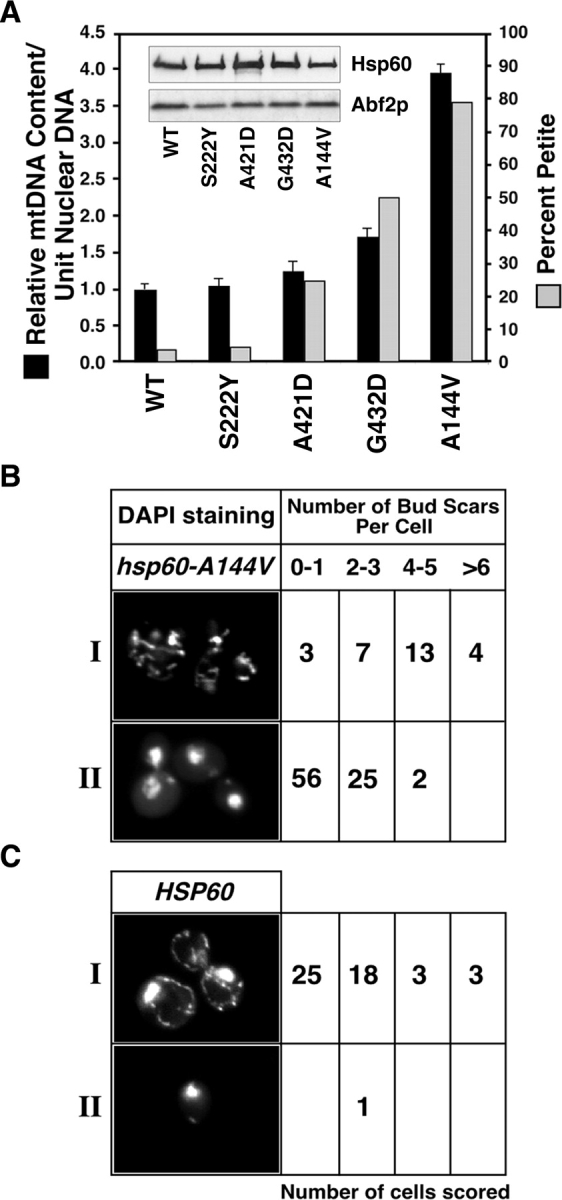
Figure 1.
Figure 1.
Mutations in HSP60 increase mtDNA levels and result in an mtDNA transmission defect. (A) Correlation between ρ+ mtDNA instability in hsp60-t s mutants grown in glucose medium (YPD) and mtDNA content in the same cells grown in glycerol medium (YPG). mtDNA instability data, scored as the percent petites in the population after 24 h growth on YPD at 24°C (gray bars, right Y axis), are from Kaufman et al. (2000). mtDNA levels relative to nuclear DNA (black bars, left Y axis) were determined by Southern blot analysis on whole-cell DNA. (A, inset) The elevated DNA levels in hsp60 mutants are not a result of altered Hsp60 or Abf2p protein levels. The indicated mutant strains were grown in YPG, and protein levels in whole cell lysates from equal numbers of cells were determined by Western blotting. (B and C) Older hsp60-A144V mutant cells grown in glucose medium contain more mtDNA than younger cells. Mutant (B) and wild-type (C) cells were precultured in YPG and transferred to YPD for 8–10 generations. Class I and class II cells were randomly chosen from fields to represent cells with either high (≥wild type) or low (≤two or three DAPI staining bodies) amounts of mtDNA nucleoids per cell, respectively, and then counterscored for bud scar number as described in the Materials and methods.
Figure 2.
Figure 2.
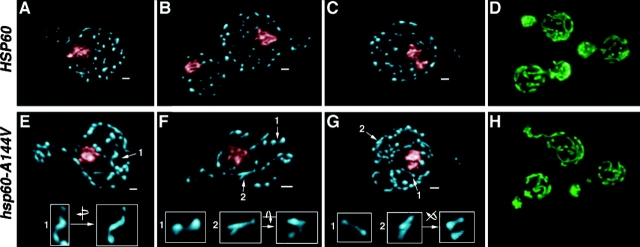
hsp60-A144V mutant cells contain altered nucleoid structures. Wild-type (A–D) and hsp60-A144V mutant cells (E–H) were prepared as described in the Materials and methods. Nuclear DNA (A–C and E–G) was colored red after rendering. Numbered structures have been enlarged in panel insets, and some structures were rotated in three-dimensional space as indicated. The wild-type cells (and buds, A–C) contain 2.7, 2.3 (small cell not included), and 2.3 μm3 of mitochondrial DAPI staining, respectively, and hsp60-A144V cells (E–G) contain 4.3, 2.6, and 5.3 μm3, respectively. Bars, 1 μm. Unrendered, single focal plane images of GFP-labeled mitochondria in wild-type and hsp60-A144V mutant strains are shown in D and H, respectively.
Figure 3.
Figure 3.
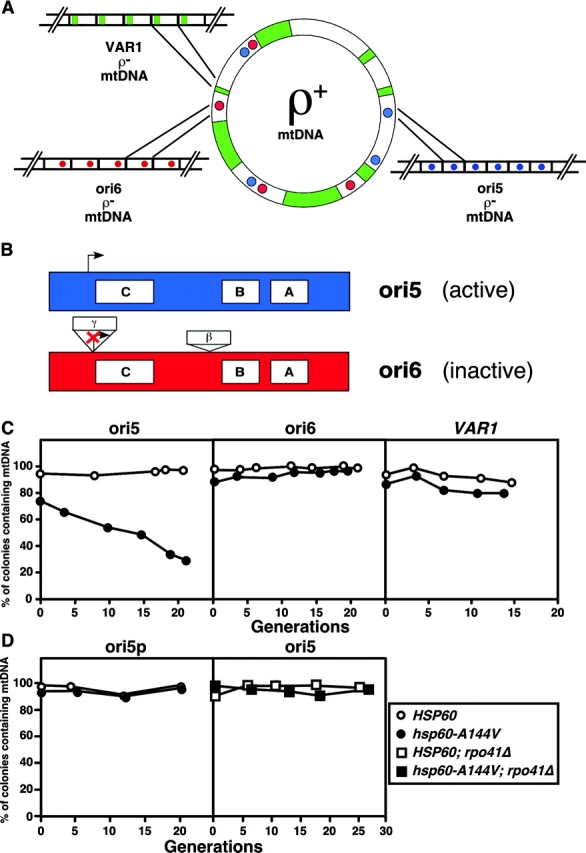
hsp60-A144V selectively destabilizes active ori-containing petite mtDNA in a promoter driven transcription–dependent manner. (A) Spontaneous ρ petite mtDNAs are formed from random portions of the ρ+ genome that have been amplified into tandem repeats. (B) Active ori sequences contain three GC-rich sequences known as the A, B, and C boxes, as well as a nonanucleotide promoter at which transcription initiates (ori5). Inactive ori sequences have the same elements as active oris, plus two GC-rich inserts, one of which disrupts the promoter. (C) Petite strains containing different mtDNA sequences were tested for stability in HSP60 and hsp60-A144V mutant backgrounds during growth in YPD. (D) The instability of an ori5 ρ petite genome in the hsp60-A144V background is rescued by the loss of promoter-driven transcription (left) or by inactivation of RPO41 (right). The ρ petite strains contained an active ori (ori5) (C, left, and D, right); an inactive ori (ori6) (C, middle); no ori sequences (VAR1) (C, right); and ori5 in which the promoter was mutated (ori5p) (D, left).

References

    1. Albring, M., J. Griffith, and G. Attardi. 1977. Association of a protein structure of probable membrane derivation with HeLa cell mitochondrial DNA near its origin of replication. Proc. Natl. Acad. Sci. USA. 74:1348–1352. - PMC - PubMed
    1. Bernardi, G. 1982. The origins of replication of the mitochondrial genome of yeast. Trends Biochem. Sci. 7:404–408.
    1. Blanc, H., and B. Dujon. 1980. Replicator regions of the yeast mitochondrial DNA responsible for suppressiveness. Proc. Natl. Acad. Sci. USA. 77:3942–3946. - PMC - PubMed
    1. Cheng, M.Y., F.-U. Hartl, J. Marton, R.A. Pollock, F. Kalousek, W. Neupert, E.M. Hallberg, R. Hallberg, and A.L. Horwich. 1989. Mitochondrial heat shock protein hsp60 is essential for assembly of proteins imported into yeast mitochondria. Nature. 337:620–625. - PubMed
    1. de Zamaroczy, M., R. Marotta, G. Faugeron-Fonty, R. Goursot, M. Mangin, G. Baldacci, and G. Bernardi. 1981. The origins of replication of the yeast mitochondrial genome and the phenomenon of suppressivity. Nature. 292:75–78. - PubMed

Publication types

MeSH terms