


Population structure of Alexandrium (Dinophyceae) cyst formation-promoting bacteria in Hiroshima Bay, Japan
- PMID: 14602614
- PMCID: PMC262264
- DOI: 10.1128/AEM.69.11.6560-6568.2003
Population structure of Alexandrium (Dinophyceae) cyst formation-promoting bacteria in Hiroshima Bay, Japan
Abstract
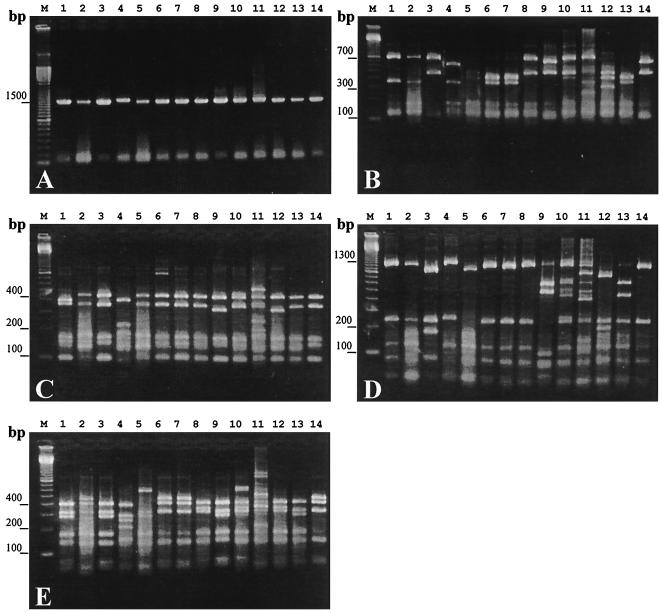
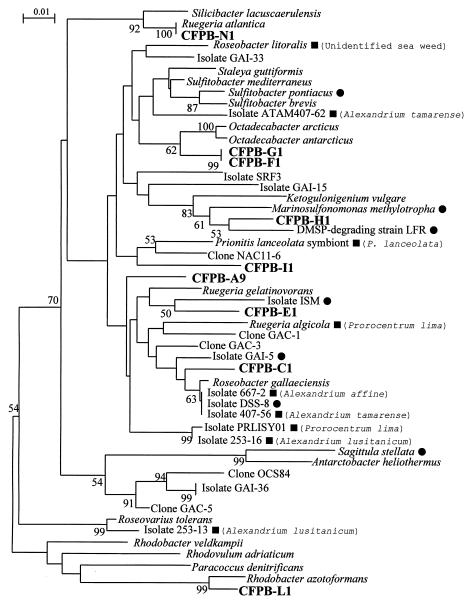
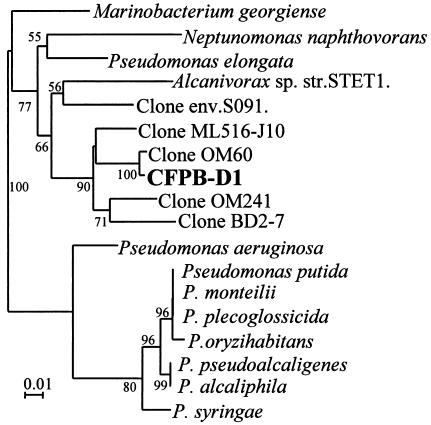
A total of 31 bacterial isolates that have potential Alexandrium cyst formation-promoting activity (Alex-CFPB) were isolated from Hiroshima Bay (Japan), which is characterized by seasonal blooms of the toxic dinoflagellate Alexandrium tamarense. The population structure of Alex-CFPB was analyzed by means of restriction fragment length polymorphism analysis of the 16S rRNA genes (16S rDNA). Fourteen ribotypes, A to N, were observed among the 31 isolates of Alex-CFPB by using four restriction enzymes, MboI, HhaI, RsaI and BstUI. Among them, seven isolates, which were obtained from the seawater samples taken during the peak and termination periods of the A. tamarense bloom in 1998, belonged to ribotype A. This result suggests that bacterial strains of ribotype A may be dominant in the Alex-CFPB assemblages during these periods. The partial 16S rDNA-based phylogenetic tree of 10 ribotypes studied showed that nine of them fell into the Rhodobacter group of the alpha subclass of the Proteobacteria: Eight of nine ribotypes of the Rhodobacter group fell into the lineage of the Roseobacter subgroup, and one fell into the Rhodobacter subgroup. The non-Rhodobacter group type fell into the Marinobacterium-Neptunomonas-Pseudomonas group of the gamma-Proteobacteria: Isolates of Alex-CFPB ribotypes A and C do not have clear growth-promoting activities but have strong cyst formation-promoting activities (CFPAs) under our laboratory conditions. These results show that the Alex-CFPB assemblage may consist of various bacteria that belong mainly to the Roseobacter group and have strong CFPAs. These results suggest that not only the Alexandrium cyst formation-inhibiting bacteria (Alex-CFIB) reported previously but also Alex-CFPB, especially bacteria of ribotype A, may play significant roles in the process of encystment and bloom dynamics of Alexandrium in the natural environment.
Figures
References
-
- Adachi, M., T. Kanno, T. Matsubara, T. Nishijima, S. Itakura, and M. Yamaguchi. 1999. Promotion of cyst formation in the toxic dinoflagellate Alexandrium (Dinophyceae) by natural bacterial assemblages from Hiroshima Bay, Japan. Mar. Ecol. Prog. Ser. 191:175-185.
-
- Adachi, M., T. Matsubara, R. Okamoto, T. Nishijima, S. Itakura, and M. Yamaguchi. 2001. Inhibition of cyst formation in the toxic dinoflagellate Alexandrium (Dinophyceae) by bacteria from Hiroshima Bay, Japan. Aquat. Microb. Ecol. 26:223-233.
-
- Adachi, M., Y. Sako, and Y. Ishida. 1996. Analysis of Alexandrium (Dinophyceae) species using sequences of the 5.8S ribosomal DNA and internal transcribed spacer regions. J. Phycol. 32:424-432.
-
- Adachi, M., Y. Sako, and Y. Ishida. 1994. Restriction fragment length polymorphism of ribosomal DNA internal transcribed spacer and 5.8S regions in Japanese Alexandrium species (Dinophyceae). J. Phycol. 30:857-863.
-
- Anderson, D. M., S. W. Chisholm, and C. J. Watras. 1983. Importance of life cycle events in the population dynamics of Gonyaulax tamarensis. Mar. Biol. 76:179-189.
Publication types
MeSH terms
Substances
Associated data
- Actions
- Actions
- Actions
- Actions
- Actions
- Actions
- Actions
- Actions
- Actions
- Actions
LinkOut - more resources
Full Text Sources
Molecular Biology Databases
