. 2003 Nov 15;31(22):6450-60.
doi: 10.1093/nar/gkg863.

DNA-protein cross-linking by trans-[PtCl(2)(E-iminoether)(2)]. A concept for activation of the trans geometry in platinum antitumor complexes

Affiliations

DNA-protein cross-linking by trans-[PtCl(2)(E-iminoether)(2)]. A concept for activation of the trans geometry in platinum antitumor complexes

Olga Novakova et al. Nucleic Acids Res. .

Abstract

The structure-pharmacological activity relationships generally accepted for antitumor platinum compounds stressed the necessity for the cis-[PtX(2)(amine)(2)] structure while the trans-[PtX(2)(amine)(2)] structure was considered inactive. However, more recently, several trans-platinum complexes have been identified which are potently toxic, antitumor-active and demonstrate activity distinct from that of conventional cisplatin (cis-[PtCl(2)(NH(3))(2)]). We have shown in the previous report that the replacement of ammine ligands by iminoether in transplatin (trans-[PtCl(2)(NH(3))(2)]) results in a marked enhancement of its cytotoxicity so that it is more cytotoxic than its cis congener and exhibits significant antitumor activity, including activity in cisplatin-resistant tumor cells. In addition, we have also shown previously that this new trans compound (trans-[PtCl(2)(E-iminoether)(2)]) forms mainly monofunctional adducts at guanine residues on DNA, which is generally accepted to be the cellular target of platinum drugs. In order to shed light on the mechanism underlying the antitumor activity of trans-[PtCl(2)(E-iminoether)(2)] we examined oligodeoxyribonucleotide duplexes containing a single, site-specific, monofunctional adduct of this transplatin analog by the methods of molecular biophysics. The results indicate that major monofunctional adducts of trans-[PtCl(2)(E-iminoether)(2)] locally distort DNA, bend the DNA axis by 21 degrees toward the minor groove, are not recognized by HMGB1 proteins and are readily removed from DNA by nucleotide excision repair (NER). In addition, the monofunctional adducts of trans-[PtCl(2)(E-iminoether)(2)] readily cross-link proteins, which markedly enhances the efficiency of this adduct to terminate DNA polymerization by DNA polymerases in vitro and to inhibit removal of this adduct from DNA by NER. It is suggested that DNA-protein ternary cross-links produced by trans-[PtCl(2)(E-iminoether)(2)] could persist considerably longer than the non-cross-linked monofunctional adducts, which would potentiate toxicity of this antitumor platinum compound toward tumor cells sensitive to this drug. Thus, trans-[PtCl(2)(E-iminoether)(2)] represents a quite new class of platinum antitumor drugs in which activation of trans geometry is associated with an increased efficiency to form DNA-protein ternary cross-links thereby acting by a different mechanism from 'classical' cisplatin and its analogs.


Figures
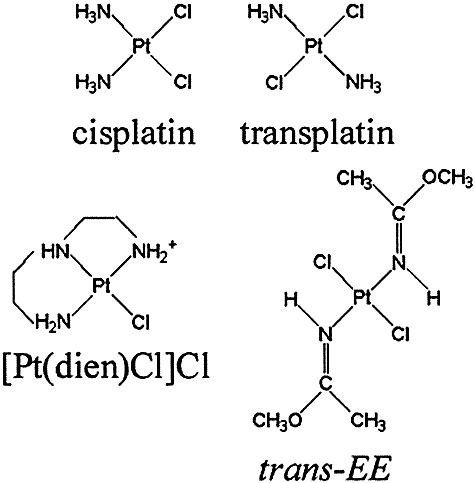
Figure 1
Figure 1
Structures of the platinum complexes.
Figure 2
Figure 2
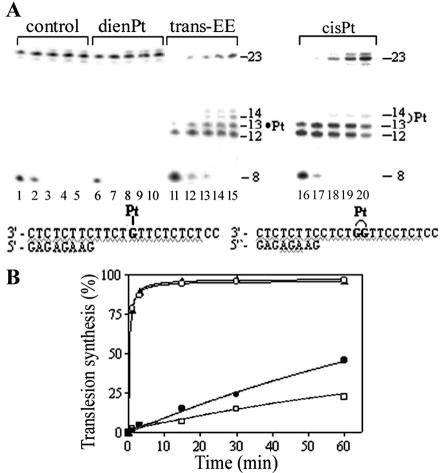
Primer extension activity of exonuclease-deficient Klenow fragment of DNA polymerase I (KF). (A) Experiments were conducted using the 8mer/23mer primer/template duplex for various times using undamaged template (lanes 1–5), the template containing monofunctional adduct of [Pt(dien)Cl]Cl (lanes 6–10), monofunctional adduct of trans-EE (lanes 11–15) or 1,2-GG intrastrand CL of cisplatin (lanes 16–20). Timings were as follows: 1 min, lanes 1, 6, 11 and 16; 3 min, lanes 2, 7, 12 and 17; 15 min, lanes 3, 8, 13 and 18; 30 min, lanes 4, 9, 14 and 19; 60 min, lanes 5, 10, 15 and 20. The pause sites opposite the platinated guanines and flanking residues are marked 12, 13 and 14 (the sites opposite the platinated residues are still marked ‘Pt’). The nucleotide sequences of the templates and the primer are shown beneath the gels. (B) The time dependence of the inhibition of DNA synthesis on undamaged (control) template (open circles), DNA containing monofunctional adduct of [Pt(dien)Cl]Cl (closed triangles), DNA containing monofunctional adduct of trans-EE (open squares) or DNA containing 1,2-GG intrastrand CL of cisplatin (closed circles). Data are means (±SE) from three different experiments with two independent template preparations.
Figure 3
Figure 3
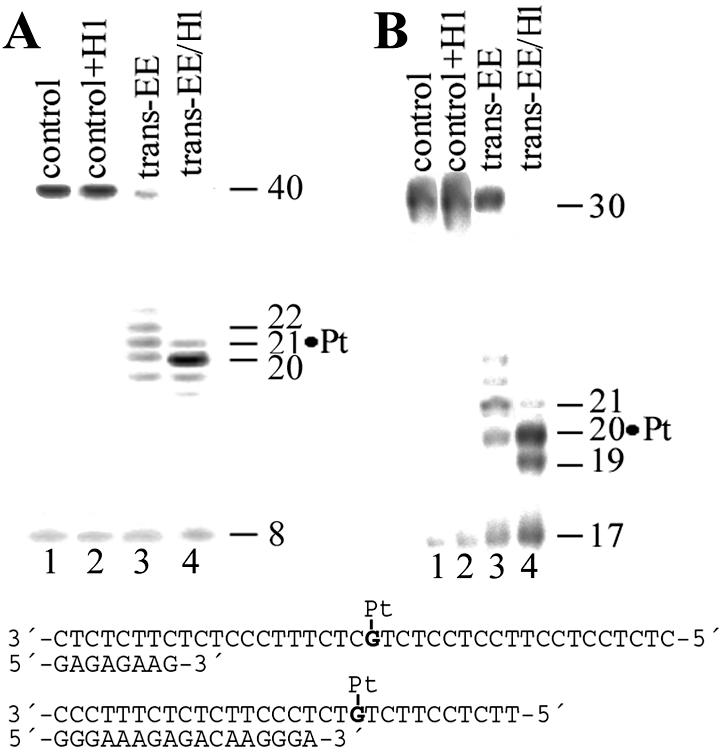
Primer extension activity of exonuclease-deficient Klenow fragment of DNA polymerase I (KF) (A) and RT HIV-1 (B) using the 8mer/40mer and 17mer/30mer primer/template duplexes, respectively. The experiments were conducted for 30 min using undamaged templates (lanes 1), undamaged templates to which histone H1 was added at a molar ratio of 4:1 (lanes 2), the templates containing monofunctional adduct of trans-EE (lanes 3) and monofunctional adduct of trans-EE cross-linked to histone H1 (lanes 4). The pause sites opposite the platinated guanines and flanking residues are marked 19, 20, 21 and 22 (the sites opposite the platinated residue are still marked ‘Pt’). The nucleotide sequences of the templates and the primers are shown beneath the gels.
Figure 4
Figure 4
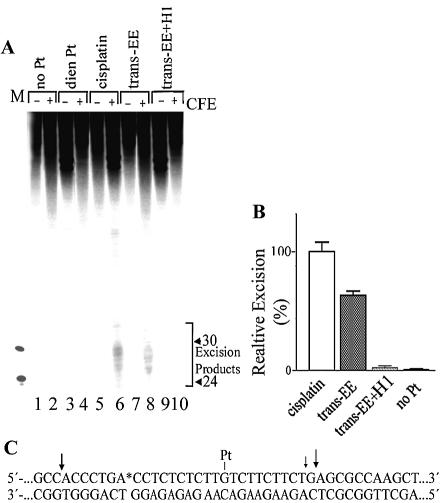
Excision of the adducts of platinum complexes by rodent excinuclease. (A) The 148 bp substrates were incubated with CHO AA8 CFE and subsequently treated overnight with NaCN prior to analysis in 10% PAA/8 M urea denaturing gel. Lanes 1 and 2, control, unplatinated substrate; lanes 3 and 4, the substrate containing the monofunctional adduct of [Pt(dien)Cl]Cl; lanes 5 and 6, 1,2-GG intrastrand CL of cisplatin; lanes 7 and 8, the monofunctional adduct of trans-EE; lanes 9 and 10, the monofunctional adduct of trans-EE cross-linked to histone H1. Lanes 1, 3, 5, 7 and 9, no extract added; lanes 2, 4, 6, 8 and 10, the substrates were incubated with CHO AA8 CFE for 40 min at 30°C. Lane M, the 20 and 30 nt markers. (B) Quantitative analysis of removal of the adducts. The columns marked cisplatin, trans-EE, trans-EE+H1 and noPt represent 1,2-GG intrastrand CL of cisplatin, monofunctional adduct of trans-EE, monofunctional adduct of trans-EE cross-linked to histone H1 and unplatinated substrate, respectively. The radioactivity associated with the fragments excised from the duplex containing the 1,2-GG intrastrand CL of cisplatin was taken as 100%. Data are the average of two independent experiments performed under the same conditions; bars indicate range of excision. (C) The central sequence of the 148 bp substrate. The site of the monofunctional adduct of trans-EE or [Pt(dien)Cl]Cl is marked ‘Pt’ and arrows indicate the major incision sites.
Figure 5
Figure 5
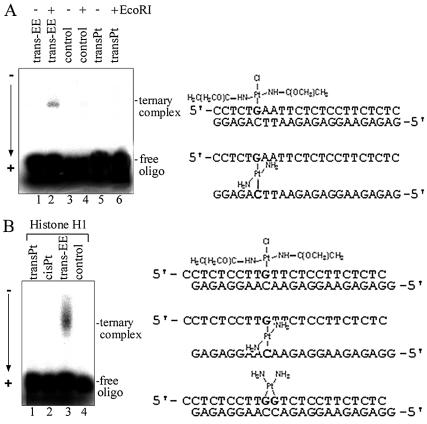
Ternary complex formation of unmodified and platinated oligodeoxyribonucleotide duplexes containing single, site-specific platinum adduct with EcoRI (A) or histone H1 (B) assessed by SDS–PAA gel electrophoresis. (A) Lanes 1 and 2, the 23 bp duplex containing the monofunctional adduct of trans-EE; lanes 3 and 4, non-modified duplex; lanes 5 and 6, the duplex containing the interstrand CL of transplatin. Lanes 1, 3 and 5, no enzyme added; lanes 2, 4 and 6, EcoRI added. (B) Lane 1, the 22 bp duplex containing the interstrand CL of transplatin; lane 2, the duplex containing the 1,2-GG intrastrand CL of cisplatin; lane 3, the duplex containing the monofunctional adduct of trans-EE; lane 4, non-modified duplex. The nucleotide sequences of the duplexes with the platinum adducts are shown to the right of each panel.

References

    1. O'Dwyer P.J., Stevenson,J.P. and Johnson,S.W. (1999) Clinical status of cisplatin, carboplatin and other platinum-based antitumor drugs. In Lippert,B. (ed.), Cisplatin. Chemistry and Biochemistry of a Leading Anticancer Drug. VHCA, WILEY-VCH, Zürich, Weinheim, pp. 31–72.
    1. Farrell N., Kelland,L.R., Roberts,J.D. and Van Beusichem,M. (1992) Activation of the trans geometry in platinum antitumor complexes: a survey of the cytotoxicity of trans complexes containing planar ligands in murine-L1210 and human tumor panels and studies on their mechanism of action. Cancer Res., 52, 5065–5072. - PubMed
    1. Wong E. and Giandomenico,C.M. (1999) Current status of platinum-based antitumor drugs. Chem. Rev., 99, 2451–2466. - PubMed
    1. Judson I. and Kelland,L.R. (2000) New developments and approaches in the platinum arena. Drugs, 59, 29–36. - PubMed
    1. Brabec V. (2002) DNA modifications by antitumor platinum and ruthenium compounds: their recognition and repair. Prog. Nucleic Acids Res. Mol. Biol., 71, 1–68. - PubMed

Publication types

MeSH terms