


Distribution of intimin subtypes among Escherichia coli isolates from ruminant and human sources
- PMID: 14605134
- PMCID: PMC262460
- DOI: 10.1128/JCM.41.11.5022-5032.2003
Distribution of intimin subtypes among Escherichia coli isolates from ruminant and human sources
Abstract
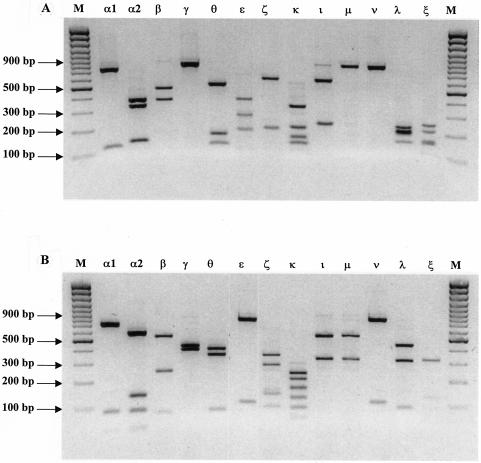
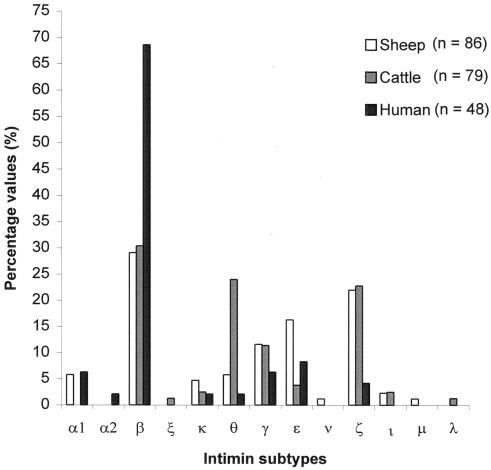
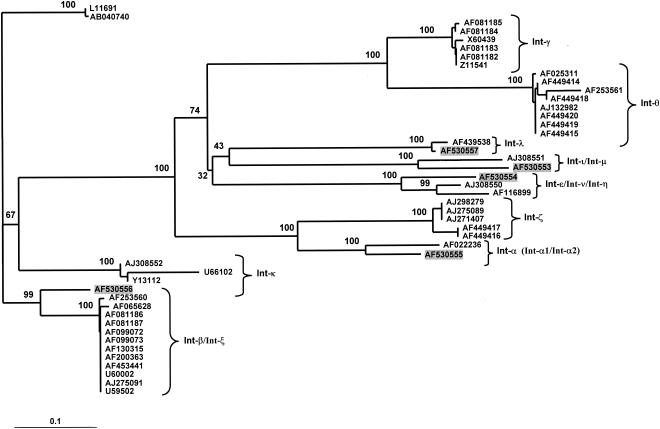
The intimin gene eae, located within the locus of enterocyte effacement pathogenicity island, distinguishes enteropathogenic Escherichia coli (EPEC) and some Shiga toxin-producing E. coli (STEC) strains from all other pathotypes of diarrheagenic E. coli. EPEC is a leading cause of infantile diarrhea in developing countries, and intimin-positive STEC isolates are typically associated with life-threatening diseases such as hemolytic-uremic syndrome and hemorrhagic colitis. Here we describe the development of a PCR-restriction fragment length polymorphism (RFLP) assay that reliably differentiates all 11 known intimin types (alpha1, alpha2, beta, gamma, kappa, epsilon, eta, iota, lambda, theta, and zeta) and three new intimin genes that show less than 95% nucleotide sequence identity with existing intimin types. We designated these new intimin genes Int- micro, Int-nu, and Int-xi. The PCR-RFLP assay was used to screen 213 eae-positive E. coli isolates derived from ovine, bovine, and human sources comprising 60 serotypes. Of these, 82 were STEC isolates, 89 were stx-negative (stx(-)) and ehxA-positive (ehxA(+)) isolates, and 42 were stx(-) and ehxA-negative isolates. Int-beta, the most commonly identified eae subtype (82 of 213 [38.5%] isolates), was associated with 21 serotypes, followed by Int-zeta (39 of 213 [18.3%] isolates; 11 serotypes), Int-theta (25 of 213 [11.7%] isolates; 15 serotypes), Int-gamma (19 of 213 [8.9%] isolates; 9 serotypes), and Int-epsilon (21 of 213 [9.9%] isolates; 5 serotypes). Intimin subtypes alpha1, alpha2, kappa, lambda, xi, micro, nu, and iota were infrequently identified; and Int-eta was not detected. Phylogenetic analyses with the Phylip package of programs clustered the intimin subtypes into nine distinct families (alpha, beta-xi, gamma, kappa, epsilon-eta-nu, iota- micro, lambda, theta, and zeta). Our data confirm that ruminants are an important source of serologically and genetically diverse intimin-containing E. coli strains.
Figures
References
-
- Bettelheim, K. A., M. Whipp, S. P. Djordjevic, and V. Ramachandran. 2002. First isolation outside Europe of sorbitol fermenting verocytotoxigenic Escherichia coli (VTEC) belonging to O group O157. J. Med. Microbiol. 51:1-2. - PubMed
Publication types
MeSH terms
Substances
LinkOut - more resources
Full Text Sources
Other Literature Sources
Research Materials
